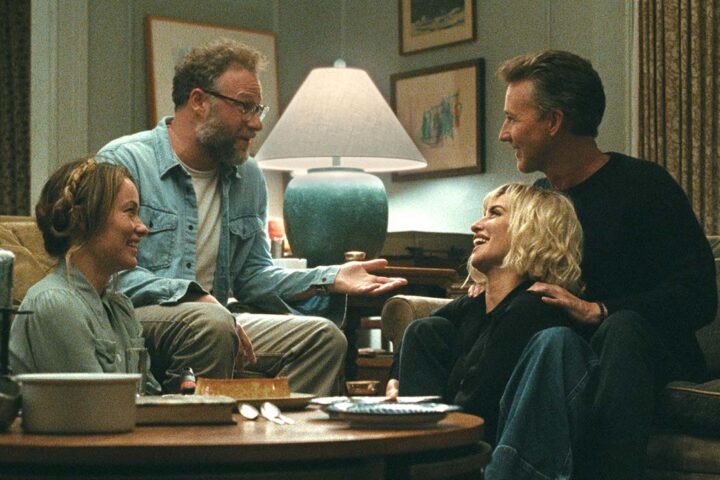
No, this list-maker hasn't had the pleasure of devouring Kate Hudson's ticking-clock romance, A Little Bit of Heaven, which sees everyone's favorite Almost Famous alum continue to chase her first hit like an undiscerning free-baser. The movie did, however, inspire thoughts of cinema's approach to the great hereafter, which has been visualized as everything from an inhabitable oil painting to your good old field of clouds. Diagnosed with terminal cancer by a doctor (Gael García Bernal) who in turn becomes her squeeze, Hudson's character tries for a little heaven on earth before her time runs out. These 15 heavens, however, almost all exist on another plane. Continue Reading »
For a novel that features dreams so prominently, N.K. Jemisin's The Killing Moon rarely stays in them. But dreams loom large over the novel's city-state of Gujaareh. Here, Gatherers—followers of the dream goddess Hananja—collect tithes of "dream humors" from sleeping citizens who are judged corrupt by the Hetawa, the Hananjan temple. In return, these citizens' souls are sent to eternal bliss in Ina-Karekh, the afterlife and "land of dreams," though this leaves their bodies quite dead in the waking world. Dream humors—including the potent "dreamblood"—are redistributed by the Hananjan faithful, and go toward narcomantic healing magics that keep Gujaareh relatively healthy and peaceful. They become a resource that fuels this city-state.
The opening scene elegantly introduces much of this intricate culture by diving into the thick of things. It show us Ehiru, a veteran Gatherer, botching a gathering and unexpectedly receiving a "truth-saying" (prophecy) from the tithebearer whose soul he messily delivers into the nightmare shadowlands (instead of the sunnier part of Ina-Karekh). Dreams and prophecy are a terribly annoying combo in fantasy fiction, but are delivered with speed and restraint here. The prophecy is as succinct as they come: "They're using you." Continue Reading »
According to IMDB, there are no less than twenty print biographies of the actress Romy Schneider, sixteen of which are in German, four in French, and zero in English. At this point Schneider is barely known in America, though her beauty used to be world-renowned. Alain Delon, one of French cinema's greatest male beauties, had a long running on- and off-screen affair with Schneider, and in 2009 he told the French newspaper Le Provence that Romy was the love of his life. Schneider's movie stardom arced across three distinct periods: teenaged German ingenue turned overnight national icon; all-purpose Euro superstar on jet-setting international co-productions; and, finally, worldly grand dame of French cinema, her hair pulled severely back from her face. Yet even or especially at the end of her career, Schneider remained a kind of living toy, a fetish doll that directors, costume designers and makeup artists delighted in dressing up and re-painting. And thus it seems apropos that Schneider is perhaps most recognizable today not for a particular role or performance but for posing in test footage for a film that was never actually finished.
To read the rest of the article at Alt Screen, click here.
Reporting from the 2012 Tribeca Film Festival, House contributors Gerard Raymond and Kenji Fujishima offered reviews of Wagner's Dream, BAM150, Rubberneck, Mansome, and more.
In Books, Sumanth Prabhaker reviewed Jonathan Franzen's Farther Away, Indrapramit Das reviewed Ben Marcus's The Flame Alphabet, and Tim Peters reviewed Guy Delisle's Chronicles from the Holy City.
Reviewing such titles as Samsara, Reportero, and The Queen of Versailles, Budd Wilkins provided extensive coverage of this year's Full Frame Documentary Film Festival.
Metric, "Youth Without Youth." Not to be confused with some sort of tribute to the 2007 Francis Ford Coppola film of the same name, Metric's "Youth Without Youth" is absolutely brimming with the kind of devilishly cool energy that made the Canadian indie-pop foursome's hypnotic "Black Sheep" the perfect pick for a pivotal scene in Edgar Wright's equally mesmeric Scott Pilgrim vs. the World. Propulsive drums, dense synthesizers, and Emily Haines's enticing contralto are a reminder of the band's refreshingly kinetic, potent side that they've yet to bring to an entire album's worth of material. Here's hoping their upcoming Synthetica changes all that. Mike LeChevallier
With an asterisk, World Trade Center is back on top in NYC.
The New Yorker's Sasha Frere-Jones, who was allowed to see Kraftwerk at MoMA, explains how the pop band ended up at the museum.
Sad New Yorkers and longtime listeners called into 98.7 Kiss FM for the last time yesterday, as the iconic station switched off its transmission at midnight to make way for sports talk radio.
With "The Ghost of Harrenhal," David Benioff and D.B. Weiss try too hard to introduce an elemental aspect to Game of Thrones's focus on the nature of power. A veiled, unidentified woman tells Jorah Mormont (Iain Glen) the reason Qarth's residents lust after Daenerys Targaryen's (Emilia Clarke) dragons is because "dragons are fire made flesh. And fire is power." Fire is thus associated with strength in "The Ghost of Harrenhal" and water represents powerlessness. Continue Reading »
Commissioned by the Brooklyn Academy of Music, it's no surprise that BAM150 is both celebratory and promotional. But the story of the arts institution that's survived a century and a half is certainly worth commemorating. And director Michael Sládek, best known for Con Artist, the documentary about 1980s New York art world celebrity Mark Kostabi, makes this particular pleasure to watch by adeptly interspersing high-definition performance footage with backstage moments, archival material, and historical commentary. Continue Reading »
[Editor's Note: Poster Lab is your weekly dose of movie poster dissection, wherein the House examines the pluses, minuses, and in-betweens of the poster design(s) for a buzzworthy film.]
If recent sci-fi film ads are any indication, all we are is pixels in the wind. Movies like Total Recall, a remake that's poised to give you déjà vu this August, face the predicament of promoting themes like memory and alternate reality, which aren't exactly the easiest things to visualize. Common solutions have been to break matter apart like low-res jpegs, and let the debris disperse in smoky, techy milieus. The first Total Recallposter follows this path, depicting futuristic hero Doug Quaid (Colin Farrell) as if his very identity is being erased in geometric fragments. Why does it look so familiar? Well, you just saw a variation of it—same font and all—during the release of last year's Source Code, whose poster also shattered the hero's existence into flashes and swept them up like confetti. Though not not as clean as the Total Recall one-sheet, the Source Code ad uses the trend as a tool to integrate film stills, filling the pieces with headshots of co-stars Michelle Monaghan and Vera Farmiga. More generically, Farrell's gun-toter just disapparates into thin air, which may well point to how this F/X cash cow will be received. Continue Reading »
Though the title of Alex Karpovsky's new film takes on a literal meaning its final moments, it also applies metaphorically to Rubberneck as a whole—not only to the circumstances surrounding its main character, Paul (played by Karpovsky himself), but also to the unsettling aura of psychological disturbance it instills in a viewer.
Paul is a man unable to shake the memories of the one sexy weekend he had with a female co-worker, Danielle (Jaime Ray Newman), a weekend that ends unceremoniously with her expressing—not directly, but in so many words—her lack of romantic interest in him. The fact that, eight months later, he continues to work in the same building with her naturally increases his obsessive feelings, which shade into jealousy when he witnesses her reciprocating the romantic advances of another male co-worker. This incident, though, is merely the latest manifestation of deep-seated childhood traumas that continue to exert a hold on him in adulthood; the filmmakers leave these stresses tantalizingly vague throughout—something to do with Paul's own broken family and a mysterious basement. Continue Reading »
In what's unfortunately one of the lesser films about a literary great, John Cusack wields a quill and a gun as The Raven's Edgar Allen Poe, a legend who would've skewered this thriller in one of his sharp-tongued newsprint critiques. What's perhaps best about the movie is the eerie mood that's established, a mood symbolized by the titular winged creature. Blackbirds have been harbingers of doom in many a dark tale, and otherwise added spooky style to countless filmic palettes. Even in lighter fare, they point to something sinister, be it imminent attack, loneliness, or even racism. Continue Reading »
Recent Comments:
The Conversations: Michael Haneke
by Ed Howard
Links for the Day: The Yankee Comandante, Dunces Maybe Finds Its Ignatius, Michael Haneke on Amour, The Great Gatsby Trailer, & More
by shootthecritic
February House Composer Gabriel Kahane and Book Writer Seth Bockley Talk Communal Music
by David Ehrenstein
A Movie a Day, Day 83: Andrei Rublev
by murtazaali
Critical Distance: The Artist
by DRush76