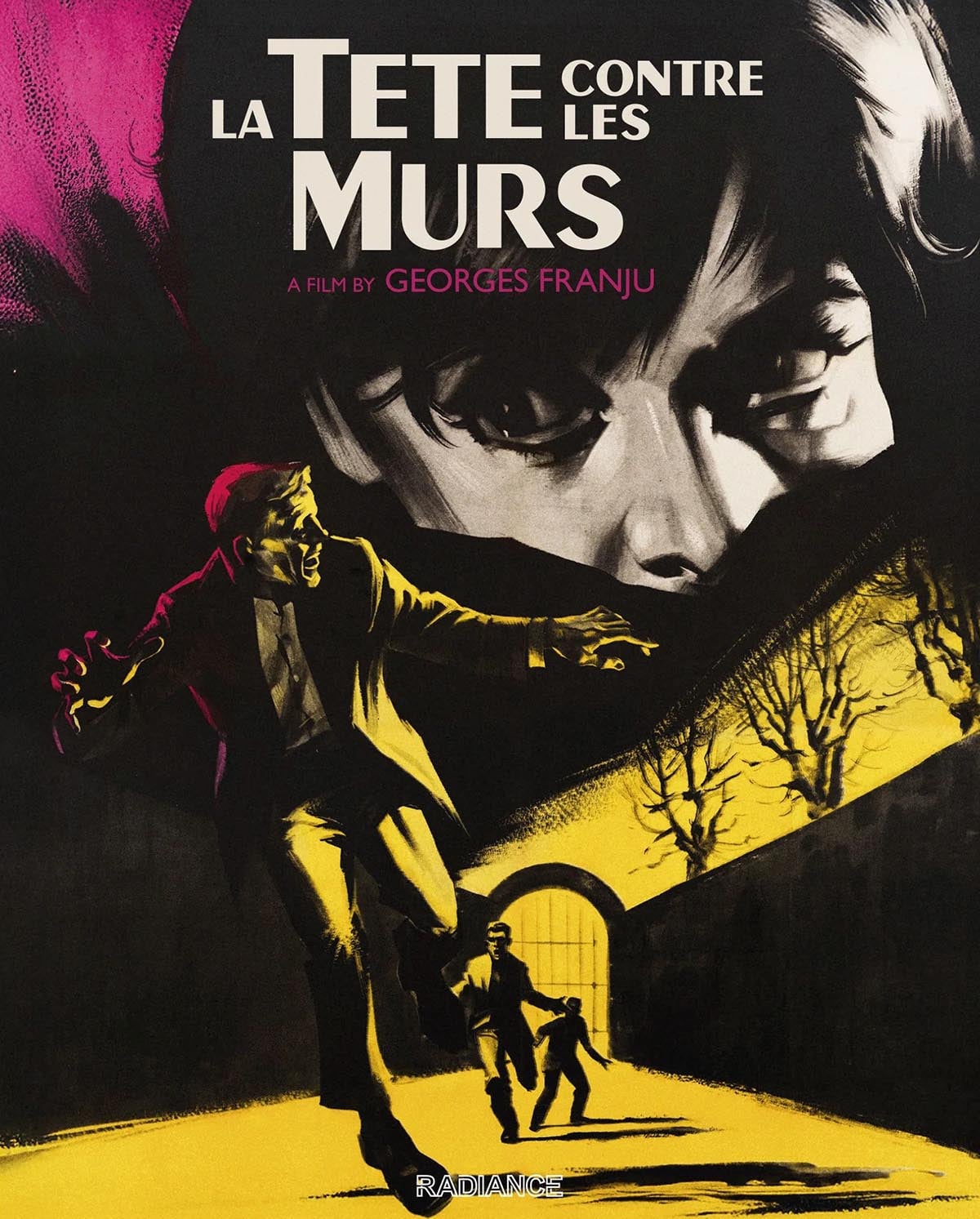
 Georges Franju’s feature-length directorial debut, La Tête Contre Les Murs, is a study in social alienation and institutional indifference that shares a resemblance with the filmmaker’s pioneering 1949 short “Blood of the Beasts.” Both works infuse a poetic, even surreal, quality into the verité verisimilitude of the documentary form.
We first get a glimpse of rebellious, leather-clad François Gérane (Jean-Pierre Mocky) tooling around the hills outside of Paris on his motorbike. He owes money that he can’t repay, so he decides to steal it from his lawyer father (Jean Galland). But not before setting alight an important packet of court documents.
However antisocial François proves, La Tête Contre Les Murs shows his father to be the real villain, a man capable of bullying his wife into suicide, who’s concerned only with the proprieties of social conformity. When he catches François red-handed, his father prefers to have him committed to a private asylum rather than call the police, which would inevitably result in a public scandal. François is soon ensconced in the suitably gothic sprawling institutional compound, fronted by a massive wrought iron gate, and surrounded by sturdy, high walls.
The two psychiatrists in charge of the patients are a study in contrasts. More than working to achieve a cure, the stolid, bespectacled Dr. Varmont (Pierre Brasseur) believes that the function of the asylum should be to keep the patients away from society, since they endanger society as much through the public’s fear of madness as by any violent acts the patients might perpetrate. The more worldly Dr. Emery (Paul Meurisse), on the other hand, stands for the supposedly enlightened new wave of psychiatry. But the best he can offer the inmates is the prospect of spruced-up facilities and the opportunity for a bit of gentlemanly sport.
Neither of these men questions the fundamental assumption that a character like François, who seems not nearly as disturbed as many of the patients that surround him, belongs there in the first place. For that matter, the film quite deliberately hedges its bets about François’s stability, effectively undercutting the notion that he’s an entirely heroic victim of the institution.
Early on, François almost runs over a child with his motorbike in his reckless need for speed. At the nightspot where his compatriots dance and carouse, he comes across as aloof and apart. He forges a connection with Stéphanie (Anouk Aimée), the sister of a friend from whom François has borrowed a large sum of money, only after she comes to visit him in the asylum. By the film’s end, their relationship comes to resemble a doomed amour fou of the sort beloved by the surrealists. This serves as another subversive turn of the screw, since at first we might be led to suspect that the love of a good woman could “save” François in his plight, especially when she offers to follow him into a life of deprivation and endless pursuit by the authorities.
Franju finds evocative ways to illustrate the futility of escape from Varmont’s asylum in François’s two unsuccessful attempts. For the first, he and the epileptic Hurtevent (Charles Aznavour) wind up hiding in an automotive junkyard before getting caught. It’s a fitting metaphor for the detritus of modern society, prefiguring a similar scene in Arthur Penn’s Mickey One. The second attempt occurs on the heels of Heurtevent’s funeral, with François taking off across barren fields that have been set ablaze like the vision of a hellscape.
Throughout La Tête Contre Les Murs, Franju consistently visualizes the asylum in terms of a vicious circle. Spotlights play around the surrounding walls when François escapes, patients rotate in a therapeutic circle hand-in-hand like a game of ring-around-the-rosy, and the facility’s main rest area comprises a lone tree encircled by benches. The narrative also falls into this circular pattern, with François being returned through the asylum’s infernal gates at film’s end, which might as well bear a sign above them reading “Abandon all hope, you who enter here.”
Image/Sound
Radiance offers La Tête Contre Les Murs in a new 4K restoration by Éclair Classics and sourced from the original 35mm camera negative. The transfer presents Eugen Schüfftan’s moody monochrome cinematography with impressive clarity. Blacks are deep, fine details stand out strongly, and there’s a gratifying absence of blemishes. Audio comes in a French LPCM mono mix that cleanly delivers the dialogue and strongly conveys Maurice Jarre’s protean score, which oscillates between stirring orchestral cues and disturbingly discordant passages.
Extras
In an interview from 2008, actor and screenwriter Jean-Pierre Mocky discusses, among other things, his interest in the source material, getting Franju to direct when the producers wouldn’t let him do it himself, and some troubling incidents when filming in a real asylum. In an archival piece from 1958, director Georges Franju talks about his interest in the material, his approach to directing, and his desire to make a hard-hitting film. In a recent interview, Mocky’s onetime assistant Eric Le Roy delves into the collaboration between Franju and Mocky and the film’s relationship to the French New Wave. Finally, the enclosed booklet contains an essay from 1967 by critic Raymond Durgnat assessing the film’s treatment of its incendiary subject matter.
Overall
Poetic and primed to disturb, Georges Franju’s La Tête Contre Les Murs gets a gorgeous new 4K restoration and a handful of satisfying supplements from Radiance Films.
Since 2001, we've brought you uncompromising, candid takes on the world of film, music, television, video games, theater, and more. Independently owned and operated publications like Slant have been hit hard in recent years, but we’re committed to keeping our content free and accessible—meaning no paywalls or fees.
If you like what we do, please consider subscribing to our Patreon or making a donation.