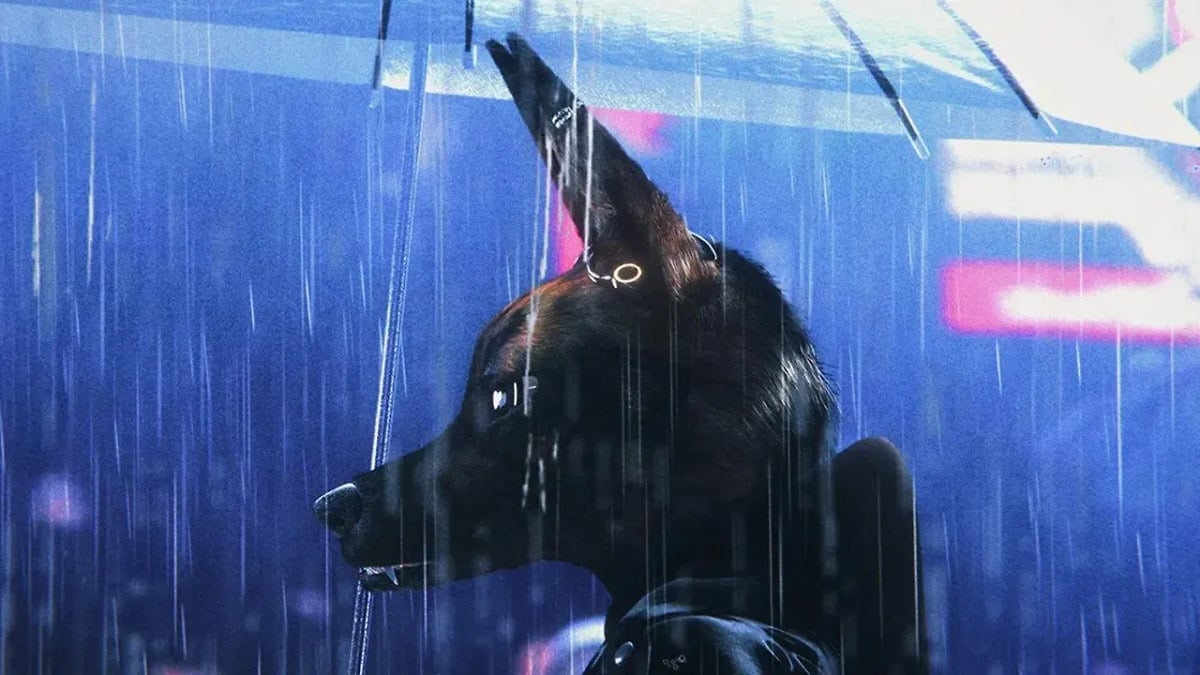
Befitting writer-directors Orian Barki and Meriem Bennani’s backgrounds in visual and installation video art, Bouchra’s most striking quality is its aesthetic. The film’s collage style combines photorealistic backgrounds, textures, lighting, and mocap with pseudo-stop-motion, low-frame character animation and expressionistic color, populated by glassy-eyed humanoid animal character models whipped up in Blender 3D software on a tight budget and short timeline. The result is akin to the meeting point between Wes Anderson’s The Fantastic Mr. Fox, a brooding Wong Kar-wai romance, and Anthrocon-adjacent corners of DeviantArt.
At its best, this results in strange and beautiful images: of the humanimal characters wandering through grainy worlds drenched in deep neon hues and cloaks of shadow. Pockmarked concrete and dust specks are visible amid the drastically different architectural framing of rainy New York City and sunblasted Casablanca. Hand-painted art decorates a home, and pen-scribbled storyboards for the film we’re watching are glimpsed in cutaways. When framed in close-up, though, the characters are digital abstractions, all blurry textures and stiff movements.
The eponymous character—a stand-in for Bennani, whom she also voices—feels dual alienation as a Moroccan expat artist in America and lesbian in a socially conservative Muslim family. The jarring contrasts of realism and artifice speak to the Prada-sporting coyote Bouchra’s self-distancing and sense of otherness as she navigates jobs, girlfriends of different species, and an effort to rekindle her relationship with her mother. Aicha (Yto Barrada in some scenes, Dounia Berrada in others) struggles to accept her daughter’s sexual identity: To Bouchra’s particular angst, Aicha has responded to her coming out by not acknowledging it for nearly a decade.
The script, co-written with Ayla Mrabet, is a diaristic account of mostly mundane experiences, many of them centered either on mediation through screens—Bouchra’s reality TV and social media diet, as well as her metafictional attempts to translate her life into the film we may or may not be watching—or social interactions centered around screens. These are glancing, naturalistically delivered discourses on such thrilling questions as the ethics of sharing friends’ YouTube videos and “What if they made an Is It Cake? theme park?”
These slice-of-life scenes are generationally accurate representations of everyday life—they seem to be recreated from lived experiences, and never make any reference to the fact that all the characters are animals—but they aren’t given the narrative or dialectical form to actually say much about that life. The scraps of characterization around Bouchra, her family, her lovers, and the conflicting social milieus they inhabit never seem to add up to a comprehensive whole.
And there’s not much else to grab ahold of. The narrative, tinged with metafictional irony, jumps around in time and place confusingly, and with little directional momentum. It’s unclear what Bouchra is actually discovering in her journey of self-discovery, which seems to take her from one single-scene romantic partner to another and back again with little connective tissue. Her reconciliation with her mother and ever-progressing film project, the closest thing to structuring threads holding the film together, seem largely repetitive and disjointed for most of the film before intertwining at the end—the most moving segment, both an embrace and rejection of conventional dramatic form and cinematic fiction—en route to a pat, abrupt resolution.
Since 2001, we've brought you uncompromising, candid takes on the world of film, music, television, video games, theater, and more. Independently owned and operated publications like Slant have been hit hard in recent years, but we’re committed to keeping our content free and accessible—meaning no paywalls or fees.
If you like what we do, please consider subscribing to our Patreon or making a donation.