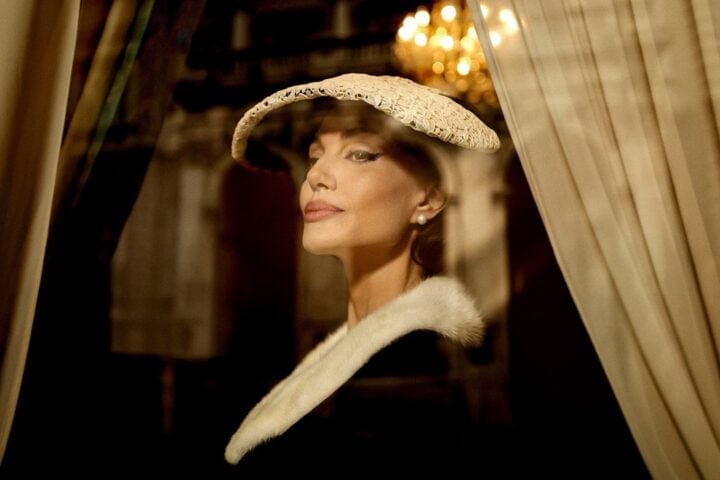
Alice Winocour’s Couture begins as if it will really lean on the old-school movie star wattage of Angelina Jolie. Jolie plays Maxine, a filmmaker on her way to the offices of a fashion house for an interview about her upcoming film. As she walks up the mirror- encased staircase of the luxury brand’s headquarters (the actual location is Chanel’s 31 Rue Cambon apartment), she seems briefly startled by her reflection. It’s as if she’s aware of the vulgar opulence of the place sullying the effortlessness of her pared-down cool.
A star of Jolie’s caliber makes it all but impossible for us to see anything other than the actress in the frame, and Couture’s opening sequences point to Winocour’s desire to take advantage of that impossibility, refusing to extricate character from star. Indeed, the film proceeds for a spell as a study of the surfaces of glamour, and an alluring one at that. Until, that is, Maxine receives a worrisome call from her doctor about a biopsy and Couture turns into something different.
It doesn’t help that the film’s other storylines dilute the emotional link that we were on the brink of developing with Maxine. Throughout, we peek in on Ada (Anyier Anei), an 18-year-old model from South Sudan who’s struggling to learn her runway walk, and Angèle (Ella Rumpf), a make-up artist who’d rather be writing books but is told by her publishing coach that her writing is “not very credible.” By the time we return to Maxine, with Dr. Laurent Hansen (Vincent Lindon) telling her the bad news, you could be excused for thinking we were never going to see her again.
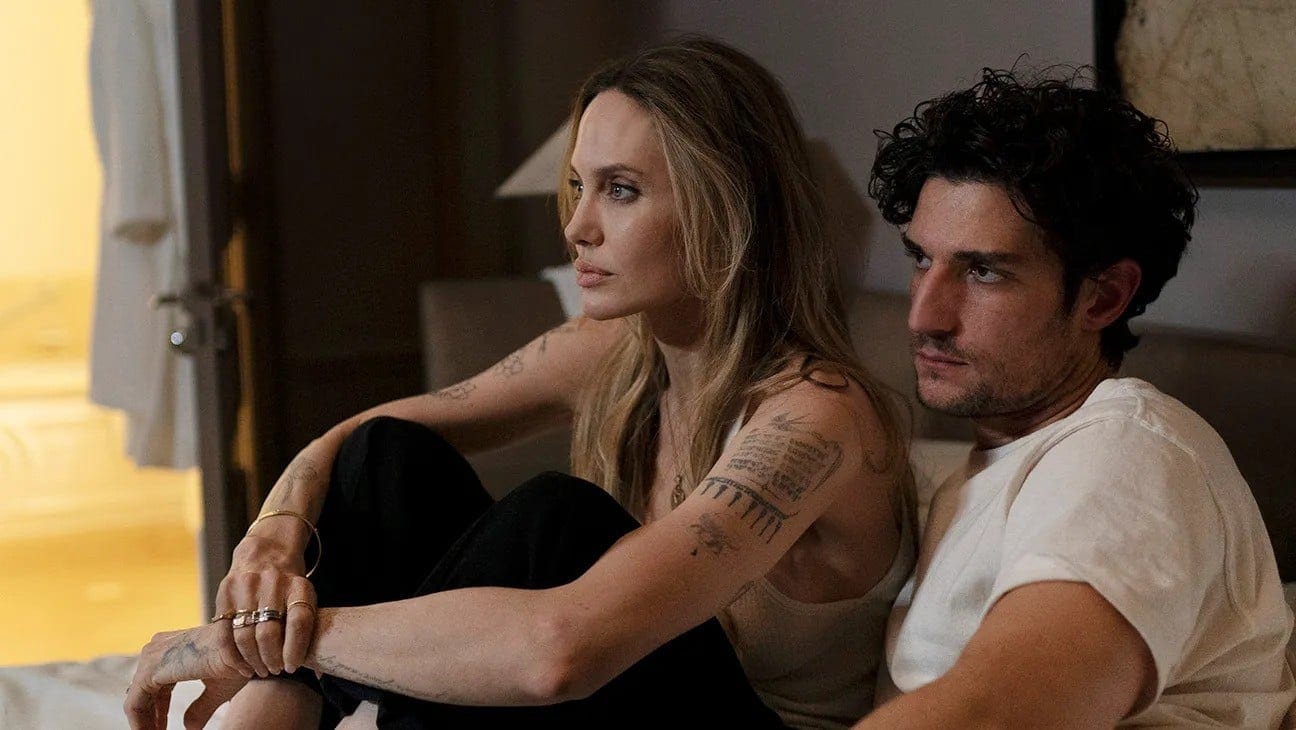
Winocour does try to animate Maxine’s storyline back to life by interspersing shots of a seamstress’s hands ripping white lace, cutting delicate fabric or stitching it, with Couture’s more narrative-advancing sequences. This is a sensible move to explore the multivalence of the titular word itself (after all, “couture” means stitching, or sewing, in French), but, then, so much of the film cumbersomely deals with the reality of its characters’ lives on the level of allegory. This makes the scenes that aren’t operating in that register, such as the love-making between Maxine and her co-worker, Anton (Louis Garrel), feel that much more welcome for being so at ease.
Garrel’s magnetism is so astonishing that you feel as if he’s the only one who could withstand Jolie’s on-screen presence, and that makes it a pity that the two actors share just a couple of scenes. At one point, Anton is undressing Maxine and notices the blood-orange markings around her breasts. Those markings vividly render the violence of illness, and Winocour pointedly cuts at one point to the apartment’s wide-open windows—a different kind of gash. All the while, the lovers’ dialogue is flooded by the carefree enjoyment of others.
Agnès Varda’s 1962 masterpiece Cleo from 5 to 7 ingeniously explored the agony of a woman facing the imminence of death, surrounded by those who don’t have to. Throughout, Corinne Marchand’s character walks past almost unbearably insouciant crowds in the street worrying about medical exam results. Varda’s film is so masterful because it knows that the experience of agony is best translated through duration, not the fragmentation of time.
It’s in the rare instance when Winocour doesn’t interrupt Maxine’s drama that the character survives the enormity of Jolie’s presence and comes to feel credible. And all that the filmmaker needed to do was find gravitas in characters lying half-naked, quietly, in an apartment in Paris—the very stuff of such great French films as Contempt and The Mother and the Whore. Otherwise, though, this is a film interrupted, prone to assaulting us with cliché lines like Maxine asking Anton, “Do you think we are responsible to what happens to us?” In such moments, Couture reminds us of the vulgarity of the flat surfaces that define our times.
Since 2001, we've brought you uncompromising, candid takes on the world of film, music, television, video games, theater, and more. Independently owned and operated publications like Slant have been hit hard in recent years, but we’re committed to keeping our content free and accessible—meaning no paywalls or fees.
If you like what we do, please consider subscribing to our Patreon or making a donation.