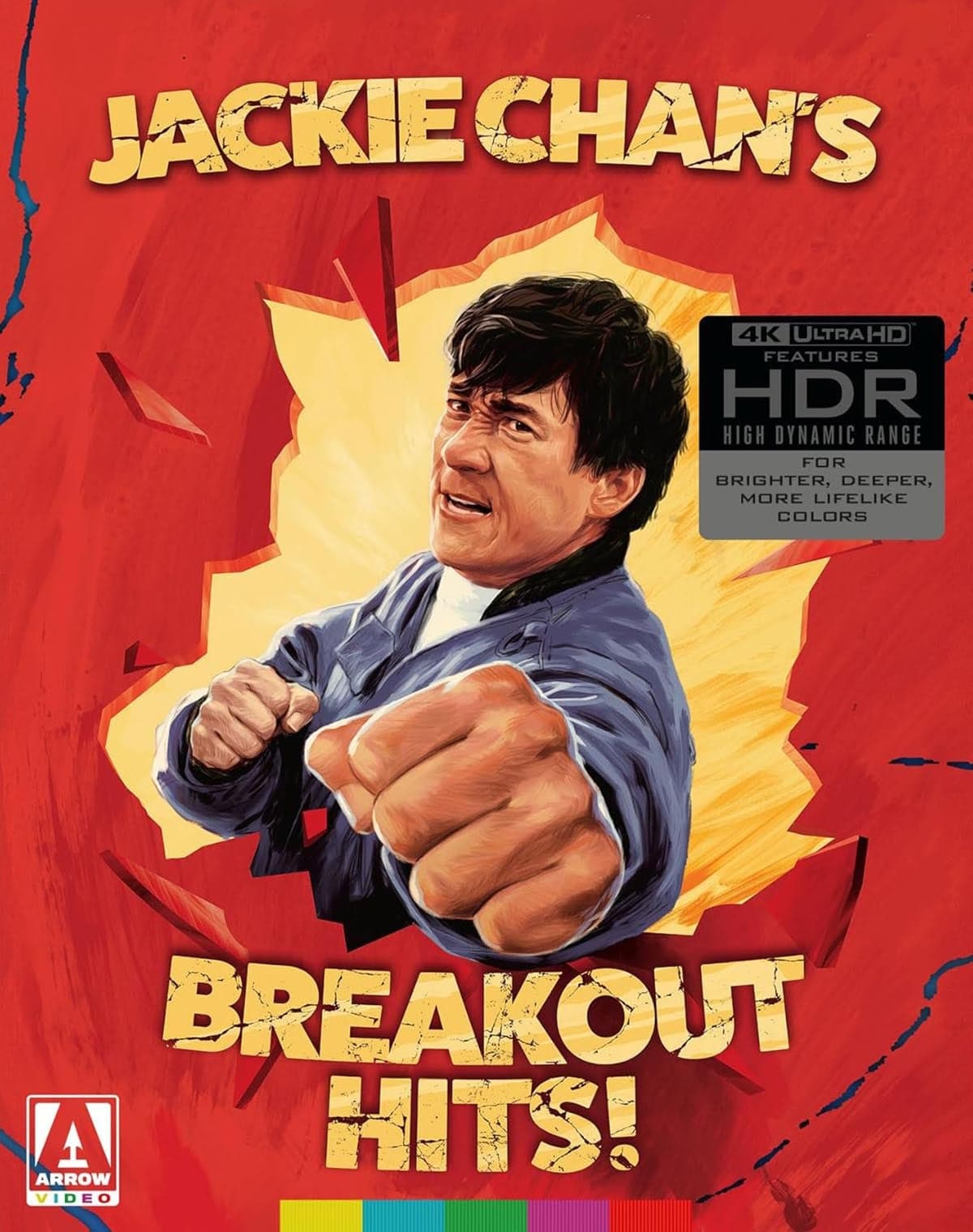
 By the 1990s, Jackie Chan was among the biggest box-office stars in the world, though he had yet to break out in North America. That all changed with 1995’s Rumble in the Bronx, one of the films in Arrow Video’s Jackie Chan’s Breakout Hits set.
Rumble in the Bronx opens with Keung (Chan) arriving in New York City to attend his uncle’s (Bill Tung) wedding, but the warm mood soon gives way to gang violence in the neighborhood around the uncle’s grocery store. Stanley Tong’s film plays like a day-lit version of The Warriors: Across graffiti-strewn environs, outlandishly styled gangsters clash against each other and civilians unlucky enough to be in their vicinity. Keung, naturally, fights back, prompting reactive waves of both cowed retreat and redoubled brutality against him and his loved ones.
One can scarcely imagine what American audiences unfamiliar with Chan must have thought when encountering him here. With even the most lithe action stars of the time still indebted to the lumbering, bodybuilding physicality of the ’80s mold of American machismo, Chan’s wiry frame and catlike reflexes feel like you’re watching the film on fast-forward.
In one of the film’s best scenes, Keung attempts to flee a gang chasing him around a parking garage, rolling over the tops of cars and grabbing holds in concrete walls to climb up levels as bat-wielding hooligans flail after him. Chan is spellbinding in his agility, able to dodge with split-second timing while also making even the silliest slapstick gag, such as clotheslining a biker with a security gate, look brutally painful. The climax, which involves a hovercraft running out of the Hudson and into Bronx streets, a heavy metal band, and a vehicular joust involving a Lamborghini, is one of the most gargantuan spectacles of Chan’s career.
Before Rumble in the Bronx firmly embedded Chan in the Anglosphere, he performed in Lau Kar-leung’s Drunken Master II, a belated sequel to Chan’s 1978 Hong Kong breakout and his first period piece kung-fu film since Fearless Hyena Part II a decade earlier. Chan’s Wong uses the drunken boxing style of fighting, defined by erratic, deceptively slovenly movements at times driven by literal intoxication, and Lau’s camera makes birdlike darting motions to reflect the staggered cadences and abrupt flurries of offense that Wong deploys on enemies. In many of the set pieces, Lau doesn’t merely capture Chan’s stunts but uses long shots to frame other skirmishes between Wong’s allies and foes happening in various planes of activity.
Also from 1995, Gordon Chan’s Thunderbolt is a bit of a mess. The plot, for one, is insipid and byzantine: Chan plays a mechanic who must get behind the wheel to chase down a renegade street racer (Thorsten Nickel) who kidnaps the man’s sisters (Wu Oi-yan and Annie Man), along the way running into forces like Interpol and the yakuza. It certainly didn’t help that Chan was nursing an ankle injury during filming that necessitated a rare reliance on stunt doubles for his action shots. The latter is evident in the frantic editing used to cut around the double’s face, leading to awkward jumps between a relatively simple movement with Chan facing the camera and a figure with his haircut always faced the other way while leaping and striking.
Still, there’s plenty to recommend the film. It’s one of the bloodiest works of Chan’s golden period, with gunshots opening great, spewing holes in victims and the villains radiating a visceral sense of loathing and depravity. And the car chases are thrillingly staged, exhibiting the same expertly timed finesse that Chan’s body typically showcases.

The fourth Police Story film, 1996’s First Strike, marks a seismic break in the admittedly loose continuity of the series, with Chan’s Hong Kong officer Chan Ka-kui inexplicably recruited by the C.I.A. to foil a nuclear plot by the Russian mafia. The film is a convoluted mess almost from the start, but it makes up for this with action set pieces that brazenly parody various moments of the James Bond franchise, from car chases to an alpine shootout in which Chan snowboards past assailants. Most impressively, it reconfigures the legendarily awful underwater fight scenes from Thunderball as high comedy, with the centerpiece stunt sequence a brawl in an aquarium tank that leans heavily into absurdism, with a great white shark at one point darting out of a giant plastic shipwreck to consume a goon before belching out his goggles.
In 1997’s Mr. Nice Guy, Chan plays Jackie, a cook for an Italian cuisine show in Melbourne who finds himself embroiled with the mob when he comes into possession of an incriminating videotape. The film’s plot largely seems cobbled together out of elements of Chan’s last few movies, and the fetch-quest structure of the story’s progression, as Jackie attempts to help the investigative reporter (Gabrielle Fitzpatrick) whose exposé tape he accidentally acquired, becomes convoluted less out of comic entanglement than flimsiness of execution.
But the action is thrilling, leaning heavily on Hung’s experience in front of and behind the camera to capture the minutiae of Chan’s stunt work. Each new location in Sammo Hung’s film invites us to catalog the objects in the area, knowing full well that the star will incorporate all of them into the inevitable fight that breaks out. Hung uses a number of techniques common to Hong Kong cinema—speed-ramping, slow-mo and repeated actions from different camera angles—to really highlight Chan’s lightning-fast reflexes and genius for prop work.
In Who Am I?, from 1998, Chan stars as a Hong Kong national named Jackie Chan who’s deployed to post-apartheid South Africa as a member of a special forces squad to stop a weapon-dealing plot. The film only picks up when the story relocates to Rotterdam and Chan incorporates some goofy cultural gags such as using a pair of traditional wooden klompen to put additional impact into his kicks before flinging them off his feet into the face of an unfortunate attacker. At its best, Who Am I? is a showcase for Chan’s most Keatonesque qualities, not just in his stunts but his command of body language to convey a range of emotions. At its worst, it still suggests that even Chan on autopilot is mesmerizing when he kicks into next gear.
Image/Sound
Arrow’s 10-disc set also includes alternate international cuts of Rumble in the Bronx, First Strike, Mr. Nice Guy, and Who Am I?, and each movie and cut comes with a Dolby Vision-enhanced 4K transfer. Image quality varies among the films, but each looks as good as anyone could reasonably expect. Colors are naturalistic and black levels are stable, while detail is consistently sharp enough that you can make out the finer cracks in, say, a broken pane of glass and the dirt that accumulates on Jackie Chan’s clothes as his characters dive and roll around opponents. The lossless soundtracks range from mono to 5.1 surround depending on the original mix, and each offers a clear blend of dialogue, music, and sound effects (screeching tire rubber, gunshots, canned sounds of fists and kicks colliding with flesh, and more).
Extras
It’s easy to take for granted that Arrow will load its releases of Hong Kong cinema classics to the gills with extras, but one should never get used to the attention lavished on movies that spent years in and out of availability on dodgy home video releases. Each movie comes with new commentary tracks by Arrow’s resident Hong Kong cinema experts, Frank Djeng and F.J. DeSanto, who offer their usual mix of aesthetic commentary and helpful information of the movie industry and wider political trends of Hong Kong at the time.
Each movie also comes with a segment of an overarching new documentary called Breakout! in which critics David West and James Mudge discuss the movies and occasionally talk to crew members and stunt performers from the various productions. Various new interviews with cast and crew are sprinkled across the set, as are many of the trailers and TV spots that Chan recorded in various languages to promote the movies in different national markets. (Sadly, there are no new interviews with the star himself, but a few archival talks are included.) The set also comes with a small deck of lobby cards taken from stills of the films, as well as a hefty 155-page booklet with numerous essays on these movies and their place in Chan’s career.
Overall
Collecting the last triumphs of Jackie Chan’s pre-Hollywood career, Arrow’s set is yet another phenomenal, loving tribute to some of the best of Hong Kong genre cinema.
Since 2001, we've brought you uncompromising, candid takes on the world of film, music, television, video games, theater, and more. Independently owned and operated publications like Slant have been hit hard in recent years, but we’re committed to keeping our content free and accessible—meaning no paywalls or fees.
If you like what we do, please consider subscribing to our Patreon or making a donation.