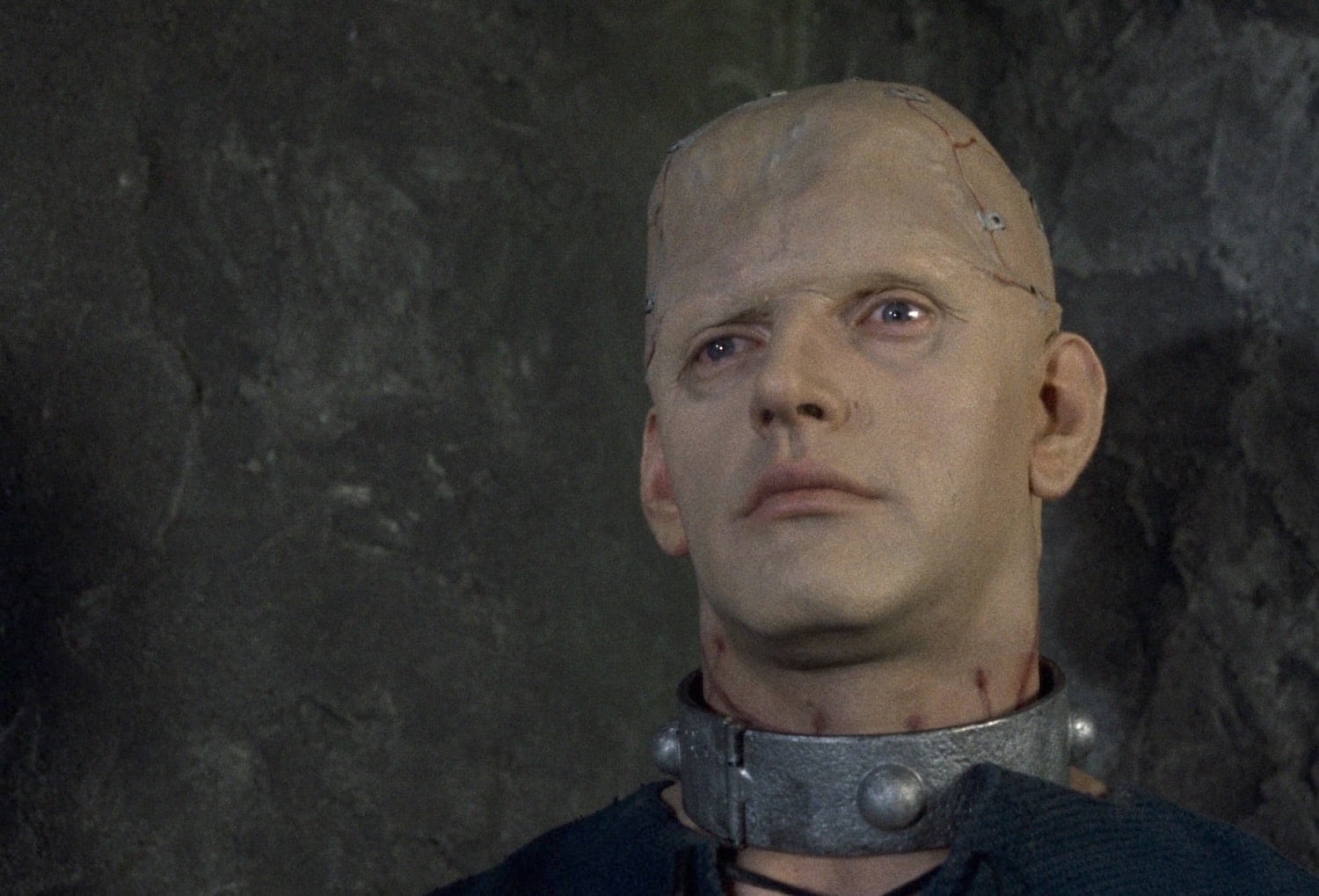
During his time at Hammer Films, Jimmy Sangster worked his way up from production assistant to production manager, before making the leap to screenwriting (turning out more than 20 scripts for the studio), and from there to directing. Now, Severin collects all three of his frightfully entertaining directorial efforts, two of which he also scripted, in gorgeous new UHD restorations, scanned in 4K from original elements by StudioCanal. The box set boasts 19 hours’ worth of new and archival supplements, and includes a massive 312-page book Horror! Lust! Fear! Sangster containing essays, interviews, comic adaptations, and more.
The Horror of Frankenstein, from 1970, is essentially an attempt to reboot the franchise with a younger, more sexually liberated protagonist, played by Ralph Bates, Sangster’s friend and star of all three of these films. Aside from his carnal rapaciousness, this Victor Frankenstein shares many baleful qualities with Peter Cushing’s portrayal of the character: He’s cold, arrogant, and prone to murder when stymied by forces beyond his control. The biggest difference that Sangster introduces is primarily one of tone, consistently going for black comedy, much of which arises from Frankenstein’s callous, perfectly cultured response to situations, even once his monster (David Prowse) embarks on a murderous rampage in the third act.
The Horror of Frankenstein teeters on the threshold of more graphic depictions of sex and violence, with Sangster content to be merely suggestive, as in the sight of a gruesome axe murder rendered palatable by only being seen in a long shot. Frankenstein almost always pays the price for his hubris with inevitable defeat or death, here the destruction of the monster seems like little more than a momentary setback. The shrug and raised eyebrow with which Frankenstein responds is sure indication that he’s resolved to start all over again.
Lust for a Vampire, from the 1971, freely indulges in the relaxed freedoms of the era, even going so far as to include a candid softcore sex scene (complete with its own theme song), though the bloodshed still remains fairly muted. Like The House that Screamed, Sangster’s film takes place in a 19th-century girls’ boarding school, and derives a certain prurient intent from the institution’s hothouse atmosphere of barely repressed sexuality. All that’s needed to set fire to the fuse is the introduction of Mircalla Herritzen (Yutte Stensgaard), who proves to be a centuries-old bloodsucker named Carmilla with an insatiable taste for the blood of both sexes.

Like Sangster’s Frankenstein film, Lust for a Vampire matches the tenor of the times with its downbeat ending. Torch-bearing mob justice proves ineffective, as the vampires are immune to the effects of fire. Our ostensible hero (Michael Johnson) is a feckless wreck, his amour fou for Mircalla/Carmilla so overwhelming that he rushes headlong into a raging inferno to be with her. And the stentorian benediction on the scene of this trial by fire delivered by the local bishop (Jack Melford) can bring no spiritual succor, since the source of evil hasn’t been vanquished.
From 1972, Fear in the Night establishes its unsettling mood from the outset. A series of shots details the autumnal grounds and eerily empty premises of a boys’ boarding school, while the boisterous sounds of the students are heard on the soundtrack, introducing a cognitive dissonance that’s central to the film’s themes. The sequence ends with a sudden shock, showing a pair of feet dangling from a tree limb. The rest of Fear in the Night serves as an extended flashback leading up to a bookending shot that reveals the deceased’s identity. Amplifying the knotty narrative, it’s frequently punctuated by short flashbacks that fill in bits of exposition.
Fear in the Night offers some clever variations on the notion of gaslighting, which is a touchstone of much Gothic literature and cinema, primarily the fact that the intended victim, Peggy Heller (Judy Geeson), isn’t all that stable to begin with. All her scheming husband, Robert (Ralph Bates), needs to do is nudge her over the edge. For much of the film, we’re just as unclear about the reality of the events depicted as Peggy is. And the script is quite canny about parceling out its revelations. By the end of the film, far from being vindicated in the soundness of her mental health, Peggy is left pitifully unhinged by the several traumas she has undergone.
The three titles collected in Sangster Directs Hammer suggest that, far from being a studio in decline, Hammer was still capable of making thoroughly entertaining and even innovative films in the 1970s. What’s more, they indicate that Hammer was willing to encourage artists like Sangster to bring their idiosyncratic sensibilities to bear on the studio’s films.
Sangster Directs Hammer is now available from Severin Films.
Since 2001, we've brought you uncompromising, candid takes on the world of film, music, television, video games, theater, and more. Independently owned and operated publications like Slant have been hit hard in recent years, but we’re committed to keeping our content free and accessible—meaning no paywalls or fees.
If you like what we do, please consider subscribing to our Patreon or making a donation.