The naughty nurse as sexual persona has long persisted in the male imagination. A staple in vaudeville, smutty magazines, grindhouse movies, and Halloween costume racks (next to the naughty French maid and naughty policewoman), her defining erotic trait is a boundless desire to please her patient—to do whatever it takes to make him feel better—while he remains incapacitated, forced to submit to his caretaker’s will.
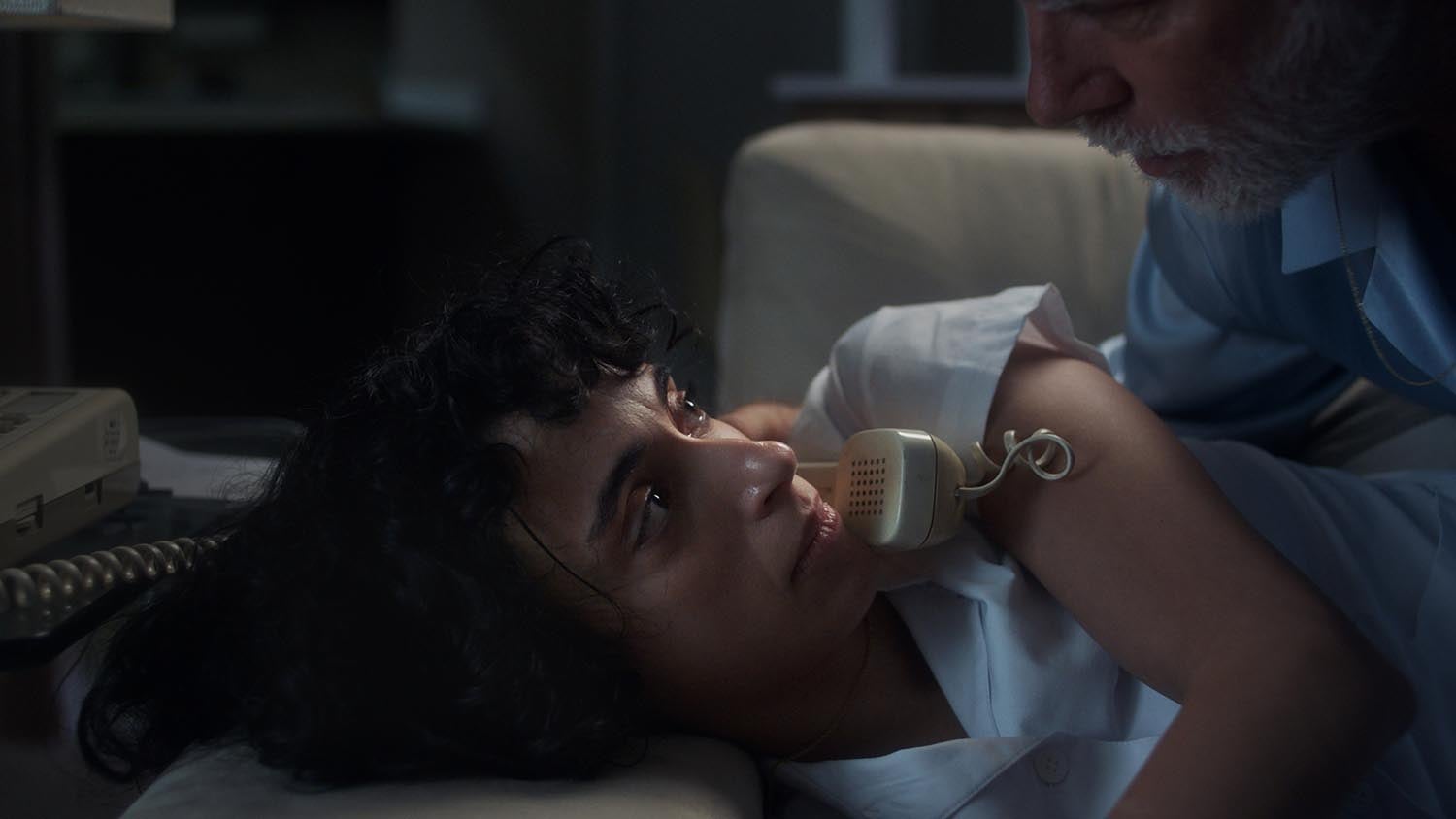
In her feature-length writing-directing debut, Night Nurse, Georgia Bernstein inverts this fantasy scenario. Instead of projecting sexuality onto a female healthcare professional, the film inhabits her point of view, daring to imagine what she might find exciting, attractive, and dangerous about the older male patient in her care. In this latter role—that of a man, Douglas Callum, placed into an assisted living facility after showing early signs of Alzheimer’s—Bruce McKenzie is transfixing for the way he shows his character’s knowing, mischievous eyes shining through the mask of his dementia, suggesting a mysterious internal life we have no access to.
Likewise, the private thoughts and motivations of Eleni (Cemre Paksoy), Douglas’s nurse, are mostly inscrutable, but the film stays firmly attached to her perspective. A brand new hire at the care facility where Douglas lives, and assigned to take the night shift looking after him, Eleni initially presents as shy and tentative, but she has a clear intention to do good. It’s Douglas’s daytime nurse, Mona (Eleonore Hendricks), who first gives voice to a more self-regarding rationale for their shared vocation: “Isn’t it amazing to feel needed?”
In an early scene, when Mona and Douglas are making a walking lap of the pool and turn to see Eleni standing by, a frowning Mona looks unmistakably possessive of her charge, while Douglas has the look of a wolf who’s found his prey. If Eleni starts off unsure as to what to make of their dynamic, she quickly proves susceptible to Douglas’s cunning ways: No mere invalid, he’s got a lucrative phone scheme going in which he preys on his vulnerable peers.
Bernstein was inspired to write Night Nurse after her grandmother nearly fell for a common phone scam targeting seniors, wherein the caller pretends to be their grandchild, says they were in an accident, and asks for money. One compelling aspect of the film is that the mastermind is himself an ailing senior, posing as an attorney to swindle his own neighbors. Of course, to really make the con work he needs a young female voice, and Eleni is only the latest one to join what seems, increasingly, like Douglas’s own personal harem. Even the facility’s director, Dr. Mann (Mimi Rogers), though not complicit, seems like she’s in his thrall.
If what follows between Eleni and Douglas can’t credibly be described as a love story, it certainly offers up a perverse, darkly comic vision of romance and seduction. There’s an almost sadomasochistic push-pull between the two, in that she both serves his needs and yet maintains some power over him because he relies on her for basic needs. If it seems, at first, that Douglas coerces his new accomplice, Eleni soon shows herself to be an eager participant.
Unfortunately, this central aspect of the film doesn’t go anywhere particularly interesting. Other residents are typically seen from a distance, so we never see Douglas have to face his victims. (This is a deliberate choice, but one that deprives Night Nurse of an additional source of tension.) And when it veers into thriller terrain during a rushed third act, the film all wraps up too quickly, only hinting at potential complications that could have been drawn out for longer.
Bernstein’s gifts as a storyteller, at this early stage of her career, are less narrative than atmospheric. Her use of shallow-focus close-ups and claustrophobic compositions, along with her elliptical editing and judicious deployment of Steven Jackson and Sam Clapp’s spacious piano-led score, all lend Night Nurse a dreamy feel, at times recalling the hermetic visions of Peter Strickland, but without the meta-cinematic homages that characterize his work. Which is to say that while her film may leave one wanting for richer detail and a more satisfying narrative, Bernstein certainly knows how to create a world that’s easy to get drawn into.
Since 2001, we've brought you uncompromising, candid takes on the world of film, music, television, video games, theater, and more. Independently owned and operated publications like Slant have been hit hard in recent years, but we’re committed to keeping our content free and accessible—meaning no paywalls or fees.
If you like what we do, please consider subscribing to our Patreon or making a donation.