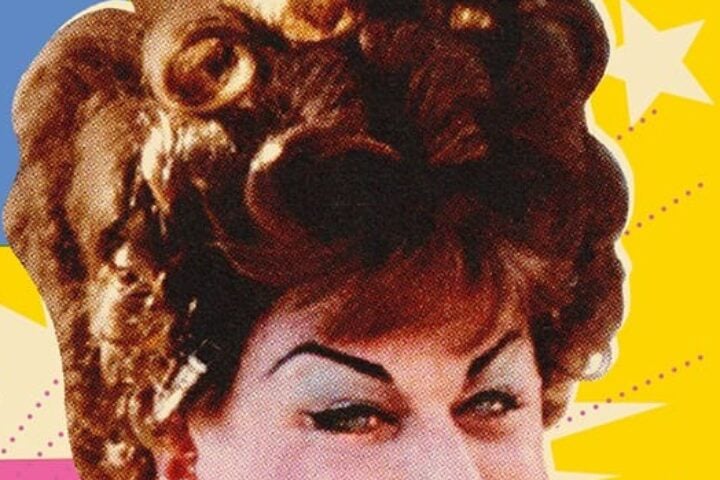
 As odd as it sounds, the films John Waters unleashed up to and including Female Trouble, at their heart, positioned aesthetic terrorism as nothing more dangerous than a form of play. Of all of John Waters’s “untamed”-era films, Desperate Living, the 1977 feature that marked the director’s first major statement without Divine at the center (due to a prior commitment), is also his first and very arguably his only work that colors outside the lines of playful ribaldry into the realm of the seriously political.
Stripped of Divine’s transgressive center and the class-coded antagonism between the Dreamlanders and their upper-middle-class tormentors (the template that defined his breakout hit Pink Flamingos and his seamy masterpiece Female Trouble), Waters film bluntly unveils the machinery of respectability crushing aberrance without even so much as paying lip service to morality. And while one might think the film’s lack of Divine’s centering gravity would be a debit, the film brims with no fewer than six high-powered female performances shrieking for attention (including, in what was quite a coup for Waters at that point, serial starfucker Liz Renay), making it perhaps Waters’s most divalicious work ever.
Mink Stole sets the tone as Peggy, a foully unhinged, upscale housewife who’s convinced that her children are incestuous perverts and the neighbor kids are trying to kill her. Her in-house nurse, Grizelda (played to the absolute hilt by Jean Hill), provides the darkly absurdist foil to this suburban paranoia. When Grizelda “saves” Peggy from “another mental fit” by sitting on her feckless husband’s (George Stover) face, instantly killing him, the two are forced to leave suburban Baltimore for the safe haven of Mortville. There, they discover a town where all of humanity’s rejects congregate under the totalitarian rule of the whiny, marshmallow-shucking puddle of imperious goo that is Queen Carlotta (Edith Massey, clearly putting every last ounce of her under-exercised thespian muscles into each disinterested “C’mon, c’mon”).
What ultimately distinguishes Desperate Living from Waters’s earlier work isn’t merely the absence of Divine or David Lochary (whose presence in the earlier films had always coded a certain quality of bourgeois longing for the transgressive), but the film’s refusal to grant its audience even an anti-heroic figure to root for. The Dreamlanders who surround Peggy and Grizelda function not as a family unit of misfits—as they later would in Polyester, Hairspray, and Serial Mom—but as the unwitting foot soldiers of an authoritarian state.
It’s precisely here that Desperate Living reveals itself as something far more pointed and furious than satire. Where Female Trouble positioned transgression itself as a kind of performance art, Desperate Living demonstrates how easily the logic of fascism can erase the distance between performance and reality, and how quickly the victims of one system can become the perpetrators of another. Queen Carlotta’s downright disinterested authoritarianism is absolute and arbitrary, her whims are law and the activities of her subjects are at best a distraction from her voracious appetites. (Does that remind you of anyone?)
Waters here seems to be suggesting something deeply uncomfortable in the context of midnight movies: that transgression and totalitarianism are not opposites but cousins, that the very energy that propels the Dreamlanders toward obscenity and depravity can be channeled into tyranny with terrifying ease. The cardboard sets and damp firepit aesthetic—a world that’s simultaneously fairy-tale-like and squalid—becomes the visual manifestation of this logic.
What makes Desperate Living particularly significant as a feminist statement is precisely what its superficial departure from Waters’s established playbook suggests: The removal of both Divine and Lochary strips away the homoerotic dynamic that had previously mediated his work. In particular, Lochary (who died of a drug overdose months after the release of Female Trouble) had always represented a certain class-inflected desperation, a bourgeois subject whose transgression was always coded as slumming, or even tourism.

In their absence, what remains is a more direct, and far more bleak, assessment of how women navigate systems of power without access to the tools of performance, or for that matter the “excuse” of male desire. The latter precept is most notably represented in Desperate Living in the form of a perverted motorcycle cop pulling Peggy and Grizelda over and immediately stealing from them their panties, in order to fit his own “big business” into them, reaching slobbering climax entirely without their consent or participation.
Still, it’s Peggy who, in the film’s very opening moments, provides the film’s most politically clarifying moment, and perhaps the most enduring image of Waters’s entire oeuvre. The sequence in question, in which Peggy summarily howls to a gathering of school children, “I hate the Supreme Court,” arrives not as a punchline but as a kind of involuntary truth-telling. The line has acquired a prophetic quality that Waters couldn’t have fully anticipated. The court, as it’s proven time and again from the 1980s onward, has become precisely the kind of totalizing force that Carlotta’s regime represents: arbitrary, unaccountable, capable of rendering entire categories of people—women seeking abortion, LGBTQ individuals seeking recognition, voters seeking access to the ballot—suddenly vulnerable to state power.
The endurance of “I hate the Supreme Court” as an internet meme testifies to the prescience of Desperate Living. Waters’s other films have remained transgressive in the classic sense, but Desperate Living has become something else entirely: a film that speaks directly to the experience of political subjugation, to the realization that the systems designed to protect you are in fact designed to bind you unless you can tactically fuck them up.
In that sense, Desperate Living is Waters’s most furious political statement. It abandons the seductive apparatus of his earlier films, specifically the charm of the outcast, in favor of something far more austere. It’s his most pointed attack on the mirage of “normalcy,” revealing fascism as the poison pill that underwrites systems of power, no matter how down market they may be. Desperate Living’s cold, unsparing vision has come to feel less like provocation and more like prophecy, and Waters seems to suggest that the choice was never between transgression and respectability—that, in fact, there may never have been a choice at all.
Image/Sound
Nothing could be more John Waters-coded than to release Desperate Living in 4K UHD. And, honestly, it’s the most satisfyingly decadent physical media move that Criterion could make amid the rise of other labels focusing their curatorial efforts on the darkest, least reputable corners of exploitation cinema history. Even by Waters’s own standards, the aesthetic bar was leagues below the gutter when he made this twisted fairy tale. While that’s not a surprise given it obliquely tackles, at least from a production design standpoint, the plight of the homeless American, it’s a bracing splash of cold slime to experience this restoration, which hides absolutely no blemish. You can feel dirt in every corner, marvel at the imperfections of human flesh, and at the same time marvel at the on-a-dime ingenuity that went into building out the fairytale world of Mortville. The monaural sound is basic and flat, highlighting every maladroit cue from composer Chris Lobingier’s sardonic music score, Prokofiev by way of Hee-Haw.
Extras
That Waters created Desperate Living at something of a low point in his life is obvious in the film proper, but in case it wasn’t clear, he says it both in the archival commentary from roughly a quarter-century ago and then again in a newly filmed interview segment. Undoubtedly, the untimely death of David Lochery played a role, but it’s also easy to imagine Waters wondering how much further he could push into obscenity beyond Pink Flamingos and Female Trouble without turning himself into exactly the sort of audience-assaulting avatar that Divine portrays at the violent climax of the latter, literally turning the gun on his artistic constituency.
Nonetheless, comparing the commentary against the interview indicates that, while he never quite shook off the feeling that he might have pushed the envelope a tad too far, Waters is still willing to lean into the bad-faith humor that’s his default mode. In any case, the true star of the track is Liz Renay, who wouldn’t know a filter if it smacked her in the face. In addition to telling all about her various husbands (some well below the law), she makes the act of describing what she likes about each of the various sizes of cock sound naïvely wholesome. She may have only been in one of Waters’s films, but she comes off as a true Dreamlander through and through.
In addition to Waters’s new interview and another Waters-guided walking tour of the original locations, another segment (audio only) brings together three long-standing Dreamlanders—Mink Stole, Mary Vivian Pearce, and Susan Lowe—to chat about their (predictably miserable) conditions during filming, and another separate archival interview with production designer Vincent Peranio. Rounding out the stacked package are a spirited introductory essay by critic Grace Byron and, most perplexingly, an alternate Italian dub that, if you squint your ears hard enough, sort of makes the movie feel like a bizarre missive from the Years of Lead.
Overall
Criterion typically reserves Pride Month for new John Waters releases, and in 2026 it’s a relief that Waters’s angrily anti-fascist masterpiece has been brought back to the spotlight.
Since 2001, we've brought you uncompromising, candid takes on the world of film, music, television, video games, theater, and more. Independently owned and operated publications like Slant have been hit hard in recent years, but we’re committed to keeping our content free and accessible—meaning no paywalls or fees.
If you like what we do, please consider subscribing to our Patreon or making a donation.