 John Waters’s Cry-Baby is the ideal companion piece to the filmmaker’s 1988 hit Hairspray. That film takes place in the early ’60s, against the backdrop of the civil rights movement, and deals in a lighthearted fashion with thorny issues of racial segregation, while Cry-Baby uses its mid-’50s setting to poke fun at class conflict in staid Eisenhower-era Baltimore. And both films are perfectly realized period pieces awash with the music of their respective eras: Hairspray focusing on soul and R&B, Cry-Baby packed with catchy rockabilly and doowop numbers.
Cry-Baby focuses on Wade Walker (Johnny Depp), the leader of a redoubtable gang of “drapes,” a Baltimorean spin on the greasers of the time. Events begin to echo Romeo and Juliet once Cry-Baby, who’s known for driving girls crazy for the way he’s able to shed a single tear, makes a play for Allison (Amy Locane), the main squeeze of Baldwin (Stephen Mailer), the leader of the rival “squares” and, subsequently, Cry-Baby’s avowed nemesis. Where, in the Shakespeare play, the divided factions are, while mortally adversarial, at least socially on par, Waters plays to the hilt the class differences between the drapes and the squares, which extend to such major social signifiers as choice of attire and favorite automobile and musical genre.
Waters and cinematographer David Insley give Cry-Baby the vibrant-hued look of Frank Tashlin’s zany The Girl Can’t Help It in all its Technicolor glory. Like Tashlin, Waters is essentially a parodist at heart with a penchant for the downright cartoonish. The film takes loving yet irreverent potshots at an array of cinematic subgenres, especially movies that focus on teen idols, the “dangerous” fad of rock ‘n’ roll music, and the spread of juvenile delinquency. The urtext and epicenter for all these trends is the hip-shaking specter of Elvis in Jailhouse Rock, a film that Waters directly parodies in the “Doin’ Time for Bein’ Young” number.
Cry-Baby flaunts Waters’s ability to create characters of consummate comic intensity. The process of finding the right actors to embody these roles often entails a perverse sort of stunt casting. An early illustration of this in the filmmaker’s canon is the way that former matinee idol (and then still closeted) Tab Hunter brought his own professional and personal baggage to the 1981 masterpiece Polyester, an affectionate parody of a Douglas Sirk melodrama. Cry-Baby doubles down on this tendency, with most of its cast simultaneously playing with and against type, both unabashedly embracing and outrageously exaggerating their public personas, thereby providing the proper ironic distance to the proceedings.
With every single teardrop that roll down Cry-Baby’s cheek, Depp demolishes the teen-heartthrob image he earned coming off the TV phenomenon 21 Jump Street. Former porn starlet Traci Lords knowingly addresses her legacy by vamping to the hilt as bad-girl Wanda Woodward, who even gets turned on by a polio vaccine shot. Heiress and SLA kidnapping victim Patricia Hearst perfectly embodies the milk-fed earnestness of Wanda’s naïve mother, a part-time crossing guard and exchange student enthusiast. And punk icon Iggy Pop turns up as the wonderfully named Belvedere Ricketts, first glimpsed zealously bathing in a tiny tin bathtub.
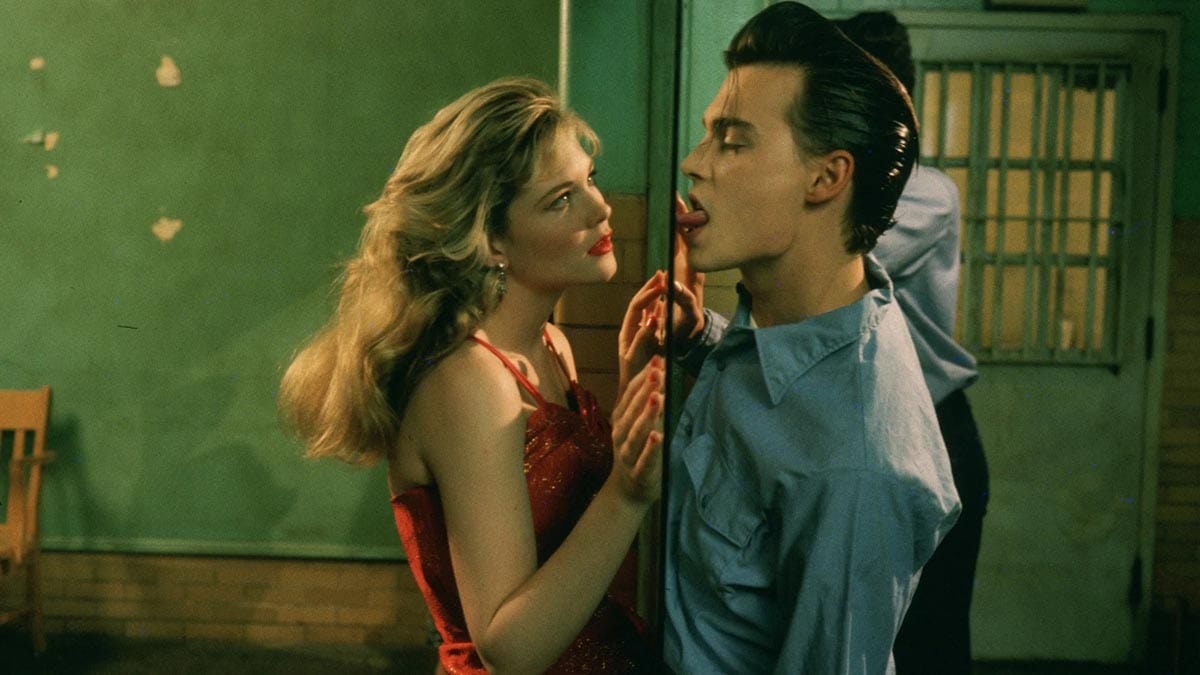
Cry-Baby rewards multiple viewings with the sheer density of its verbal and visual humor. Exaggerated as a Looney Tunes cartoon, the film is also stuffed with the sort of surreal background gags that Mad magazine artist Will Elder called “chicken fat.” Because Cry-Baby was Waters’s first real Hollywood movie, the increased budget allows him to supplement the usual Baltimore location shooting with some impressively detailed sets from production designer Vince Peranio, none more so than the red-and-black festooned barroom at Turkey Point that’s owned by Belvedere and Ramona Rickettes (Susan Tyrrell).
The intractable Baldwin represents the forces of intolerance and small-mindedness. His inability to change sets him apart from other bastions of the social order like Allison’s grandmother, Mrs. Vernon-Williams (Polly Bergen), who, despite her initially aghast response to Cry-Baby, eventually comes around to a more tolerant point of view. So Cry-Baby culminates in a staple of ’50s movies about juvenile delinquents that was arguably inaugurated by Nicholas Ray’s Rebel Without a Cause: the chicken race. Of course, Waters being Waters, he has his antagonists riding on top of their cars while performing a musical number. Moreover, the race effectively brings together the various strata of Baltimore society, a unifying event that signals Waters’s inherently good-natured take on this particular time and place.
Image/Sound
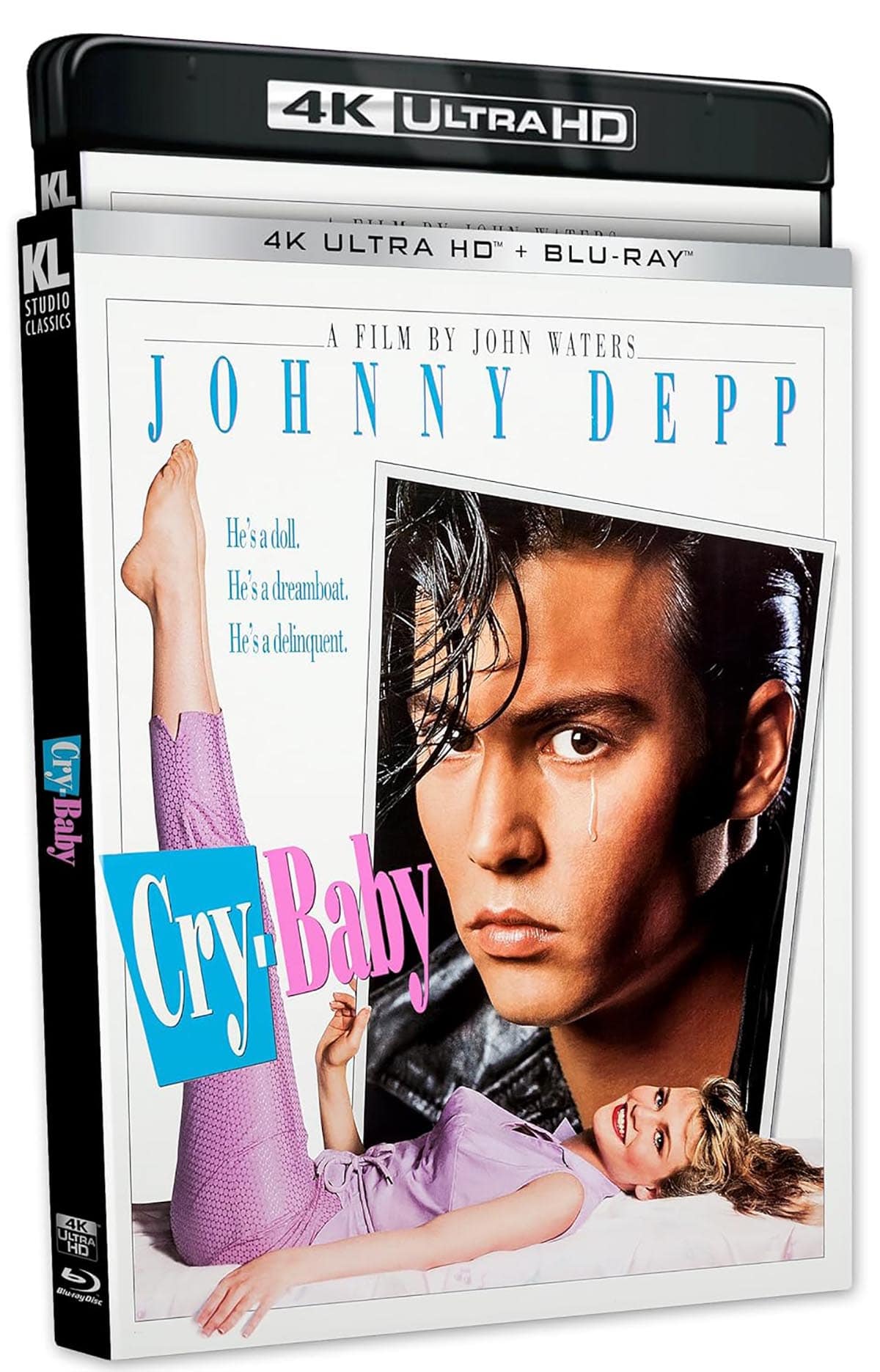
Kino Lorber offers two versions of Cry-Baby. The 85-minute theatrical version comes on a 4K UHD disc, sourced from the original camera negative, while the 92-minute director’s cut is on a standard Blu-ray, with the additional material taken from a 4K scan of the interpositive and an “up-rez” of the SD master. The director’s cut looks excellent, with vibrant colors, well-maintained grain levels, deep blacks, and some excellent depth and clarity. The theatrical version yields even more vivid colors, with a finely tuned range of hues, and that much more depth and clarity. Audio comes in both stereo and 5.1 surround tracks, the former closer to the theatrical experience, the latter nicely opening up the sound field, giving added oomph to the film’s wall-to-wall musical numbers and vintage needle drops.
Extras
Kino assembles an impressive array of extras both old and new for this release, most of them found on the standard Blu-ray of the director’s cut of Cry-Baby. Carried over from earlier home-video releases of the film are the nicely detailed “It Came from…Baltimore” making-of documentary from 1990 that features input from many of the cast and crew (including Johnny Depp), as well as John Waters’s insightful, occasionally hilarious, commentary track. Always a captivating raconteur, Waters provides a deep dive into the social and cultural history of Baltimore in the ’50s, divulges the real-life prototypes of the many of the film’s characters and story beats, and points out the additional scenes that were put back in for the director’s cut.
A new commentary track, and the sole extra found on the UHD disc, features Waters and Heather Buckley, a producer at Black Mansion Films. Their discussion covers a lot of the same ground as Waters’s solo track, but there are enough new details (including bits about star Amy Locane’s ongoing legal issues and the Cry-Baby stage musical) to make it a worthwhile listen.
The new “Bringing Up Baby” featurette contains interviews with Waters, casting director Pat Moran, cinematographer David Insley, and actress and Dreamlander Mink Stole. There are also a slew of recent interviews with Locane (in her prison orange), Traci Lords, Iggy Pop, Ricki Lake, Patricia Hearst, Darren E. Burrows, and Stephen Mailer. There’s some inevitable anecdotal overlap among all these interviews, but at least each one comes from a decidedly different vantage point. Also included here are a theatrical trailer and five deleted scenes that, however disposable, aren’t without their honest-to-goodness laughs.
Overall
Packed with catchy musical numbers, John Waters’s Cry-Baby is a riotous satire of ’50s teen idol and JD films that still has something to say about class in America.
Since 2001, we've brought you uncompromising, candid takes on the world of film, music, television, video games, theater, and more. Independently owned and operated publications like Slant have been hit hard in recent years, but we’re committed to keeping our content free and accessible—meaning no paywalls or fees.
If you like what we do, please consider subscribing to our Patreon or making a donation.