That Luchino Visconti’s adaptation of Fyodor Dostoevsky’s “White Nights” shifts the setting from mid-19th-century Russia to mid-20th-century Italy needn’t change anything essential to the text. Dostoevsky’s short story, a bittersweet romance about a daydreaming young man pursuing a cloistered teenage girl in love with someone else, is so characteristically trenchant in its evocations of urban loneliness, intellectual alienation, and awkward courtship that it could be easily relocated to any modern city in any time. Indeed, while Visconti’s is the earliest film based on the story, it’s since been adapted for the screen multiple times across the decades in France, Iran, India, the United States, and its native Russia.
Dostoevsky’s story very much lies within the realm of language, consisting of verbose internal monologue and static dialogues set in a fixed location. It’s crucially framed by the unnamed protagonist’s narration and ironic distance from the reader. Living in a rich fantasy world in which he’s always surrounded by friends and attains ideal love and success, this timid, hyper-literate naïf is flummoxed by social interaction, prone to launch into florid soliloquies that exasperate strangers, if he speaks at all. He seems perpetually at the ready to will one of his storybook romances into reality with the first attractive female who acknowledges him.
Yearning for Nastenka, the young and lesser-educated object of his desire, yet unable to betray his self-image as a romantic do-gooder, the protagonist finds himself pantomiming the role of platonic friend and helping her pursue his older rival, all while privately cursing his misfortune and waiting for his opportunity to move in. Rooting around in the gulf between the inner world of the self and the social world of others, Dostoevsky’s seemingly straightforward story creates space for rich ambiguity in which its microscopically precise renditions of human behavior can be judged by the reader. Depending on one’s own reading and values, the protagonist is ultimately either redeemed by his empathetic selflessness or failed by his passivity.
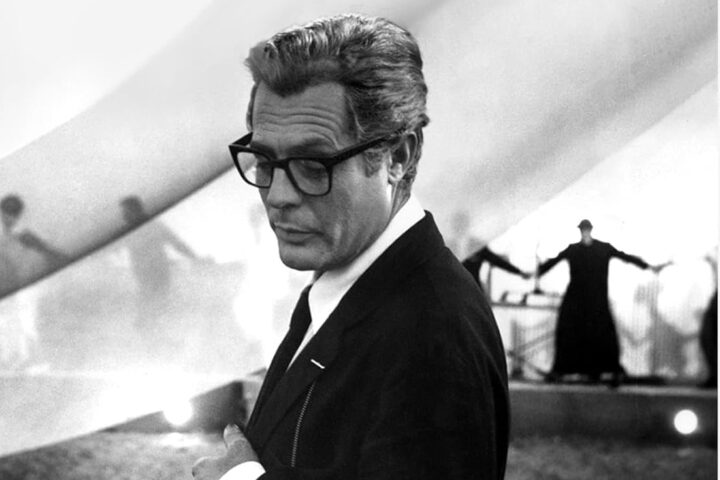
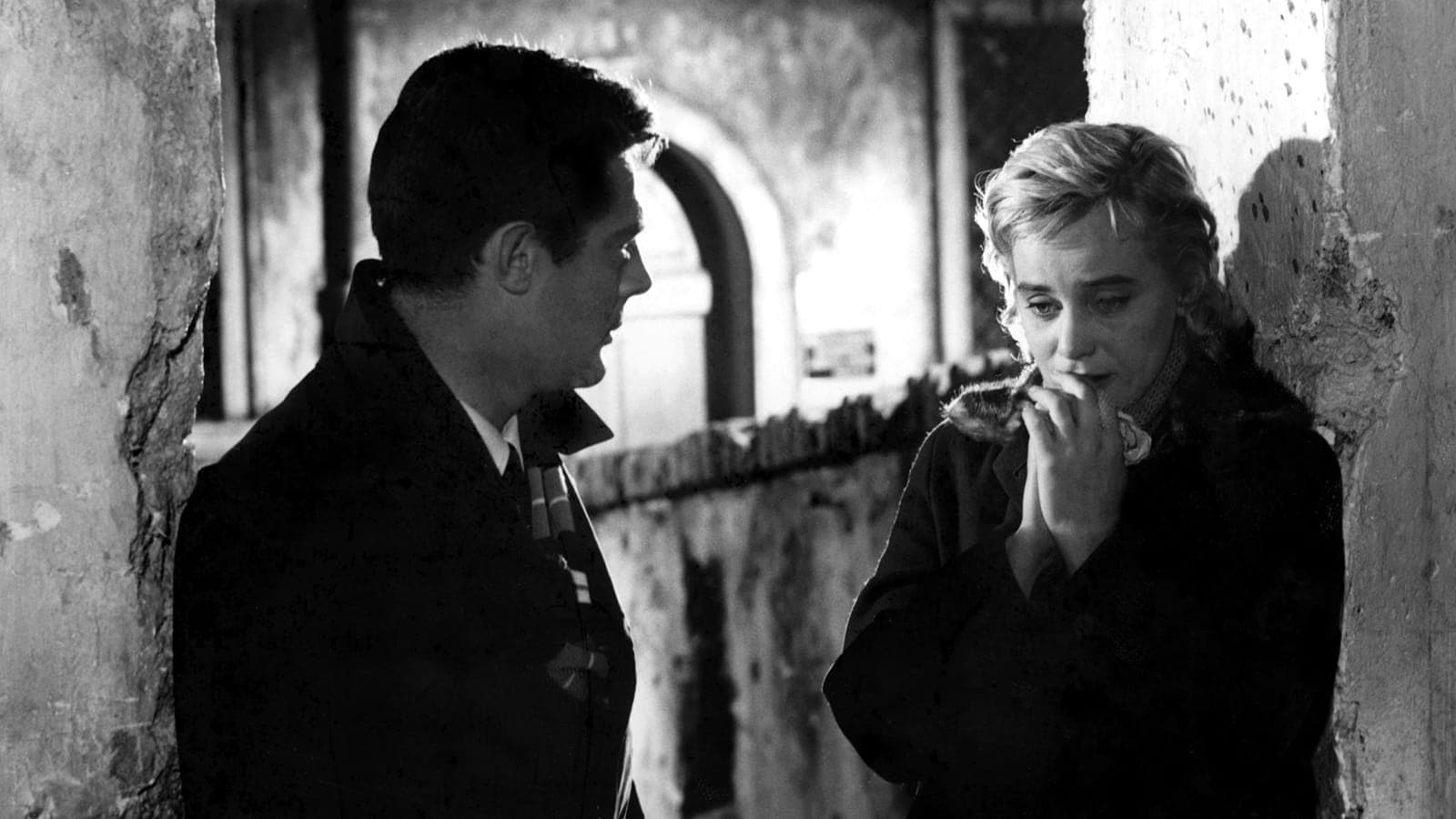
Similar to his later adaptation of Albert Camus’s The Stranger, Visconti flattens the psychological depth and ambiguity of the narrative into more surface-level melodrama. The lonely protagonist, played by a young Marcello Mastroianni, is changed from a meek intellectual to a hot-blooded Italian man, his fretting inner monologue replaced with manly stoicism and impassioned outbursts. He storms and sulks about, dancing vigorously and shrugging off the affections of other women as he pursues his crush (here named Natalia) and even sabotages her efforts to reunite with her own object of desire (a smoldering Jean Marais).
Natalia, played by Maria Schell, is less a sad and desperate figure mirroring the protagonist’s loneliness and more of a dainty, ever-swooning princess, glowing in her pins and dresses. Throughout, her eyes bulge and moisten before the attentions of men, with Nino Rota’s romantic strings soaring on the soundtrack every time they do. This simplification of the characters and heightening of their interactions make the story’s final twist of the long-lost lover’s return feel less earned, though Visconti and screenwriter Suso Checchi d’Amico at least preserve enough of Dostoevsky’s understanding of the characters to land their simplified bittersweet moral about appreciating happiness and beauty while they last.
If Visconti operates on the surface level of the material, however, he crafts a uniquely seductive surface. Dostoevsky told a claustrophobic story of lonely souls lost in a metropolis, but Visconti’s reimagining frames the Livorno-like postwar Italian city at his film’s center as a shimmering nocturnal dream shared by all. Filmed on a massive, gorgeous set, actors and extras continually weave their way through a world molded by chiaroscuro lighting and dotted by blazing street lamps, through crisscrossing canals, stout old apartments, and bombed-out building husks.
In the film’s final act, the set is even showered in globby, powdery snow that hardly resembles the real thing. Impressionistic matte paintings heighten the flattened picture-book unreality of the world and its production design. Semi-abstract formations of long, bold lines, embedded into windows, doors, and archways in textures of wood, stone, and iron, often box characters off into quarter segments of the frame, separated or together. Critic Dave Kehr once described the film as “the link between Visconti’s early neorealist manner and the obsessive stylization of his later films.” That balance of vivid humanity and stately modernist abstraction gives the film a personality and appeal of its own, even if it falls short as an adaptation.
Since 2001, we've brought you uncompromising, candid takes on the world of film, music, television, video games, theater, and more. Independently owned and operated publications like Slant have been hit hard in recent years, but we’re committed to keeping our content free and accessible—meaning no paywalls or fees.
If you like what we do, please consider subscribing to our Patreon or making a donation.