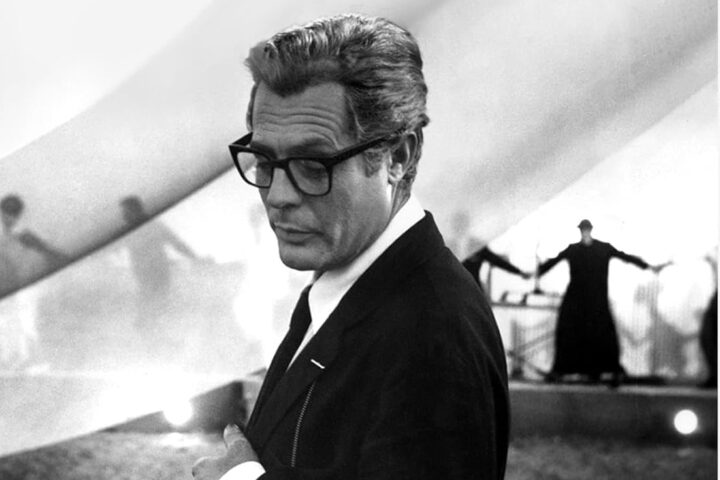
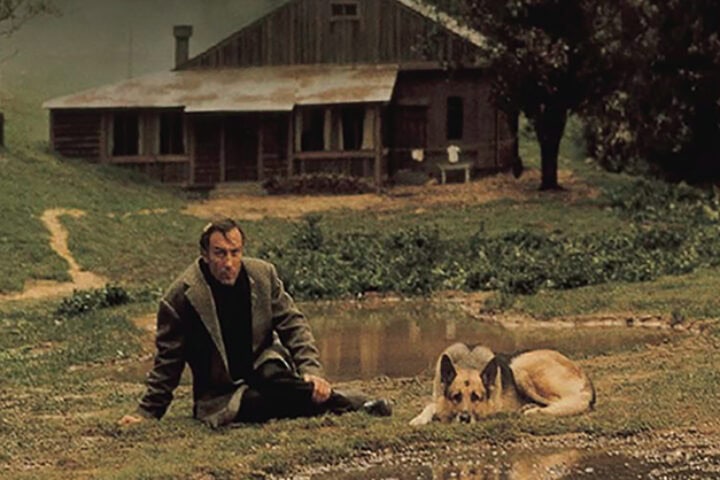
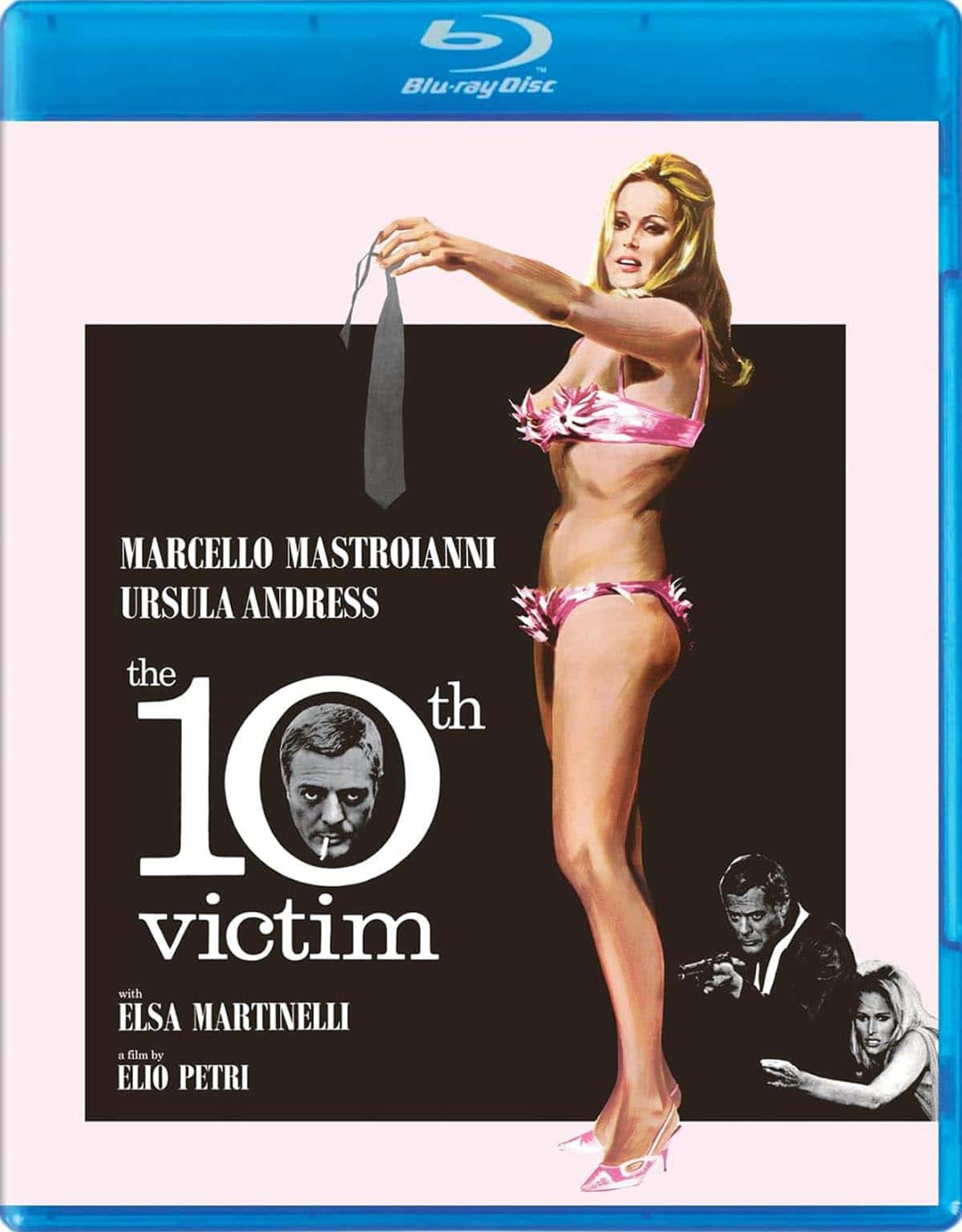
 Genre-hopping maverick Elio Petri’s half-mod, half-madcap ’60s mindbender is set in a dystopian society obsessed with a government-sponsored game known as “The Big Hunt” that pits volunteer hunters against victims in mortal combat. Based on a Robert Sheckley sci-fi short story, Elio Petri’s social satire, co-written by the director and frequent Michelangelo Antonioni collaborator Tonino Guerra, takes aim at consumer capitalism and the “society of the spectacle,” five years before Guy Debord popularized the term in his Situationist manifesto.
Among its targets, the film draws a bead on ageism, with Marcello Poletti (Marcello Mastroianni) having to hide his elderly parents from government search and seizure. It spoofs corporate-media domination through the machinations of Marcello and Caroline Meredith (Ursula Andress), the wily American trying to track him down, arranging to have their kills broadcast on live TV. And The 10th Victim takes on New Age cultism, with Marcello serving as high priest to the Sunsetters, a bikini-clad wild bunch that gathers every evening to worship the westering sun. The Sunsetters are opposed by “vulgar neorealists,” who blow raspberries at them—one of many cinematic references strewn throughout the film.
Marcello suffers from a torturous love life (termagant wife, materialistic mistress), making him similar to roles that Mastroianni played in films like Pietro Germi’s Divorce, Italian Style, and a vacuous press-junket interview owes a debt to Mastroianni’s frequent collaborator Federico Fellini, who’s namedropped jokingly as a street address. Andress’s flaxen-maned vixen recalls her turn as Honey Ryder in Dr. No. The staccato electric voice issuing from the computers that pair hunters and victims for “The Big Hunt” seems to parody Alpha 60 in Jean-Luc Godard’s Alphaville, which came out earlier that year. (Another character even speaks through an electronic larynx—the same method Godard used to achieve Alpha 60’s uncanny vocal patterns.)
Visually speaking, The 10th Victim is, at bottom, a Pop Art melting pot. Every scene is filled with eye candy, from the bright primary tones of Gianni Di Venanzo’s cinematography to the optical-illusion backdrops. The film employs a sort of bric-a-brac bricolage (plaster statues and “winking eye” paintings used for home decorations), championing its comic-strip sensibilities (Marcello’s confiscated literary “classics” are shelves of comic books) at the same time that it decries mass culture’s “bread and circuses,” lowest-common-denominator appeal.
The vérité opening sets the pace and tone: A man and a woman chase each other around downtown Manhattan, exchanging potshots, while, in a series of crosscuts, an MC introduces the rules of “The Big Hunt” to an unseen audience. The chase concludes inside the austere, glaring-white Masoch Club, strewn with sleek ultramodern décor, where the MC announces the performance of a masked dancer. As she strips down to a glass shard-festooned bikini, she whips the audience with her cast-off clothing and now and then slaps a patron across the face. The unmasked dancer, revealed to be nine-time “Big Hunt” winner Caroline Meredith shoots down one of the patrons, the Chinese man involved in the chase, with two guns mounted in her bikini top. (The influence that The 10th Victim had on the Austin Powers is most evident here.)
After successfully bagging his own prey, a German aristo who he takes out with explosives hidden in his clicking heels, Marcello visits the Great Hunt Ministry Building, a squat Orwellian nightmare where a professorial type lectures on “Big Hunt theory,” a sardonic admixture of Freud’s death drive and Nietzsche’s famous dictum, “Live dangerously!” “The Big Hunt” is understood here as a safety valve—state-sanctioned mayhem that allows humanity to vent its violent instincts. Or, as a loudspeaker informs passersby outside, “An enemy a day keeps the doctor away. Why control the birth rate when we can increase the death rate?”
Later, Meredith and Marcello finally meet cute at a rooftop eatery. The scene’s jazzy score turns out, in a clever meta bit, to be diegetic, as the panning camera picks out two black-clad saxophonists blatting away from atop black cubes, while nearby Marcello pages through a comic book. Passing herself off as an American journalist, Caroline says she wants to interview him, as a typical “difficult man,” about his love life, staging the event at the Temple of Venus near the Coliseum. In actuality, she’s arranged, along with her sponsor, Ming Tea, a telegenic tableau mort for Marcello, complete with dancing teacups and crane-mounted cameras.
The climactic four-way shootout at the Coliseum that pits Marcello and Caroline against his wife (Luce Bonifassy) and mistress (Elsa Martinelli) becomes a parody of the Italian westerns of the day. And the acid-edged epilogue, Petri’s modernist take on a shotgun wedding, posits marriage as the most dangerous game of them all. Indeed, Marcello’s erotic imbroglio, torn between wife, lover, and (potential) wife, points to a recurrent theme in many commedia all’italiana films: Italy’s then-lack of divorce laws, which wouldn’t be instituted until the early ’70s. Petri visualizes Marcello’s prospective future—the future of the future, if you will—as a sight-gag gun blasting out a bouquet of flowers rather than the usual “BANG!” sign.
Image/Sound
Kino’s Blu-ray release, sourced from a new 2K restoration by the Cineteca Bologna, is a marked improvement over Blue Underground’s impressive 2011 Blu-ray. The transfer is a good bit darker and boasts greater contrast and fine detail, with the Pop Art colors of Gianni Di Venanzo’s cinematography practically jumping off the screen. As in the Blue Underground release, audio comes in either English or Italian Master Audio mixes. The English track is a bit bolder and louder. The gunshot-laden sound design, as you might expect, comes as quite a blast. Piero Piccioni’s bouncy score (especially the sprightly “Spiral Waltz” end credits themes sung by ’60s pop star Mina) will likely burrow its way into your brainpan.
Extras
The lively and engaging commentary track included here finds filmmaker Steve Mitchell and film historian Troy Howarth arguing the case for Elio Petri as an underrated auteur of Italian cinema, effing upon the ineffable nature of a movie star, and more. On the featurette “Elio Petri – Subject for Further Research,” film historian Kim Newman situates The 10th Victim within the subgenre of dystopian gladiatorial films along the lines of Rollerball, Death Race 2000, and, more recently, the Hunger Games franchise, while Petri’s wife, Paola Pegoraro Petri, offers anecdotes from the film’s production, including the less than enthusiastic response of producer Carlo Ponti, and attests to her husband’s unabashed love for the sci-fi genre.
Overall
Elio Petri’s influential dystopian satire The 10th Victim gets an impressive new 2K restoration and a couple of context-rich supplements.
Since 2001, we've brought you uncompromising, candid takes on the world of film, music, television, video games, theater, and more. Independently owned and operated publications like Slant have been hit hard in recent years, but we’re committed to keeping our content free and accessible—meaning no paywalls or fees.
If you like what we do, please consider subscribing to our Patreon or making a donation.