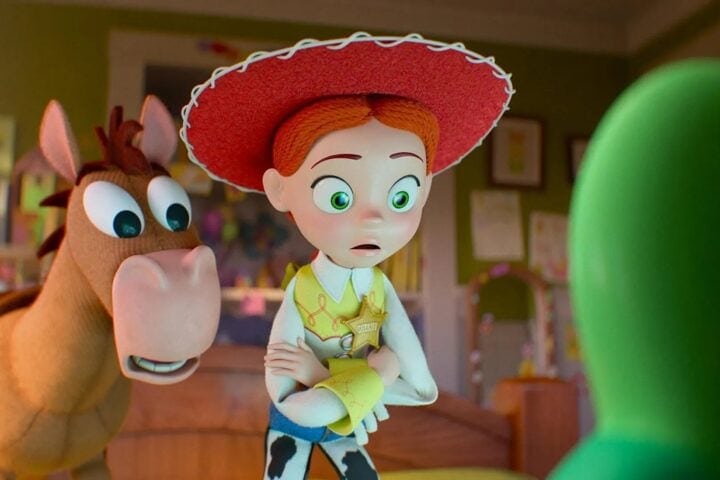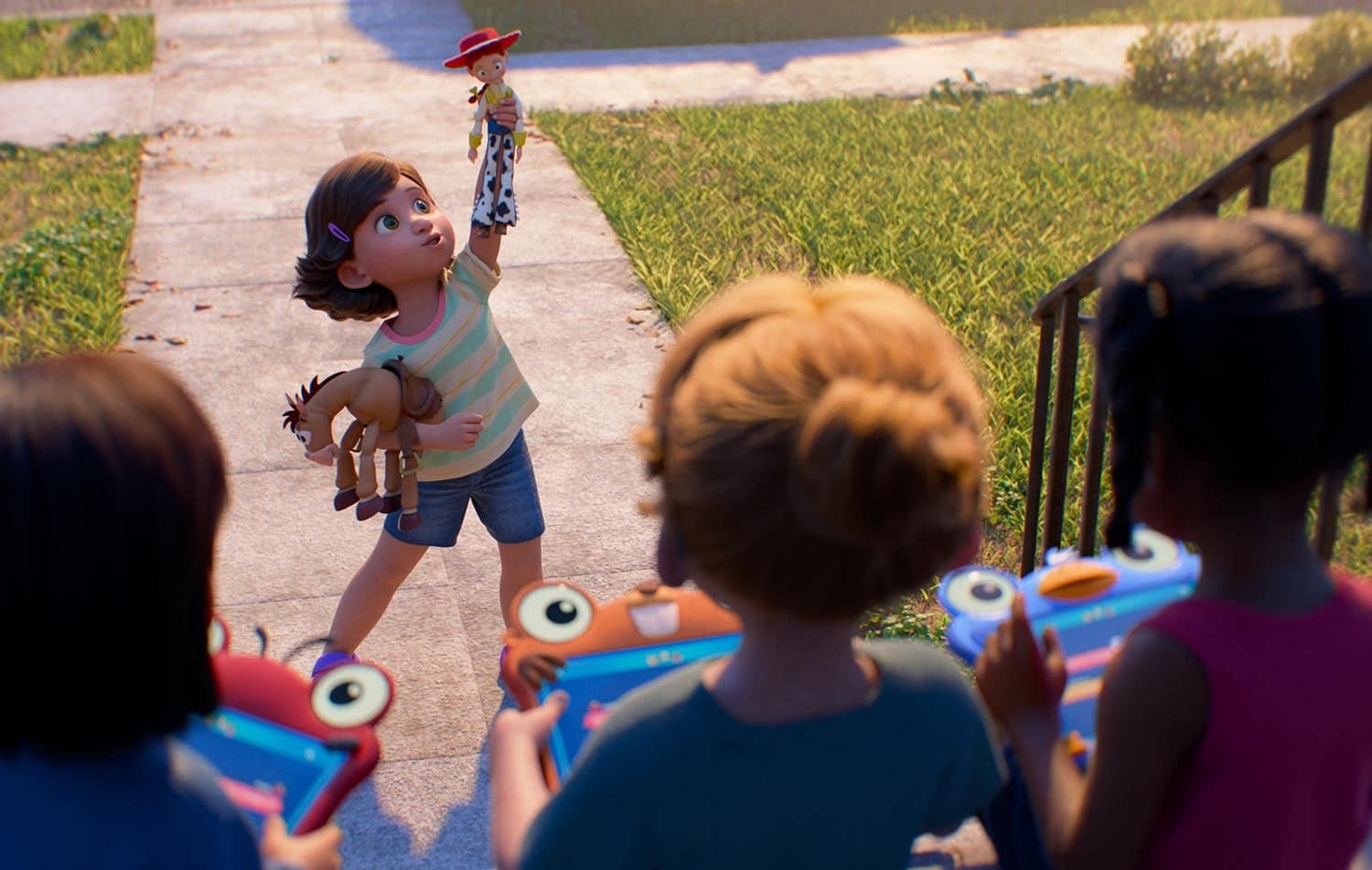
With Toy Story 5, Pixar’s existentially restless series moves past ruminations on how toys remain frozen in time as their human owners age to ask what even is a toy in the age of widespread tech adoption. This idea is introduced at the top of Andrew Stanton’s film when Bonnie (Scarlett Spears), the child who inherited Andy’s toys at the end of Toy Story 3, receives her first tablet, Lilypad (Greta Lee), and becomes zombified by it. Worried about the girl’s social isolation and her own future, Jessie (Joan Cusack) marshals Woody (Tom Hanks) and Buzz Lightyear (Tim Allen) to rescue Bonnie from the device’s grip.
It’s an interesting wrinkle that Pixar, which began under the aegis of Steve Jobs, has devoted an entry of its flagship franchise to anxiety over the impact of screen addiction. But it’s also hard to ignore that here we are, yet again, with Woody and company being brought out of storage more than 15 years after the third film seemingly had the last word on the value of toys playing a transient role in the lives of children by affecting their cognitive and intellectual development.
Jessie’s attempts to break Bonnie of her attachment to Lilypad is consistent with her long-running fears of being forgotten by her owners. But the hamfisted subplot about Buzz’s desire to propose to the cowgirl and the return of Woody, who struck out on his own at the end of the fourth film, feel like nothing more than thin justifications for getting the gang back together.
The aesthetic whimsy that’s made the Toy Story movies so popular is all but absent in Stanton’s film. Most of the action occurs within two drab bedrooms, and Toy Story 5 contains few of the clever perspective tricks that dot its precursors. Ironically, for a work of art worried about the diminishing power of imagination, the film often feels like a procedurally generated series of images meant to remind you of the characters you loved in your youth. (There are fewer new characters than usual, but one, a primitive electronic toy that teaches toddlers to potty train, is notably voiced by Conan O’Brien, who brings all his manic, oddball energy to the part.)
Toy Story 5 leans into the sentimental beats that are familiar to the series, except those moments too often give the film the feel of a PSA aimed at convincing parents to monitor their kids’ screen time. Still, there’s some spark to the brief moments where we see an approximation of Bonnie’s imagination when she plays with her old toys. For a few seconds, the world is suddenly rendered in a kind of 2.5-D where the usual three-dimensional outlines of the characters are placed against flat backdrops that look drawn in crayon.
A few tear-jerking moments are also effective, none more so than one involving Jessie finally coming to terms with her abandonment issues regarding her original owner. Still, for the first time, a seemingly unnecessary Toy Story sequel has at last pushed the material too far, finding a compelling new topic but failing to build a sturdy structure on top of it.
Since 2001, we've brought you uncompromising, candid takes on the world of film, music, television, video games, theater, and more. Independently owned and operated publications like Slant have been hit hard in recent years, but we’re committed to keeping our content free and accessible—meaning no paywalls or fees.
If you like what we do, please consider subscribing to our Patreon or making a donation.