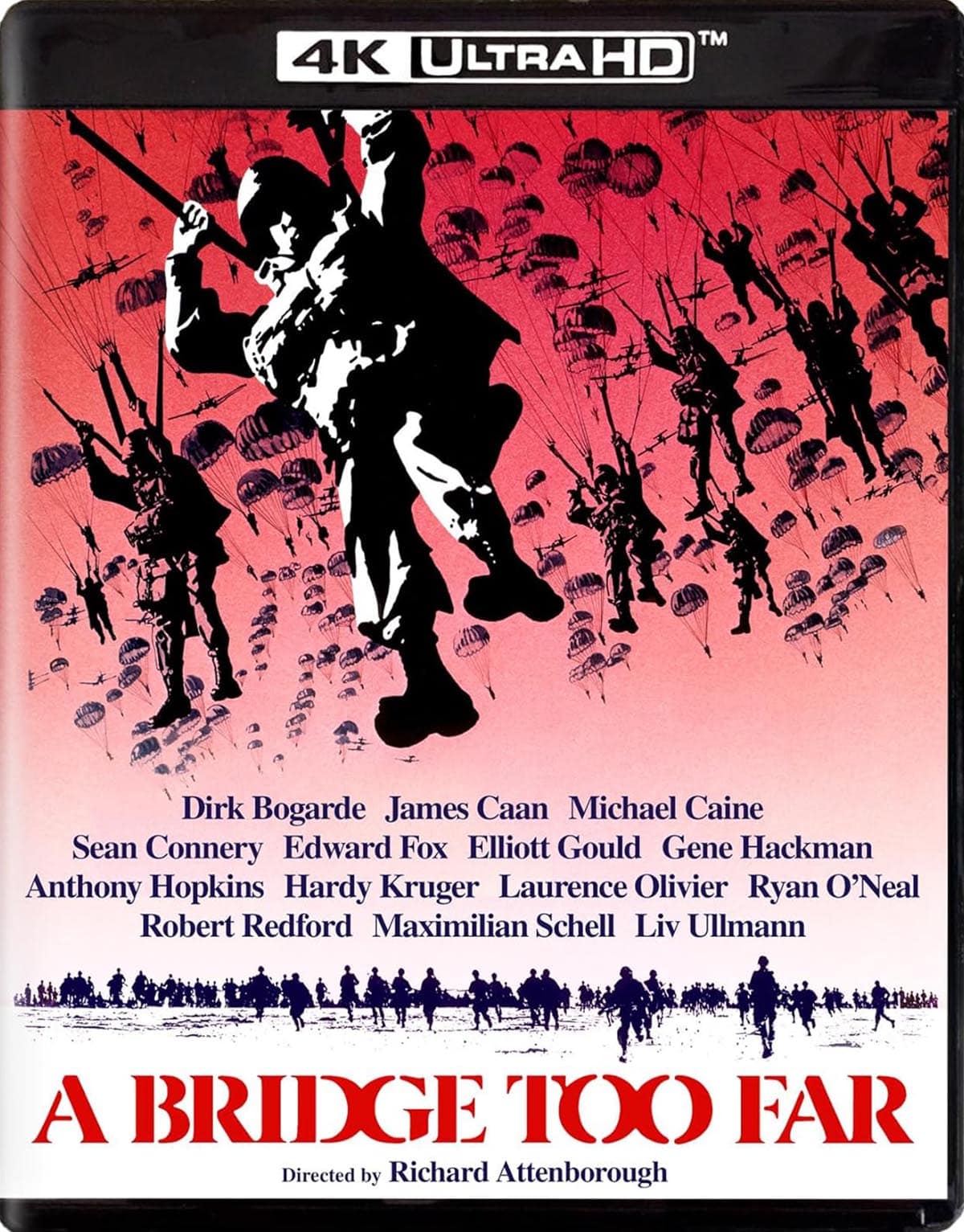
 On its surface, A Bridge Too Far is an example of what film critic Manny Farber called “white elephant art.” A veritable who’s who of American and British acting luminaries, Richard Attenborough’s 1977 epic depicts the failed Operation Market Garden invasion of Nazi-occupied Holland in September 1944. All of this is impressive from a logistical standpoint, as Attenborough meticulously recreates paratrooper drops, stalemated urban warfare, and landscape-flattening artillery bombardment. But this U.S. and British co-production suffers from the same stodgy, too-clean quality of many a classic war film, representing the overwhelming barrage of bullets and bombs in a sanitized manner that leaves the dead just a bit too intact and unbloodied to convey the senselessness of warfare.
Underneath this façade, though, A Bridge Too Far is a fascinating mix of aesthetic and tonal contradictions. Narratively, the film doesn’t shy away from the fact that Operation Market Garden was doomed for the start and that the officers who ordered the military operation, in pursuit of personal glory, knew so. By the same token, the pervading atmosphere is one of hollow patriotism, honoring soldiers’ sacrifice as inherently noble despite the fact that better planning would have achieved the objective and with fewer casualties. Individual acts of heroism are sprinkled throughout the film’s nearly three-hour running time, so as to champion the idea of refusing to admit defeat, creating a disconnect between earlier cinematic depictions of World War II and an emerging skepticism toward blind jingoism.
That tension carries over into some of the filmmaking choices. Attenborough favors classical camera techniques with mounted images and controlled tracking and crane shots in movement. You’ll likely marvel at the careful composition of such images as panzers arranged along the treeline of the Dutch village that’s the focus of the operation, or hordes of Allied troops landing in a field and their uniformed bodies nearly completely obscuring the verdant land beneath their feet. But there are also gestures toward the grittier methods of 1970s cinema: Diffusion scatters the natural light over the terrain into a white haze that’s soon distorted even more by gunsmoke, and the occasional bit of handheld footage joltingly brings us closer to the action.
Perhaps the most fascinating collision of forms can be found in the vastly different performance styles of the older and younger actors. Older, classically trained actors like Dirk Bogarde and Sean Connery bring their stage-honed techniques to the stuffier, more dispassionate British generals who, even as their plans go awry, insist on a stiff-upper-lip resolve. Meanwhile, others like James Caan and Michael Caine radiate a rawer, more realistic energy, their spiky, caustic attitudes conveying both the less composed emotions of men on the frontlines and their increasingly open hatred of the officers sending them into a meat grinder.
In an especially clever touch, the American brass is played by younger actors like Ryan O’Neal and Elliott Gould—a reflection of the lack of tradition shaping the American military and the higher likelihood of attaining a leading rank before the middle-age barrier that continued to define British military hierarchy at the time. For such an extraordinary undertaking in its magnitude and scope, A Bridge Too Far is most captivating in its granular details.

Image/Sound
Geoffrey Unsworth’s intentionally drab, desaturated cinematography limits the extent to which Kino Lorber’s 4K transfer can offer a meaningful boost in color and sharpness over past home video editions of A Bridge Too Far, but the film-like presentation suggests that the existing elements were in optimal condition. Even in extreme long shot, detail remains clear enough for one to make out the faint wrinkles in parachutes or the markings on vehicles. A few scenes point toward the use of perhaps unnecessary color timing, but otherwise the metallic silvers, earthen browns, and muted greens look faithful to the film’s intended look. The disc comes with the original stereo and a 5.1 surround soundtrack, and between the explosions, gunfire, and John Addison’s marching, brassy score, they’re consistently boisterous presentations, with the 5.1 mix more robustly distributing these elements across all channels.
Extras
Kino’s disc comes with two archival commentaries. The first features writer William Goldman, with occasional recorded anecdotes from other crew members, and it’s a treasure trove of insight into the immense undertaking that went into shooting the film and assembling the all-star cast. (We also get some amusing gossip about raging egos among said actors.) The second, infinitely drier track comes from film historians and critics Steven Jay Rubin and Steve Mitchell, who see the film as something of a fulcrum between the classic war film and more revisionist works of the genre that would become commonplace after Apocalypse Now.
Overall
Richard Attenborough’s occasionally stiff but fascinating war epic receives an excellent, if slightly flawed, 4K upgrade from Kino Lorber.
Since 2001, we've brought you uncompromising, candid takes on the world of film, music, television, video games, theater, and more. Independently owned and operated publications like Slant have been hit hard in recent years, but we’re committed to keeping our content free and accessible—meaning no paywalls or fees.
If you like what we do, please consider subscribing to our Patreon or making a donation.