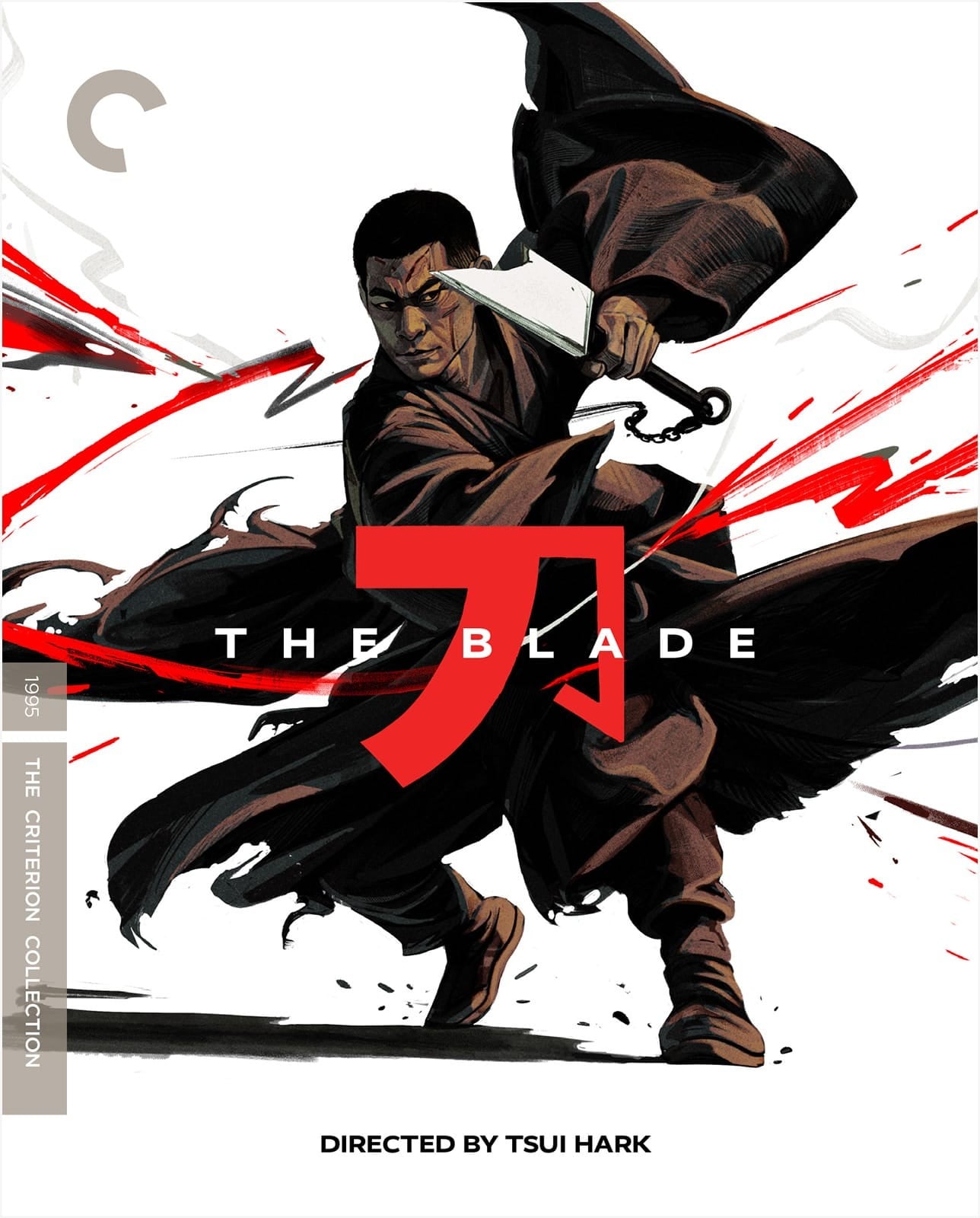
 Tsui Hark’s The Blade isn’t so much a revisionist take on a Shaw Brothers wuxia as a distillation of the critiques embedded in the genre’s most popular classics. Reworking Chang Cheh’s 1967 mega-hit The One-Armed Swordsman, Tsui’s film presents the quest of a maimed blacksmith, Ding’an (Vincent Zhao), to avenge his father’s murder by a gang of bandits as the most nihilistic expression of Chang’s own interrogation of the genre’s codes of honor.
The film presents feudal China as a place of outlandish sadism, where outlaws torture dogs out of boredom and pillage less for material gain than the thrill of victimizing others. As for our ostensibly more heroic, they’re scarcely moral in their ways. The protagonist’s lifelong friend and rival, Tietou (Moses Chau), rescues a woman from attack only so he can take advantage of her, and Ding’an himself ceases to care about anyone or anything other than killing those who wronged him.
The action scenes are some of the most chaotic in Tsui’s canon, with an emphasis on rapid, almost cubist editing that seduces you with swings and strikes caught from multiple angles. This discombobulating effect is made even more dizzying by the inclusion of some clearly flawed footage to retain a raw feel of being in the middle of a melee. In one moment, an assailant swings a sword toward another and the image cuts to a rushing close-up of the intended target, who ducks out of the way. But the shot keeps moving forward as the sword hits nothing but air, the camera seeming as if it were swept up by the force of the blade’s swing.
The idea of the weapon itself having a visual perspective is mirrored in the film’s title, which refers to the sword that Ding’an learns to wield with one arm. Ding’an retrieves the blade, which belonged to his father and was left broken in the ambush that killed him, and places it at the end of a chain that he uses to fling the blade around in spinning attacks. Slowly, the man becomes an extension of the sword as much as it is an extension of him, his whirling dervish movements causing him to get yanked around by the blade’s centrifugal force.
Far from the usual wuxia arc of a warrior mastering martial arts, Ding’an becomes little better than the mass needed to give the sword the necessary power to kill. The subversive The One-Armed Swordsman upheld the value of martial arts’ self-improvement, but Tsui sands away the romanticism to show that the only true goal of training is to inflict death.
Image/Sound
Criterion’s UHD release beautifully presents The Blade’s explosive color palette of bright reds and painterly day-for-night blues. Compared to the transfer on Warner’s 2016 DVD release, Criterion’s transfer shows off a deeper range of colors in the natural tones of sandy ground and the off-whites of buildings and peasant clothing. There’s also a noticeable uptick in image clarity, with small details like the contours of face paint and tattoos on bandits or the dirt caking clothes now plainly visible. The lossless mono soundtrack is a busy din of sound effects, boisterous music, and overlapping dialogue, yet each element is cleanly placed in the mix.
Extras
Hong Kong cinema expert Frank Djeng contributes a new commentary track that combines exhaustive detail on the conditions of both Hong Kong filmmaking and sociopolitics of the time with an infectious breakdown of Tsui Hark’s direction. The disc comes with Action et Vérité, a 2006 documentary about The Blade that finds Tsui and lead choreographer Xiong Xin-xin discussing their upending of their usual methods to make an experimental wuxia in which behind-the-scenes chaos was reflected in the finished product. We also get a 2011 Q&A with Tsui from the New York Asian Film Festival, as well as a video essay on the film by Every Frame a Painting’s Taylor Ramos and Tony Zhou. A booklet essay by author Lisa Morton astutely focuses on how we bear witness to the story of Ding’an through the eyes of a minor character, Ling (played by Suet Nei), who abhors the violence unleashed around her.
Overall
Tsui Hark’s vicious anti-wuxia receives a gorgeous transfer from Criterion.
Since 2001, we've brought you uncompromising, candid takes on the world of film, music, television, video games, theater, and more. Independently owned and operated publications like Slant have been hit hard in recent years, but we’re committed to keeping our content free and accessible—meaning no paywalls or fees.
If you like what we do, please consider subscribing to our Patreon or making a donation.