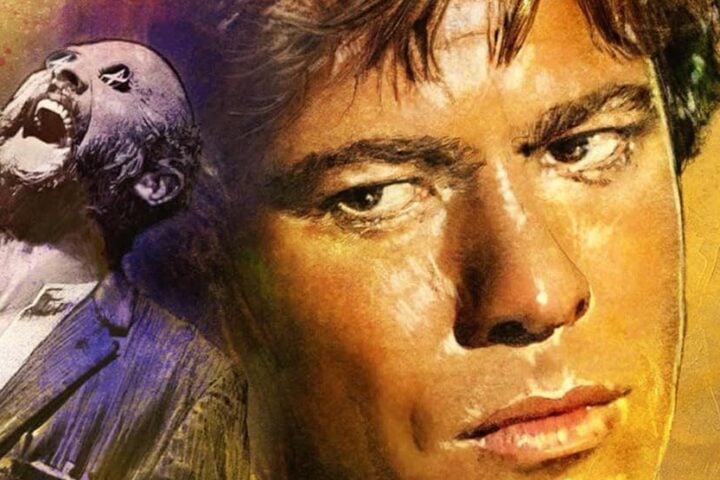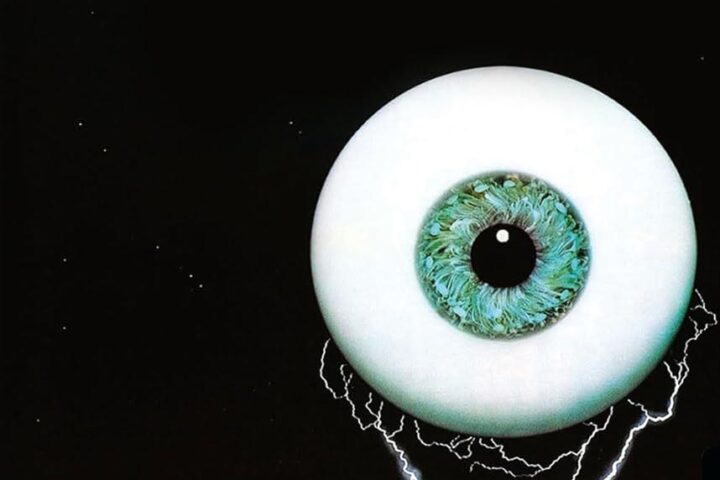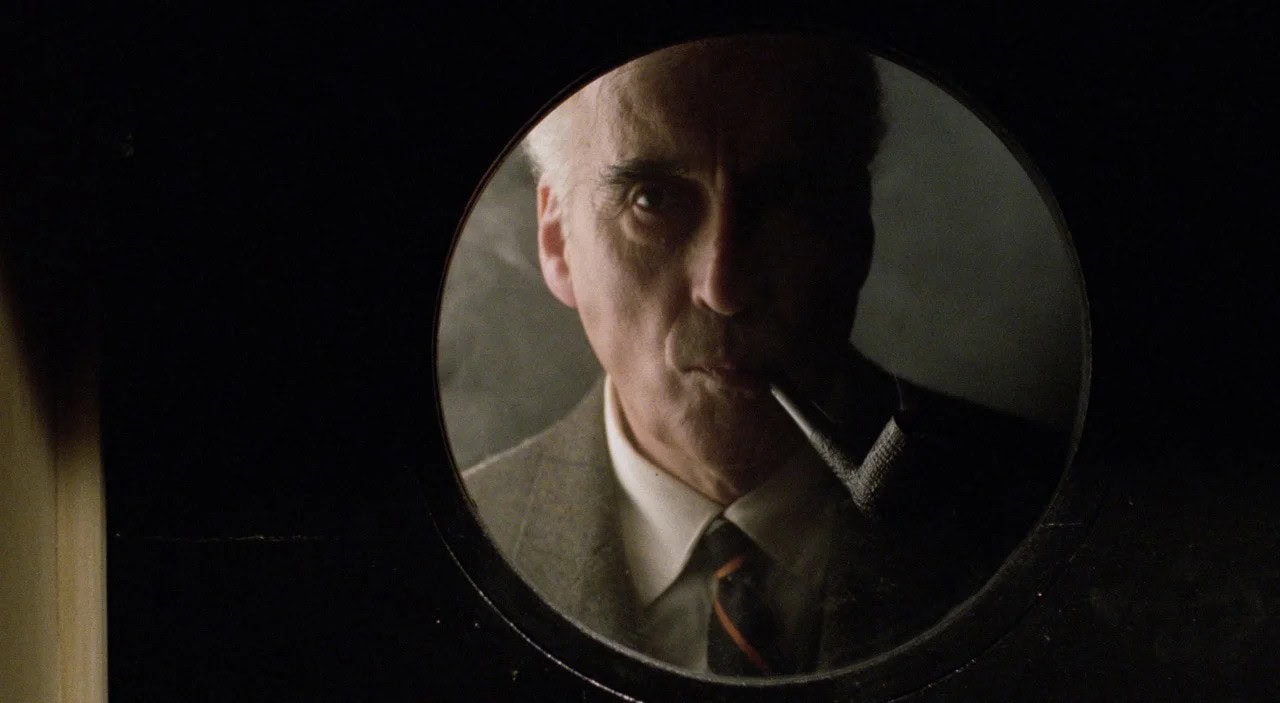
Severin’s The Eurocrypt of Christopher Lee Collection 3 features five films and a recent documentary on the life and career of the horror icon who once described himself (in the title of one of his memoirs) as “tall, dark, and gruesome.” All of the films in this set look fantastic, sporting fresh scans from original elements, and The Virgin of Nuremberg is available in both 4K UHD and standard HD. Both Beat Girl and The Hands of Orlac come with alternate cuts. What’s more, the set contains over 15 hours of bonus materials, including informative commentaries, cast and crew interviews, some in-depth visual essays, and the exhaustive 142-page book Christopher Lee: Eight Decades of a Dark Horse by Lee biographer Jonathan Rigby.
The first three films in the collection orbit around the contributions of writer and director Edmond T. Gréville, who directed the first, co-wrote and directed the second, and co-wrote the third. From 1960 comes Beat Girl, a vibrant and slightly louche account of the beatnik culture in London’s fashionable SoHo neighborhood as represented by the Off Beat coffee bar and a tatty strip club called Les Girls, the latter presided over by the ethically compromised Kenny King, played by Lee, who effortlessly steals the handful of scenes he’s in.
At bottom, Beat Girl is an examination of the widening generation gap, along the lines of Nicholas Ray’s Rebel Without a Cause, including a rather novel spin on that film’s chicken game. Only here young Jenny Linden (Gillian Hills) stands in for the James Dean character. The script by Dail Ambler cannily limns the perfectly legitimate motivations for the kids’ kicks-driven lifestyle: traumatic wartime experiences, the austerity of postwar Britain, the looming threat of nuclear annihilation. And the youth culture definitely provides the film’s careening vitality, right down to a phenomenal rock- and jazz-inflected score from a young John Barry.
The adults in the film are characterized not only by cluelessness about the younger generation but by a kind of emotional sterility. This is signaled by the soulless, inhumane spaces of the City 2000 project designed by Jenny’s architect father, Paul (David Farrar), and the dishonesty of her stepmother, Nichole (Noëlle Adam), about her checkered past. But this basically being a melodrama, jailbait Jenny gets into trouble with procurer Kenny, and can only be extricated from her predicament owing to the class and prestige of her father.
From the same year, The Hands of Orlac marks the third film adaptation of Maurice Renard’s 1920 novel after Robert Wiene’s 1924 version starring Conrad Veidt and Karl Freund’s Mad Love from 1935 starring Peter Lorre. Gréville’s subdued handling of the material keeps the transplant horror at arm’s length, as it were, instead opting for a more nuanced psychological exploration of guilt and anguish. The narrative plays up the ambiguity of whether or not Orlac (Mel Ferrer), a concert pianist who loses his hands in a plane crash, even underwent the procedure until the end of the film. It also gets a lot of mileage out of the campaign by nefarious stage magician Nero (Lee) to gaslight Orlac into believing that his hands intend murder.

The performances, including a hilariously grotesque cameo from Donald Pleasence, carry the film through occasional slow patches. Ferrer admirably conveys Orlac’s mounting paranoid and emotional frangibility. Lee, of course, steals every scene he’s in, especially the one where his Nero appears to Orlac in the guise of the executed murderer, leaving Orlac haunted by Nero’s echoing maniacal laughter. Dany Carrel brings some slinky exoticism to her role as Nero’s assistant Li-Lang. And a fun drinking game could be made by knocking back a shot every time Gréville frames a composition in a mirror or other reflective surface.
Antonio Margheriti’s The Virgin of Nuremberg, from 1963, possesses all the trappings of your classic gothic chiller with two notable exceptions: It was filmed in luscious Eastmancolor rather than moody monochrome, and it’s set in the modern day. The story is set in motion when heir apparent Max Hunter (Georges Rivière) brings his American bride, Mary (Rossana Podestà), home to his ancestral castle somewhere in Germany. Lee plays Max’s disfigured manservant Erich, an initially sinister figure with an apparent fondness for surgical implements.
On her first night on the premises, Mary bravely investigates distant screams, only to discover an eyeless and diversely punctured victim within the titular torture device, perhaps better known as an iron maiden, housed in the castle’s museum, a perfectly preserved torture dungeon. Mary is soon caught up in a bloody reign of terror conducted by a black-hooded sadist known as the Punisher who occupied the castle 300 years before.
Given its sparse and fairly straightforward storyline, Margheriti’s film lives and dies on its numerous aesthetic pleasures, which include impressively elaborate set designs by Riccardo Domenici, sumptuous cinematography by Riccardo Pallotini, and a lavish orchestral score from master composer Riz Ortolani. This eye candy is greatly appreciated since a decent amount of the running time is given over to shots of Mary prowling around the castle and its ground.
The narrative’s most significant innovation lies in the fact that it touches directly on Germany’s troubled past (to put it mildly) during World War II. The physical and psychological trauma of the times touches on both Max, who avers that things unseen aren’t a problem, and Erich, whose all-too-visible scars are a direct result of his actions during the war. The film is quite careful to position Max, Erich, and the figure ultimately revealed to be impersonating the Punisher as “good Germans,” victims of the Third Reich in their own way. The film even includes them in the plot among Hitler’s inner circle to assassinate him.
The last two movies in the set signal their family-friendly nature with an opening Severin Kids title card. Kevin Connor’s Arabian Adventure, from 1979, is cut from the same magic carpeting as Ludwig Berger, Tim Whelan, and Michael Powell’s The Thief of Bagdad. The wondrous narrative is peopled by evil caliph Alquazar (Lee), a cantankerous genie (Milton Reid), a thief with a beef (John Ratzenberger), and strapping hero Hasan (Oliver Tobias), who’s assisted by young Majeed (Puneet Sira) in his efforts to win the hand of beautiful Princess Zuleira (Emma Samms). Along the way, Peter Cushing briefly turns up as a wizened wazir if for no other reason so he can be in the same film as Lee for the umpteenth time, and Mickey Rooney makes a boisterous cameo so he can fall all over himself.

The cavernous sets, detailed miniatures, handcrafted matte paintings, and lo-tech special effects are all fairly impressive for the time. Ken Thorne’s boisterous orchestral score is definitely value added. The storyline will hold no real surprises for most adult viewers, but because 10-year-old Majeed is obviously our POV character, it’s clear that this is unabashed family filmmaking meant to entrance and entertain children of all ages. And at that it succeeds admirably.
In Justin Hardy’s A Feast at Midnight, from 1994, Lee plays fierce form master Major Longfellow, whom the boys of Dryden Park prep school have nicknamed “Raptor” after the saurian antagonists of Jurassic Park (a poster for Steven Spielberg’s film can be seen hanging on the dorm wall). The genial but slight story concerns a new arrival (Freddie Findlay) who struggles to fit in, until he starts the Scoffers Club, which is dedicated to concocting illicit late-night feasts in the school kitchen. Leet gets to play things fierce yet ultimately thaw into a more traditional paternal role. The film is also aided by sumptuous cinematography by Tim Maurice-Jones, who proves especially adept at conjuring up painterly vistas of the British countryside.
Jon Spira’s 2024 documentary The Life and Deaths of Christopher Lee is an affectionate, affecting, and comprehensive overview of Lee’s life and career. The film has the intriguing conceit of being narrated by Lee in the form of a marionette puppet. It also features several animated sequences, along with talking-head contributions from actress (and Lee’s niece) Harriet Walter, son-in-law and musical collaborator Juan Aneiros, biographer Jonathan Rigby, and directors Peter Jackson, John Landis, and Joe Dante, all of whom worked with the actor.
The documentary includes some fascinating insights into Lee’s tumultuous early life, education, and wartime experiences, including some still undisclosed espionage work that may have influenced his cousin Ian Fleming’s creation of a certain 007. Other topics include Lee’s involvement with Hammer Films, and subsequent efforts to distance himself from those roles, not to mention his work in Europe, especially his multiple collabs with Mario Bava and Jess Franco. It also touches on his latter-day foray into heavy metal music, and late-career renaissance via his involvement in the Star Wars and Lord of the Rings franchises.
The Eurocrypt of Christopher Lee Collection 3 is available on February 24 from Severin Films.
Since 2001, we've brought you uncompromising, candid takes on the world of film, music, television, video games, theater, and more. Independently owned and operated publications like Slant have been hit hard in recent years, but we’re committed to keeping our content free and accessible—meaning no paywalls or fees.
If you like what we do, please consider subscribing to our Patreon or making a donation.