
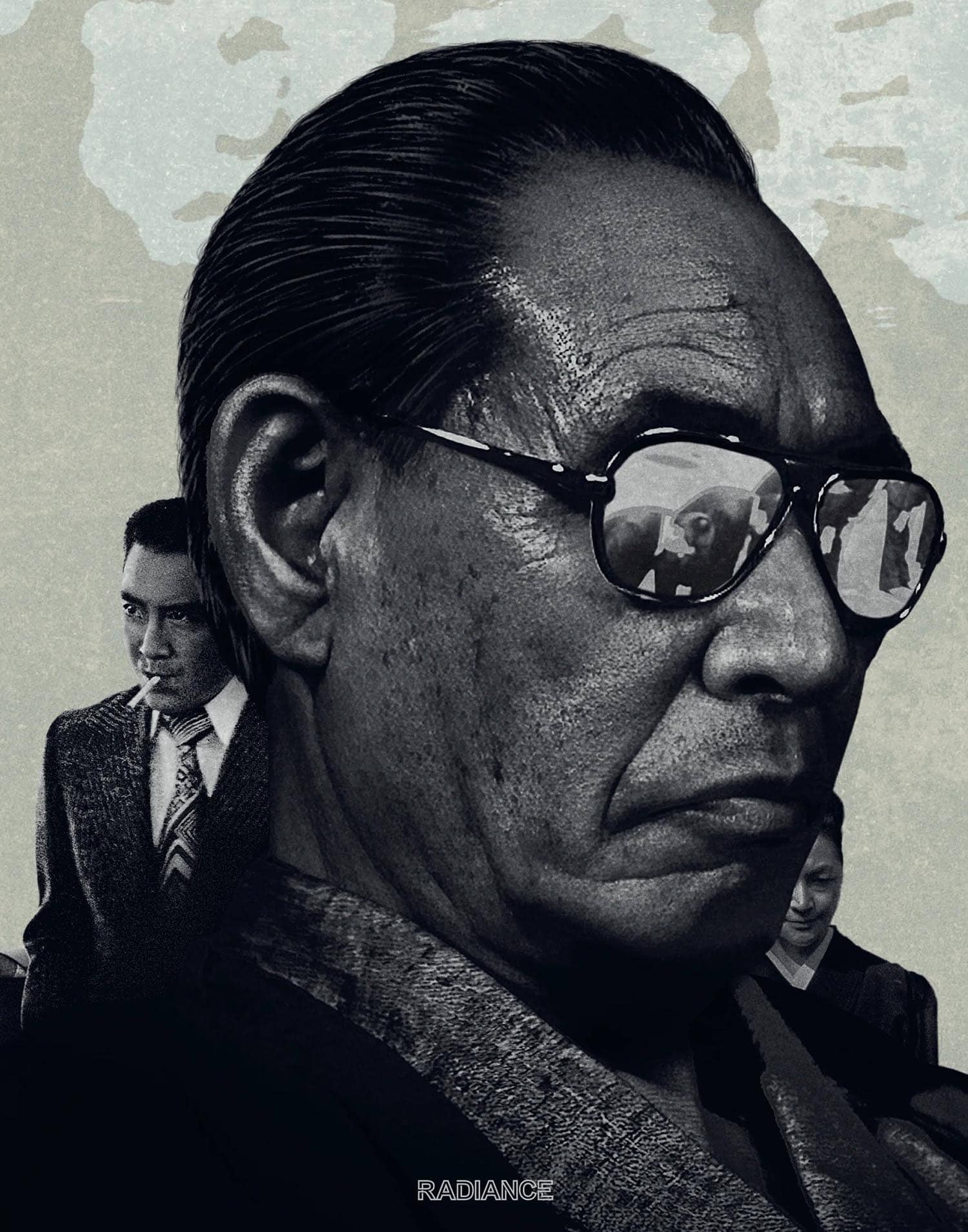
 If Fukasaku Kinji’s final yakuza film, 1977’s Hokuriku Proxy War, wasn’t the final nail in the coffin for the genre, the master director’s decision to make other types of films signaled both an exhaustion of the potential and waning audience interest in it. With the Japanese Godfather Trilogy, Nakajima Sadao breathed some new life into the yakuza film, even if it soon went into hibernation until a resurgence of popularity in the 1990s thanks to filmmakers like Miike Takashi.
Nakajima didn’t exactly reinvent the wheel with his approach to the genre, as he and screenwriter Takada Kōji were largely influenced by The Godfather. The filmmakers even included a scene where a man discovers his decapitated wife in their bed, in the same shocking manner as John Marley’s Jack Woltz stumbles upon a horse’s head in Francis Ford Coppola’s classic. But in mirroring that earlier film’s more prismatic portrait of the mob underworld, 1977’s Japanese Godfather was more sprawling and expansive than most yakuza films that came before it.
Between its focus on grimy, street-level violence, the personal lives of its characters, and the ties between yakuza gangs and various political and financial worlds, Japanese Godfather is epic in both its narrative and thematic scope. Set between 1967 and 1970, the film centers on Saburi Shin’s Sakura, the head of the Nakajima family, who’s determined to transform his massive gang into a more legitimatized organization by keeping fingers in many pots.
Deftly looking at the micro and macro concerns of Sakura’s organization, including rival gangs, corrupt politicians, police crackdowns, and strategically arranged marriages, the film captures the yakuza in a state of rapid transformation alongside the quickly growing Japanese economy. While the violent impulses of the yakuza leadership are very much on display throughout, Japanese Godfather is equally focused on the nascent desire of the yakuza’s attempts to project a sense of respectability, upon which their financial interests begin to merge more seamlessly with those of the businessmen and politicians who hold the keys to the country’s future.
The film’s sequel from the same year, Japanese Godfather: Ambition, finds the Nakajima family and their new rivals, the Kanto Alliance, led by the ruthless Oichi (Mifune Toshiro), moving on from the types of scrappy, blood-shedding acts they committed in the first film. The new battlefield here is almost fully contained within the business world, with the influences of parent companies, shell corporations, and international dealings with China and Hong Kong serving as the driver of both income and power. Unsurprisingly, Ambition is considerably less physically violent than its predecessor, but the wounds still cut deep, even if they’re inflicted through fraud, shady alliances, and underhanded corporate alliances.

The final film in the trilogy, 1988’s aptly titled Conclusion, shifts focus to the booming tourism industry, with Nakajima again duking it out with the Kanto Alliance for control of development rights on the island of Saipan. As with Ambition, the battles here are fought primarily in boardrooms and restaurants, with the yakuza gangs, now larger and more powerful, all firmly connected to and protected by the political establishment and multinational corporations. The central narrative plays out similarly to that of the prior film, but the resounding sense of moral corruption and myriad betrayals lend Ambition a strikingly mournful and tragic tone.
Image/Sound
All three high-def transfers look great, featuring naturalistic colors and skin tones and even grain distribution throughout. The image is a tad soft overall, but there’s no signs of damage, detail is strong throughout, and there’s no ghosting or blurring even in the more chaotic action scenes shot with handheld cameras. On the audio front, the uncompressed mono soundtracks are solid, as the mixes are well-balanced and robust, particularly in their presentation of the louder shootout sequences and the idiosyncratic scores by Ibe Harumi and Mayuzumi Toshirō.
Extras
This set comes with a trio of compelling interviews, one on each disc. In a 2020 archival interview, director Nakajima Sadao discusses the trilogy and his working relationship with actor Tsuruta Koji, including their falling out over an earlier film and eventual reconciliation.
There’s also a new interview with screenwriter Takada Kōji, who talks about the influence of Francis Ford Coppola’s The Godfather on the trilogy and how he adapted many of that film’s themes and focuses to Japanese and yakuza culture. The final interview is with filmmaker Kumakiri Kazuyoshi, who fondly remembers his time taking Nakajima’s film and screenwriting classes and delves into the myriad ways the director influenced his work.
Lastly, the set comes with a 40-page booklet that includes a brief archival piece by cinematographer Masuda Toshio and two new essays by film historians Akihiko Ito and Tom Mes. The first essay contextualizes the trilogy within the history of the yakuza film, while the second discusses the many highly regarded actors who appear throughout the three films.
Overall
Nakajima Sadao’s The Japanese Godfather Trilogy broke new ground in the yakuza film just as the genre’s death knell was tolling loudly.
Since 2001, we've brought you uncompromising, candid takes on the world of film, music, television, video games, theater, and more. Independently owned and operated publications like Slant have been hit hard in recent years, but we’re committed to keeping our content free and accessible—meaning no paywalls or fees.
If you like what we do, please consider subscribing to our Patreon or making a donation.

There’s a typo in the first paragraph: “the its potential.” My assumption is that there was uncertainty about which to use, and both were inadvertently included.