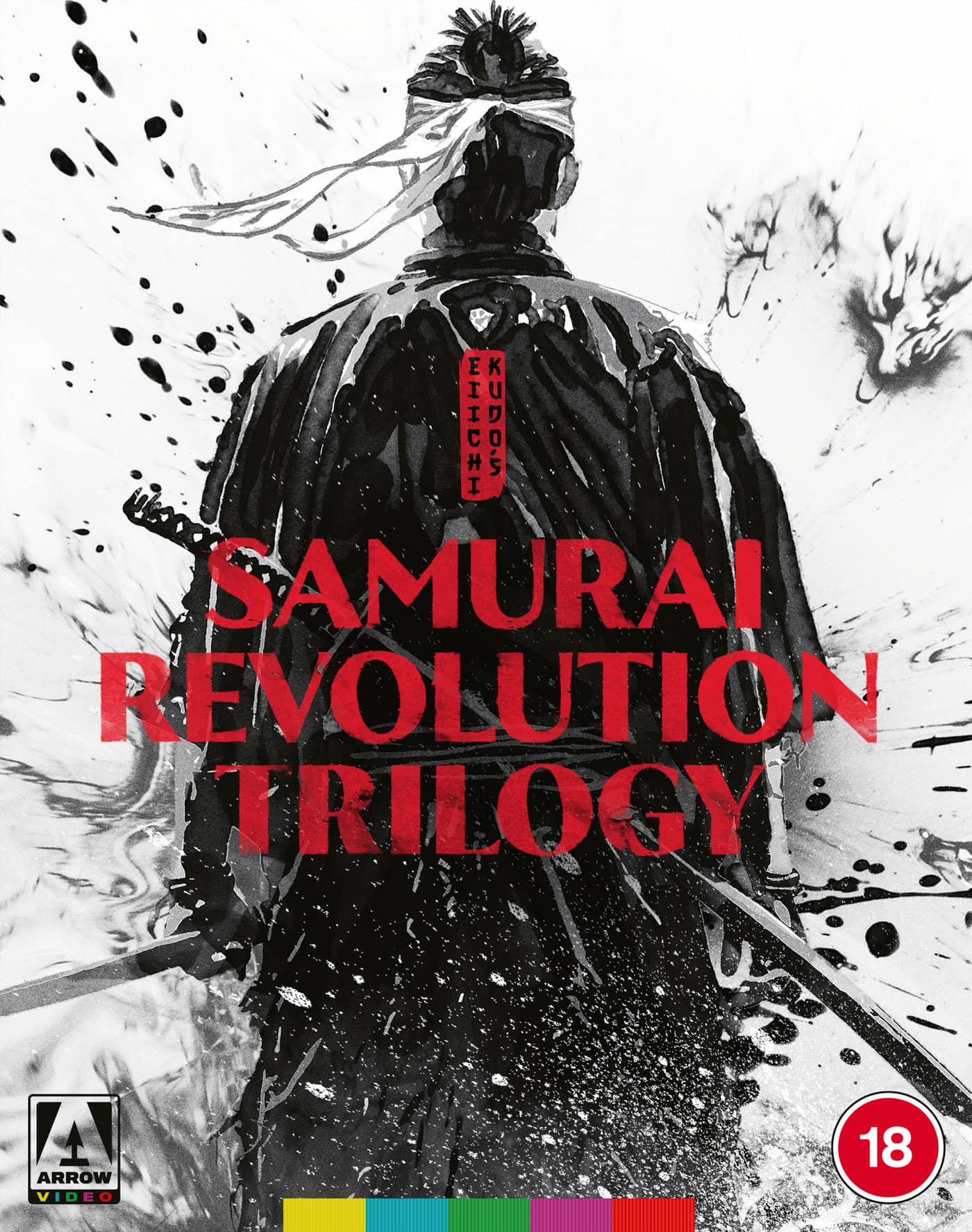
 Released between 1963 and 1967, and each based on true events, the three films in Kudō Eiichi’s Samurai Revolution Trilogy follow honorable samurai on missions to assassinate corrupt lords and political leaders. As political tides shifted in Japan during the late 1950s and early ’60s, the country began to re-examine its feudal and imperial past, and Kudō’s trilogy uses the framework of the chanbara (or sword-fighting) film as a springboard to explore the cruelty and unscrupulousness of Japan’s political systems.
The first of these films, 13 Assassins, plays out as a grand chess match between aging samurai Shimada Shinzaemon (Kataoka Chiezō) and his oldest friend, Hanbei (Uchida Ryōhei), the guard of a sadistic lord, Naritsugu (Kantarō Suga), who’s the potential heir to the current shogun. What initially begins as a getting-the-squad-together story, and with Shimada serving as captain, becomes something thornier and more politically charged as the assassins, hired in secrecy, take to the road, attempting to trap Naritsugu during his lengthy trek back to his home province.
For some 90 minutes, 13 Assassins focuses on the meticulousness with which Shimada strategizes to give his crew an advantage over Hanbei and the small army that guards Naritsugu. Then, once the assassins trap their target, the film rushes into a battle sequence for the ages. Lasting a full half-hour, the sequence clearly inspired Miike Takashi to want to remake the film as a ballet of bloodshed, which isn’t to say that Kudō’s staging of the village battle is any less thrilling. In fact, the extended action sequence more effectively serves as a release of tension that’s built up throughout the film than it does in Miike’s remake.
Where 13 Assassins follows a long, carefully coordinated attack on a single, evil lord, its follow-up, 1964’s The Great Killing, features a much broader, populist rebellion against the shogunate following its purge of revolting peasants and samurai during a famine. It also depicts the violence and corruption as rampant throughout the Tokugawa regime, while its samurai range from being stoic and honorable to cowardly and selfish, even refusing to aid their fellow revolutionaries. As such, The Great Killing expands on the first film’s critique of the shogunate, while also presenting samurai in a harsher, yet more historically accurate, light.
The Great Killing is a cynical film, but while it lays bare the ruthless barbarity of the Tokugawa shogunate, it also pays tribute to the samurai who plot the demise of their enemies, and without diluting the moral and ethical quandaries they face along the way. Like 13 Assassins, it ends with a long, masterfully executed battle sequence, but because its combatants are more fully rounded and fleshed out as individuals, its emotional crescendos are even more affecting.
Eleven Samurai, from 1967, follows a similar narrative course as 13 Assassins. The inciting incident, in which Nariatsu (Suga Kantarō), the shogun’s younger brother, crosses over into a neighboring territory during a hunt and needlessly kills the lord who confronts him, sets him up as a truly despicable villain. Yet, the shogunate’s decision to not only back Nariatsu but order the dissolution of the Oshi clan for accusing him of murder spreads the blame to the entire government, exposing the depth of corruption in the political establishment and how far political elites will go to protect anyone within their sphere of influence.
As with the previous films in the trilogy, Eleven Samurai follows samurai on a quest for revenge. But it differentiates itself in its samurais’ struggles between doing what they see as honorable and doing what’s best for the clan they represent. The tension traced between the titular samurai and the shogunate is exacerbated by the crazy lengths the latter goes to punish, and even kill, those who potentially threaten its reign. This all builds to the type of epic showdown this trilogy excels at, here featuring a particularly brutal battle in the rain. At one point, one samurai remarks, “We must put an end to this insane world,” and given the rivers of blood that flow during the film’s climax, our samurai may have done just that.
Image/Sound
The high-def presentation of all three films is spectacular, with only the occasional noticeable but forgivable speck of damage. Contrast ratio is strong, allowing for stellar black levels during nighttime sequences, while image sharpness and depth is fantastic across the board. Natural backdrops in the many wide static shots look amazing, while the rapid movements and visual chaos of the battle sequences show no sign of motion blurring. Meanwhile, grain is evenly presented throughout, giving each transfer a pleasing celluloid-like texture. As for the audio, the lossless mono tracks are well-balanced, with the dialogue, background noises, and battle sound effects remaining clear and strongly separated throughout.
Extras
Each film comes on its own Blu-ray disc and with a newly recorded audio commentary. For 13 Assassins, critic and Japanese cinema expert Tom Mes discusses how the film broke from Toei’s conventions and delves into the studio’s history, as well as Kudo’s career. For The Great Killing, critic David West discusses the film’s historical origins, the jidaigeki genre, and Kudo’s visual style. West also provides a commentary for Eleven Samurai, with a particular focus on the Tokugawa era in which the films are set and the trilogy’s antiauthoritarian spirit.
A fascinating 80-minute archival interview with Eiichi Kudo’s former assistant director Misao Arai and filmmaker Dirty Kudo is split up across the three discs. The duo talk about the hierarchy at Toei, the influence of director Tomu Uchida on Kudo, the seismic changes in the Japanese film industry throughout the 1960s, and more. Each film is also supplemented with a video essay: Music supervisor James Balmont’s focuses on Ifukube Akira’s 13 Assassins score, critic Miyao Daisuke’s covers The Great Killing’s cinematography and set design, and critic Jonathan Clements touches on Eleven Samurai’s themes and the brutal Tokugawa regime.
Finally, we get a pair of archival interviews with Kudo’s former assistant and brother-in-law Ito Masaaki, who talks about what it was like to work with the director, and filmmaker/programmer Fabrice Arduini, who makes a strong case for Kudo’s greatness as a studio craftsman along the likes of Kato Tai and Misumi Kenji. The films come housed in a sturdy cardboard box with a slipcover and a lovely illustrated booklet with new essays by Chris D., Earl Jackson, and Alain Silver that offer strong aesthetic analysis and historical context for each film.
Overall
Kudō Eiichi’s urgent and relevant films about shamelessly corrupt men in power getting their comeuppance get spiffy new transfers and fascinatingly contextualizing extras from Arrow.
Since 2001, we've brought you uncompromising, candid takes on the world of film, music, television, video games, theater, and more. Independently owned and operated publications like Slant have been hit hard in recent years, but we’re committed to keeping our content free and accessible—meaning no paywalls or fees.
If you like what we do, please consider subscribing to our Patreon or making a donation.