
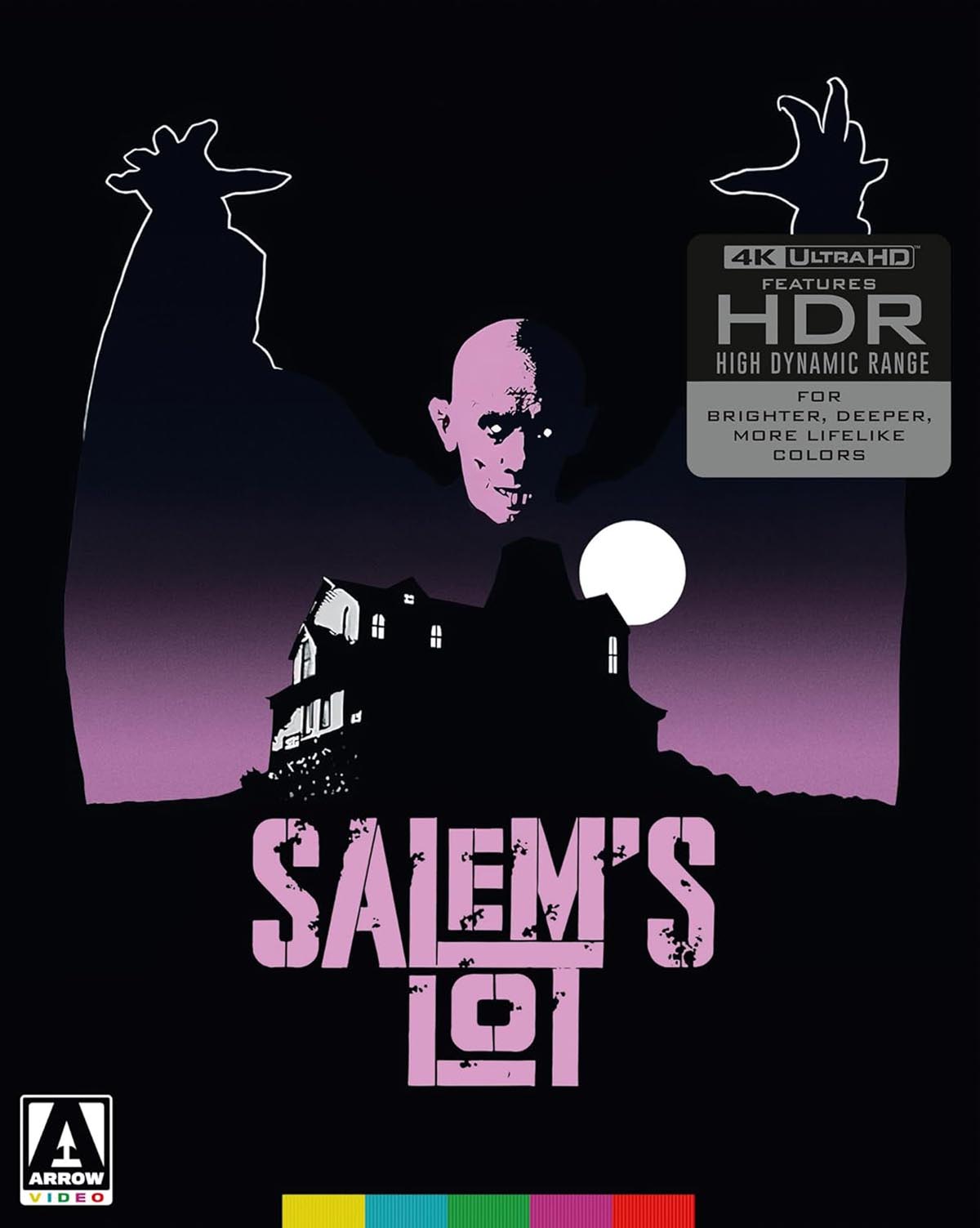
 The high-concept pitch for Salem’s Lot could be “Dracula invades Peyton Place.” Stephen King’s primary impetus for writing the book was to update Bram Stoker’s Dracula and set it in a recognizable working-class New England milieu, whose seedy underbelly (of the sort that Grace Metalious’s 1956 novel Peyton Place revels in) would be revealed in the course of the vampiric onslaught. What’s more, Salem’s Lot’s scriptwriter Paul Monash had been the showrunner for the series adaptation of Metalious’s novel that ran from 1964 to 1969.
Ben Mears (David Soul) returns to his hometown to write a novel about the uncanny Marsten House that overlooks the town in much the same way that the Bates home overlooks the motel in Alfred Hitchcock’s Psycho, and served as the source of Ben’s childhood trauma. He soon begins a romance with Susan Norton (Bonnie Bedelia), who has been forced to return home after making an unsuccessful go of it in the big city, and so chafes under the constraints of small-town life. Susan thus serves as the embodiment of the sort of second-wave feminism often explored in 1970s television movies, which were largely geared toward a female audience.
The other main characters in Salem’s Lot are also more or less outsiders. Possibly gay schoolteacher Jason Burke (Lew Ayres) lives alone in a large house, and horror film buff Mark Petrie (Lance Kerwin) spends his time building Aurora monster model kits and collecting Don Post masks. Ironically, it’s these folks—with their imaginative capacity to escape the bounds of provincial small-town folkways—who end up being the heroes of the story. The rest of the cast is rounded out by a staple of seasoned veterans of the small screen and some old-school Hollywood stars like Ayers, particularly Marie Windsor and Elisha Cook Jr. playing an oddball married couple in an explicit nod to Stanley Kubrick’s The Killing.
Salem’s Lot is rich in sociopolitical subtext. Written by King in the era of Watergate-spawned distrust of government, white flight, and soaring gas prices threatening economic stability, the story chronicles the breakdown of authority in Jerusalem’s Lot, Maine. The arrival of upper-class-coded antique-store proprietor Straker (James Mason) and his unseen vampire partner, Barlow (Reggie Nalder), signals the sort of incipient gentrification that began in the 1970s. And as the shit increasingly hits the fan when the vampiric epidemic spreads unchecked, the only representative of the medical profession we even see, Dr. Bill Norton (Ed Flanders), proves only moderately effective. Even less can be said for lawman Gillespie (Ken McMillan), who flees town with his tail tucked between his legs rather than stand and fight, and Father Callahan (James Gallery), whose own lack of faith proves disadvantageous in his encounter with Barlow.
The story cannily contrasts two orders of violence: domestic and vampiric. On the one hand, there’s shotgun-wielding Cully Sawyer (George Dzundza), whose symbolic revenge against cuckolding Larry Crockett (Fred Willard) is compounded by the all too literal abuse of his wife, Bonnie (Julie Cobb). This triangle in mirrored in the relationship between Ben and Susan, where third-wheel Ned Tebbets (Barney McFadden) lashes out against Ben in a violent assault. On the other hand, and more disturbingly, the miniseries chronicles horrific violence against children, with the first two vampire victims being the Glick brothers, Ronnie (Ronnie Scribner) and Danny (Brad Savage), the former of whom is offered up as an actual sacrifice to Barlow wrapped in plastic like Laura Palmer before vampirizing his own brother.
The idea that vampires desire to predate their loved ones isn’t as explicit in Salem’s Lot as it is in “The Wurdulak” segment of Mario Bava’s Black Sabbath, but it’s there in the Glick family—brother victimizing brother, then son vampirizing mother—and perhaps in the way Mike Ryerson (Geoffrey Lewis) returns to taunt Jason Burke by hissing, “Look at me, teacher…” This theme culminates in the epilogue when Susan tracks down Ben in Guatemala. Looking absolutely gorgeous (unlike her more buttoned-down appearance earlier), she tries to seduce Ben into life as the undead, only for Ben to make another sort of point altogether. The staging and David Soul’s anguished performance render the scene as outright tragedy.
Producer Richard Kobritz brought Tobe Hooper on board to adjust his considerable cinematic daring for the small screen. Charged with mood and suggestion, Hooper’s profoundly disturbing The Texas Chainsaw Massacre contains practically no bloodshed. Such is the case here as well, from the eerie floating vampire kids to the sickly green, detritus strewn interior of the Marsten House. Hooper and cinematographer Jules Brenner keep the camera constantly in motion, indulging in sinuous tracking movements and a couple of dizzily impressive crane shots.
Salem’s Lot is a masterclass in televisual terror. This is noteworthy, since the ’70s was a decade rife with TV horror movies and series, particularly ones that featured vampires, from Dan Curtis’s The Night Stalker to the Steven Bochco-written Vampire, which aired the month before Salem’s Lot premiered. But by dint of cinematic style and clever storytelling, Hooper’s miniseries remains one of the absolute pinnacles of TV horror movies.
Image/Sound
Arrow Video offers Salem’s Lot in two versions: the three-hour miniseries and the two-hour theatrical cut. Both are presented in 2160p UHD on separate discs. As a result of the HDR grading and Dolby Vision, the transfers look absolutely phenomenal, blowing the 2016 Warner Bros. Blu-ray out of the water, with a really significant uptick in the clarity of fine details like the interior décor of the Marsten House, which plays a sizeable role in the final act of the miniseries. Grain levels are impeccably maintained, the profound black levels suffer from no perceivable signs of crush, and colors really pop. Audio comes in Master Audio in the original single-channel mono mix that foregrounds the dialogue and really puts across Harry Sukman’s eerie score, its screeching strings strongly reminiscent of Bernard Herrmann’s score for Psycho.
Extras
Arrows puts together a truly impressive roster of bonus materials for this package. Slipped into the hard case along with the Blu-ray keep case (with reversible cover) are a double-sided foldout poster with both new artwork and cool Italian poster art, and a perfect-bound book with new essays on the miniseries and archival interviews with Hooper and some of the cast.
The miniseries version can be viewed either in one unbroken chunk or broken up into the original two parts, complete with extras credits and a short recap that starts the second part. The extras on the first part are limited to two commentary tracks, alternate footage of the notorious antler scene, and a shooting script gallery. The archival commentary features director Tobe Hooper covering every aspect of his involvement in the making of Salem’s Lot. On their new commentary, podcast host Bill Ackerman and author Amanda Reyes fill the entire three hours with a wealth of information about the telefilm’s original broadcast and ratings, place within the history of horror telefilms, what Hooper brings to bear on the production, and the “incestuous” history of the cast in other TV shows and films.
The second disc contains an enthusiastic commentary on the theatrical version by critic Chris Alexander, as well as the rest of the on-camera interviews and visual essays. Stephen King biographer Douglas Winter discusses the author’s writing habits and assesses Hooper and Monash’s adaptation; author Grady Hendrix talks about the horror literature boom of the late ’60s and early ’70s that King was instrumental in popularizing; and filmmaker Mick Garris discusses King as a friend and compatriot. Elsewhere, a short locations featurette shows just how little the town of Ferndale, California, where the exteriors were shot, has changed, while critic Heather Wixson discusses the relatability of the telefilm’s heroes and critics Joe Lipsett and Trace Thurman lay out the story’s sociopolitical and sexual themes.
Overall
A masterclass in televisual terror, Tobe Hooper’s Salem’s Lot explores the moral and social breakdown of the sort of small town that would’ve given Norman Rockwell wet dreams.
Since 2001, we've brought you uncompromising, candid takes on the world of film, music, television, video games, theater, and more. Independently owned and operated publications like Slant have been hit hard in recent years, but we’re committed to keeping our content free and accessible—meaning no paywalls or fees.
If you like what we do, please consider subscribing to our Patreon or making a donation.





I’m sold!
Great article! I can’t wait for the Blu-ray! I will say that this piece of information isn’t quite accurate: “Father Callahan (James Gallery), whose own lack of faith proves fatal in his encounter with Barlow”. Father Callahan actually lives and shows up in The Dark Tower series.