
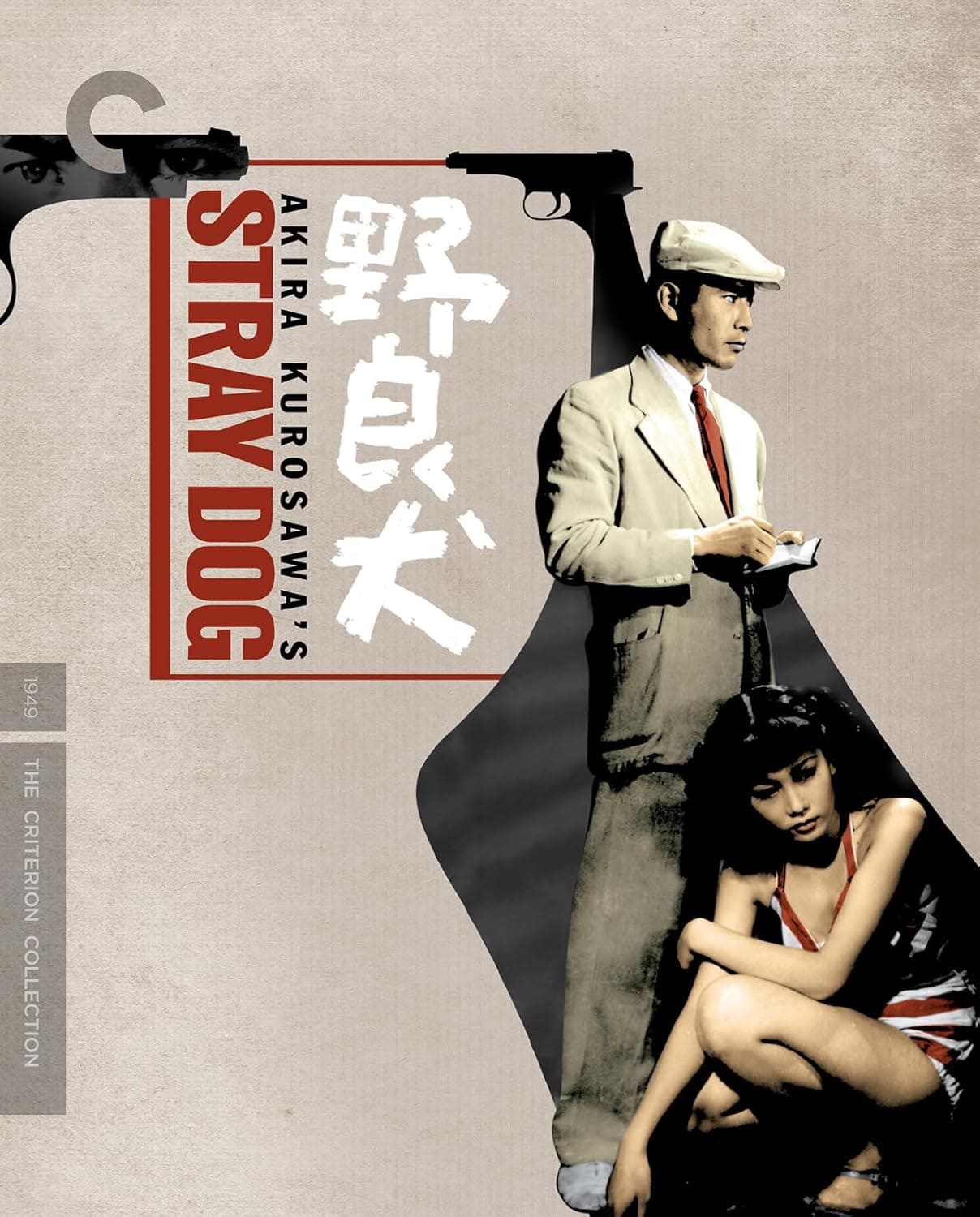
 Kurosawa Akira’s Drunken Angel, from 1948, was the first of his movies to really challenge the strictures of censorship by both state and occupying American authorities. It was also, perhaps uncoincidentally, his first collaboration with actor Mifune Toshiro. That film’s bleak film noir trappings are expanded in the following year’s Stray Dog, in which Mifune plays a green detective named Murakami whose service weapon is stolen by a pickpocket, potentially making him professionally liable for any crimes committed with the revolver.
It’s here, in his third collaboration with the director in two years, that Mifune introduces the character type he would spend the next decade perfecting with Kurosawa—that of the gravel-voiced alpha male whose intimidating bark and exaggerated show of confidence cannot quite mask the fragile insecurity just under the surface. As Murakami frantically scours the streets, his attempts to lean on lowlifes are constantly juxtaposed with his increasingly disheveled, worn-out appearance; after a certain point, some of the hoods he interviews are surprised to learn he’s a cop. Adding further insult to Murakami’s degradation is his supplicant behavior toward his superiors, all of whom express little to no concern about his missing gun and largely regard the detective’s efforts to retrieve it as an amusingly quixotic quest.
In a rare bit of superfluous exposition that would drop out of Kurosawa’s later work, opening narration informs us that the story occurs during a particularly hot day. But the film makes this obvious from the outset, with Asakazu Nakai’s deliberately blown-out cinematography conveying the punishing sunlight blazing down on Tokyo. Large damp patches appear on nearly all of the characters’ clothing, and the sheen of sweat makes people’s faces as reflective as the surface of a pond. Kurosawa also places a great many fans in his frames throughout the movie, their waving an early example of a future trademark of the auteur’s in using ambient motion as a contrast with the movement of people to compound the dynamism of shots.
Compared to some of Kurosawa’s other films from this time, Stray Dog is less concerned with an explicitly view of Japan’s postwar malaise. Nonetheless, the ambient stasis created by the sweltering heat tacitly emphasizes an immobility that defined the first few years of postwar life in Japan as its people adjusted to a new normal before the nation pulled off its economic miracle of the ’50s and ’60s. Only Murakami moves with any urgency in the film, and solely to save face in the eyes of an authority that itself has been rendered listless and impotent by occupation.
Image/Sound
Criterion previously issued Stray Dog on DVD in 2004, and the label’s new UHD transfer, sourced from a new 4K restoration, dramatically improves on the presentation on that 22-year-old disc. Gone are the many instances of print damage and debris and occasionally washed-out imagery; the film’s over-lit cinematography can now be fully appreciated with no loss of detail in exterior shots. Stable contrast reveals subtler tones of white and gray, and the occasional, expressionistically shadowed shot suffers from no crushing of black levels. Even the glimmer of sweat on characters’ faces refracts light with added sparkle. The lossless audio also gets a significant upgrade from the earlier disc, cleaning up moments of tinniness and hiss so that everything from dialogue to street noise sounds crisp.
Extras
Criterion ports over the extras from its 2004 DVD, including film scholar Stephen Prince’s commentary track. Prince offers a film school-worthy exegesis of the film’s themes and visual schema, and places it in the context of Kurosawa Akira’s career arc. Also included is a segment from the documentary Akira Kurosawa: It Is Wonderful to Create that focuses on the making of Stray Dog, featuring interviews with Kurosawa and members of the cast and crew, who reminisce about the shoot and the film’s subtle social commentary. An accompanying booklet contains an essay by critic Terrence Rafferty that highlights the film’s unorthodox approach to detective tropes and its use of documentary footage (by Kurosawa’s assistant director and future kaiju cinema titan Honda Ishiro) to ground the material in Tokyo’s contemporary ills.
Overall
Kurosawa Akira’s early 1949 triumph looks better than ever on Criterion’s UHD release.
Since 2001, we've brought you uncompromising, candid takes on the world of film, music, television, video games, theater, and more. Independently owned and operated publications like Slant have been hit hard in recent years, but we’re committed to keeping our content free and accessible—meaning no paywalls or fees.
If you like what we do, please consider subscribing to our Patreon or making a donation.



The article says “Stray Angel” instead of “Stray Dog” in several places.