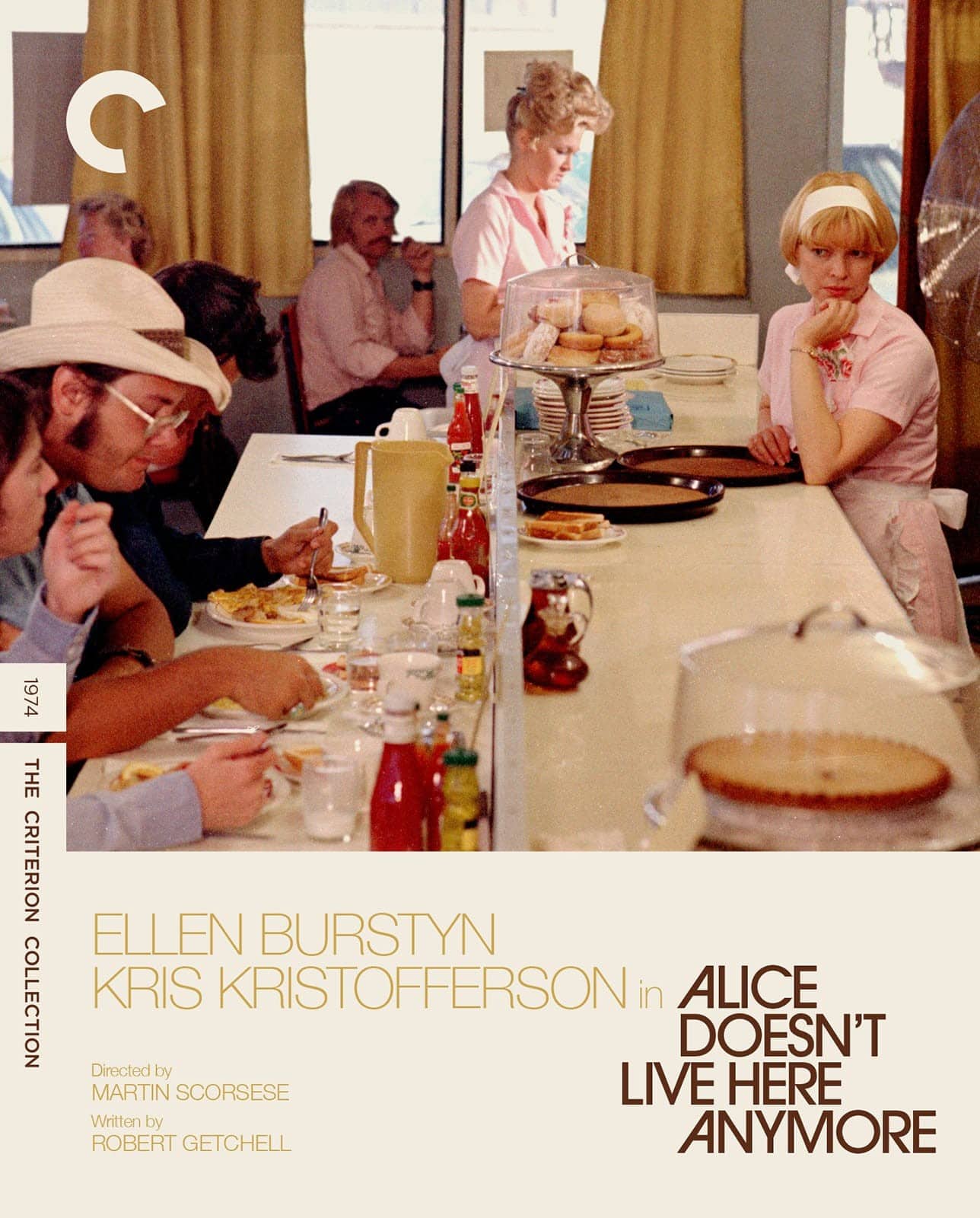
 Few could have expected Martin Scorsese to follow up his breakthrough third feature, Mean Streets, with a feminist-minded romantic comedy that marked his first movie made entirely under the aegis of a major studio. But it’s a testament to star Ellen Burstyn’s far-sightedness that she specifically sought him out to bring his raw energy to a seemingly incompatible project. The film is often overlooked in the director’s oeuvre, but it marks an early showcase of how stylistically protean and conceptually open-minded the young cineaste really was.
Compared to, say, Peter Bogdanovich’s What’s Up, Doc?, a love letter to Looney Tunes and Howard Hawks’s screwball comedies, Alice Doesn’t Live Here Anymore gets Scorsese’s cinephilia out of the way in a prologue in which Alice’s (Burstyn) childhood is rendered as a punkish parody of The Wizard of Oz’s early scenes. From there, the film cuts to Alice in the present, and in seconds conveys everything about the misery of her life through Scorsese’s oppressive depiction of the character’s home and the nervousness she exudes around her slovenly husband (Billy Bush).
Donald soon dies in a traffic accident, and after pausing for a brief cry that feels at once honest and performative, Alice’s posture shifts, as if a great weight has been lifted off her. Seeing a chance to fulfill her dream of becoming a singer, Alice sells off her meager possessions, loads son Tommy (Alfred Lutter) into the car, and sets off for Monterey, California, ultimately stalling out in Arizona for lack of funds. From here, the film morphs from a kitchen-sink marital drama into a comedy that runs less on exaggerations of gesture or expression than on the subtle shades of exasperation with which Burstyn imbues Alice as she deals with everything from the prepubescent Tommy’s nettling to the difficulties of launching a new career as a woman over 30.
Working with editor Marcia Lucas, Scorsese times cuts on Alice’s flashes of irritation around those who try her, and so they come to feel like punctuation marks. She always has the perfect response to Tommy’s whining and the men who leer at her, and Burstyn’s comic timing is a marvel. When Alice, prior to settling in Phoenix and getting a job as a waitresss at Mel’s (Vic Tayback) diner, stops into a dingy bar to audition as a singer, and one of the proprietors asks her to turn around to take a full look at her, she blurts out, less shocked or angry than honestly bewildered, “Well, look at my face, I don’t sing with my ass.”
Occasionally, Alice Doesn’t Live Here Anymore reminds you that the man who made Mean Streets is behind the camera. An early dalliance between Alice and a charming local, Ben (Harvey Keitel), comes to a sudden and harrowing end when the man’s wife, Rita (Lane Bradbury), confronts Alice at her home. Already blindsided by the revelation that Ben is married, Alice is further horrified when he breaks into her home to beat his spouse for ratting him out. It’s a harrowing scene that upends the gentle comedy of the film to that point, a blunt reminder of the patriarchal control that Alice herself is only beginning to escape.
Even the later, more resonant romance with diner patron David (Kris Kristofferson) checks its bubbly romance with moments of intense doubt from both adults as they struggle to overcome their anxieties of recommitment at their age. And when David succumbs to Tommy’s regular teasing and spanks the child, the drifting camerawork of the film abruptly turns into jittery, handheld motion that makes a relatively mild spanking feel like a violent thrashing.
Comparably, the film’s climactic reconciliation approaches rom-com tropes with remarkable understatement. In front of Mel’s patrons, David comes back to Alice contrite and confesses his love for her. It’s the kind of scene that’s usually played as a grand romantic gesture. Here, though, David delivers this address in a calm tone, stressing the rationality of his feelings, and Alice’s gentle acceptance of his apology suggests that both have soberly weighed the likelihood of finding another person at their age who makes them as happy as the other does.
Image/Sound
Kent L. Wakeford’s cinematography has the gauzy look of much American cinema from the early 1970s, and the 4K digital restoration brings out all the dreamy beauty of the film’s frames. Exteriors under the Southwestern sun are bright but never washed out or unbalanced, while interior shots, so abundant in vintage ’70s textures, are especially marvels of detail. The mono soundtrack carefully balances its various elements, keeping the dialogue clear when it’s overlapped by background conversations in Mel’s diner.
Extras
Criterion’s release comes with an archival commentary featuring director Martin Scorsese and actors Ellen Burstyn, Jodie Foster, Kris Kristofferson, Diane Ladd, and Alfred Lutter. Scorsese and Burstyn impart the most information about the production and ushering it from script to screen, while Lutter, who stopped acting only a few years later and grew up to be an engineer, is eloquent in discussing some of the shot choices and what they convey about the characters.
The disc also comes with an interview conducted by critic Farran Smith Nehme with Burstyn, who discusses the social and personal contexts that shaped Alice Doesn’t Live Here Anymore and her performance, as well as her own formative influences. In a separate interview with Marcia Lucas conducted shortly before her death in May, the Oscar-winning editor provides an overview of her career working with George Lucas, Scorsese, and Haskell Wexler, among others. Lucas is modest in recalling how she thought Scorsese wanted to work with her mainly because he was friends with her and George, but her talk of learning to intuit the small, mercurial details of an actor’s body language or a small bit of camera movement to know when to cut testifies to the skill that makes films like this and the original Star Wars so propulsive.
A 20-minute making-of documentary from 2003, titled “Second Chances,” sees Burstyn and Kristofferson reminiscing about the making of Alice Doesn’t Live Here Anymore. Finally, a booklet essay by film critic Stephanie Zacharek highlights the film’s subtle brilliance in appealing to more than just the the women energized by the feminist movement.
Overall
Martin Scorsese’s understated, hilarious fourth feature sits in the shadow of his more revered works, and Criterion’s release seeks to position it as a classic in its own right.
Since 2001, we've brought you uncompromising, candid takes on the world of film, music, television, video games, theater, and more. Independently owned and operated publications like Slant have been hit hard in recent years, but we’re committed to keeping our content free and accessible—meaning no paywalls or fees.
If you like what we do, please consider subscribing to our Patreon or making a donation.