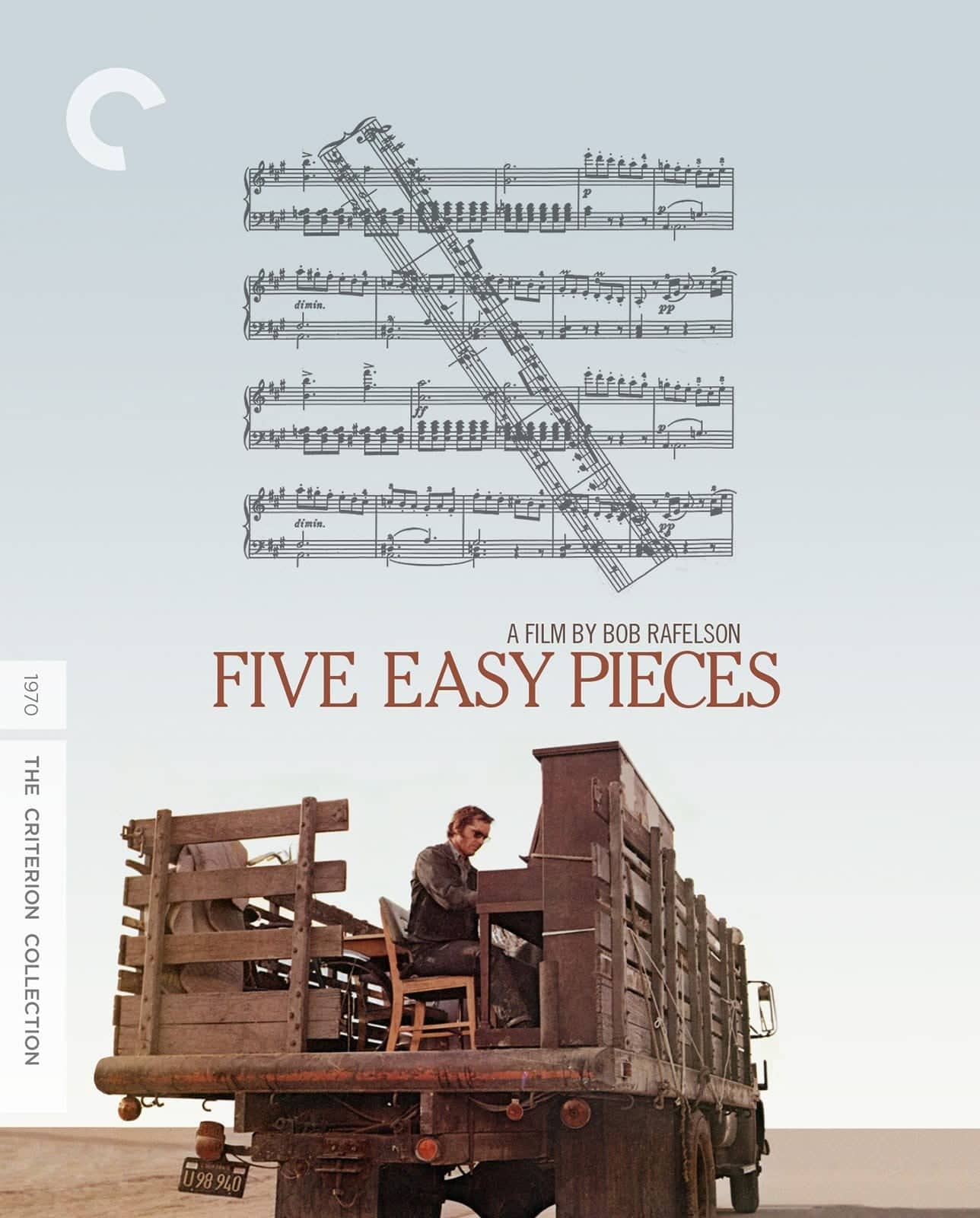
 Jack Nicholson’s performance as Robert Eroica Dupea in Bob Rafelson’s 1970 road drama Five Easy Pieces is a marvel of carefully released physical energy. The actor can push himself out of a chair or roll a bowling ball contemptuously down a lane and tell you more about his character than many performers could with pages of motivational dialogue. Indeed, you can’t take your eyes off of Nicholson in this film: He suggests an ambulatory shard of copper wire running around emitting sparks, or an emotional painter, his primary hue of choice being anger.
No one projects rage like Nicholson does in the phenomenal run of projects that punctuate his career from the late 1960s (starting with Dennis Hopper’s Easy Rider) to 1980 (ending with Stanley Kubrick’s The Shining). Nicholson understands a fundamental truth about angry white American men: that they’re often rightly or wrongly regarded as clowns, by themselves and by everyone else, and so their fury is inadvertently funny, which makes the men even madder, fueling an emotional perpetual motion machine that leaves them trapped in themselves. Nicholson’s gift, reminiscent of Humphrey Bogart’s, is that he can dramatize both the humor and the horror of such a situation without diluting the force or pathos of either.
Robert is perhaps the most annoying kind of angry male: the guy with a privileged background and exceptional talents (as a classical pianist, in his case) doing his impression of the working-class hero—an archetype that he fetishizes and despises, with particular emphasis on the latter. Yet Nicholson finds the sadness and vitality that’s at the center of Robert’s torment. Written by Carole Eastman, Five Easy Pieces is composed of a series of loose, scruffy, funny, despairing sketches that pivot on the ludicrousness of the actor as a regular Joe—a contrivance that establishes Robert as an interloper into a life that doesn’t fit him, which he turns to out of a sense of spite that’s revealed to mask deep reservoirs of guilt and loneliness.
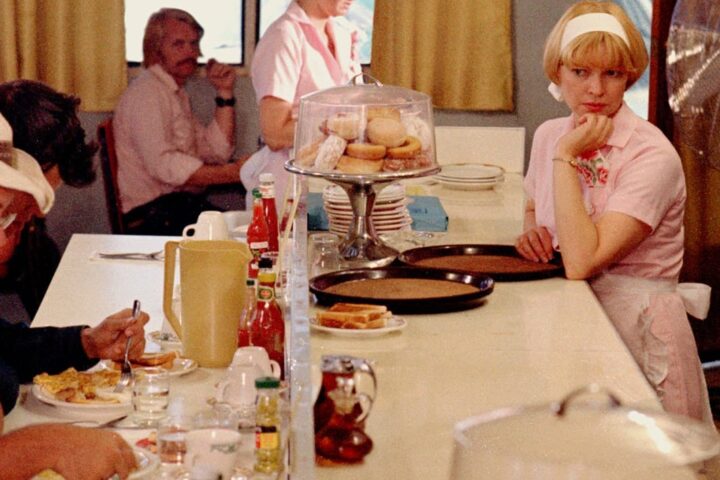
The actor’s iconic stature wasn’t quite cemented yet, but he’s obviously special, an “other” who doesn’t mesh with the extras who populate the settings as found objects, serving as testaments to the pop-cultural textures of 1970s America. This friction, between Nicholson’s blossoming stardom and the evocative ordinariness of the rest of the movie, is most famously embodied by the scene in the café when Robert demands toast by ordering a chicken salad sandwich without the chicken salad, but there are dozens of other anecdotes as amusing or telling. When two women come on to Robert at a bowling alley, he says their names, Betty and Twinky, with a prodigiously subtle mixture of disbelief, self-amusement, and anticipatory glee that would justify the film’s existence even if there were nothing else to it.
Of course, there’s quite a bit more to Five Easy Pieces: It’s a haunting, influential film that helped, along with Easy Rider, to set the obsessive, unresolved, idiosyncratic tone for the ’70s American New Wave and the indie film movements of the ’80s, ’90s, and 2000s that would follow it. Rafelson directs in an exploratory manner that naturally syncs up with Nicholson’s intuitive performance, his formalism suggesting a fusion of vérité and expressionism. Tonally, the film is all over the place, swerving from droll comedy to melodramatic tragedy and back, sometimes within a matter of seconds, and that’s to its credit. Watching Five Easy Pieces, you feel that anything can happen, sharing Robert’s feelings of instability.
The opening, in particular, is rich in tense, beautiful landscape shots of the California oil rigs where Robert works, which are ironic in this context for two reasons: The rigs represent plunder of the very nature that Rafelson’s allowing us to appreciate, and Robert is resolutely blind to the western gorgeousness he’s witnessing and defiling. Rafelson more or less prevents the film from fully embracing Robert’s disillusionment by allowing the audience to see and understand things beyond the protagonist’s depressed, distressingly narrow perimeter. But the filmmaker also verges on making sport of the people that Robert disdains, portraying the prototypical oil rigger’s life to be a cramped, hypocritical arrangement of braying children, nagging wives, ugly couches, and cheap, cold beer, with an occasionally merciless lack of grace notes.
Yet Rafelson keeps producing surprises, such as the best scene, when Robert climbs on the back of a truck in the middle of a traffic jam to play Chopin’s “Fantasy in F minor,” one of the “five easy pieces” of the title, which alludes to Robert’s uneasy relationship with his classical music tutelage. It’s a wonderful juxtaposition of the awful (the blaring car horns, redolent of Jean-Luc Godard’s Weekend) and the transcendent (Robert’s unexpected homage to his rarefied roots) that produces a heightened approximation of the intersection between our dreams and reality.

The film has aged remarkably well, as its expression of ’70s ennui unmistakably resembles the feelings of rootlessness that are seizing this country as it drifts further and further into a culture of corporatized sameness. The difference is that we might not even be permitted to enjoy the large expanses of American openness that Robert infuriatingly accepts as a given. Robert’s escape at the end of the film, merely the latest of many for him, is intended by Rafelson as a sign of damnation. But at least that option’s available to Robert. Now, the phrase “off the grid” boasts essentially mythological connotations in our phone-surveillance society, and our contemporary American New Wave is grappling with the dramatization of that trap, usually by retreating pointedly into the past, looking to films like Five Easy Pieces for guidance.
Image/Sound
The transfer of a new 4K digital restoration is gorgeous. Most astonishingly, there’s the spruced up beauty of the opening scenes in the oil fields, which have a wide, pristine majesty that’s reminiscent of western epics like Giant. The cleanness of the image emphasizes the bold through lines that cinematographer László Kovács fashions, which he contrasts with the expressive grubbiness of the images of bowling alleys and trailers. This transfer has big colors that nearly suggest Technicolor (at one point Jack Nicholson wears an impossibly red jacket that recalls James Dean’s in Rebel Without a Cause), and textures are hyper-specifically tactile.
The soundtrack is no less impressive. The sounds of the oil fields are appropriately rich and bass-y, suggesting a huge, sleeping animal, while diegetic effects subtly affirm Robert’s loneliness throughout the film. Minute aural grace notes, such as the scratching of a record that’s hastily shut off, complete the film’s heightened internal vision of external Americana.
Extras
All of the extras here originated on Criterion’s box set America Lost and Found: The BBS Story, released in 2009. The documentaries are rich in interviews that paint an evocative portrait of the BBS production company as existing at the forefront of the radically more democratic American cinema that arose in the ’60s as a reaction to the bloated, apolitical studio product that glutted cinemas. Rafelson is a particularly engaging interviewee, and he’s willing to extend credit for his company’s success to a variety of collaborators, quietly refuting the mythologies of the auteur theory. “Soul Searching for Five Easy Pieces,” “BBStory,” and a documentary from 2009 featuring critic David Thompson and historian Douglas Brinkley complimentarily cover the studio’s ascension and could’ve been folded into one feature, but that’s a minor quibble.
A more significant disappointment is the vague coverage that these supplements accord to the company’s decline, which is equally fascinating, if less inspiring, material. Rafelson’s commentary with ex-wife and interior designer Toby Rafelson is rich in telling anecdotes as well, though one wishes the two had been recorded at the same time in the same room with one another. Trailers, audio excerpts from a 1976 interview with Rafelson, and an essay by Kent Jones round out a solid package that, no doubt, would have benefited from new extras.
Overall
Five Easy Pieces has aged quite well, and the stunning new 4K digital restoration that it’s received has just extended its already robust shelf life.
Since 2001, we've brought you uncompromising, candid takes on the world of film, music, television, video games, theater, and more. Independently owned and operated publications like Slant have been hit hard in recent years, but we’re committed to keeping our content free and accessible—meaning no paywalls or fees.
If you like what we do, please consider subscribing to our Patreon or making a donation.