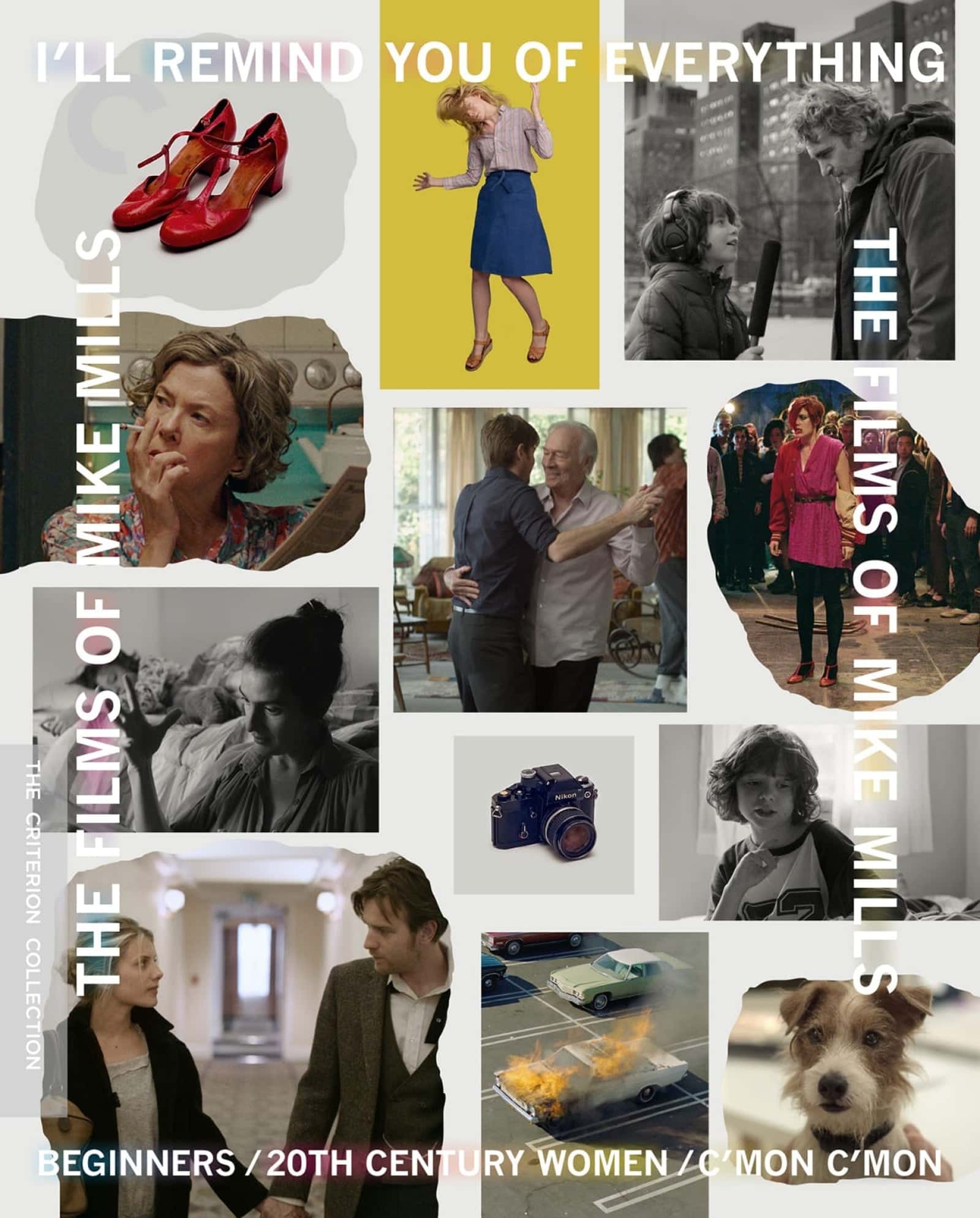
 Drawing inspiration from his past while also looking to the future, writer-director Mike Mills has lovingly crafted a loosely connected trio of films over the past decade and a half that explore the joys and challenges of intergenerational relationships. Mills’s keen eye for idiosyncratic visual details and striking ability to render humane and humorous portraits of people in various states of self-doubt and self-discovery make him a singular talent. Though they can tip toward the precious, his films never indulge in overt sentimentality, as Mills always carefully probes the depths of his characters’ emotions and connections with subtle wit and an acute sense of empathy.
Criterion’s box set of Mills’s last three films comes with sparkling new transfers and a wonderful assortment of extras full of insights into the director’s working methods. The transfers are from new 4K digital masters, and the image detail, depth, and clarity are uniformly immaculate. The dynamic range is also quite impressive across the board, with a nice array of browns and pastels standing out in Beginners and 20th Century Women and strong contrast and black levels in C’mon C’mon. On the audio front, the Dolby Atmos soundtrack for the latter is fully immersive, particularly during the field recordings taken by Joaquin Phoenix’s character, while the 5.1 surround tracks for the prior two films are perfectly crisp and clean throughout. Derek Smith
Beginners (2010)
The possibility of horror that accompanies granted happiness—the notion that now one has something to actually lose—is the fabric that Beginners uses to delicately tease out its love story. Oliver’s (Ewan McGregor) self-sabotaging mechanisms work to both guarantee the fantasy of romance and undermine its actualization. His psychoanalytically inclined insight, “I don’t really believe that it’s gonna work, so I make sure that it doesn’t work,” is the driving force for the camera’s exploration of sadness just as much as the quixotic thrills of his love affair with Anna (Mélanie Laurent). The film’s very counter-zeitgeist awareness of the self as a mere variable in a much larger equation that it cannot control, as well as its disarming belief in the human subject as perpetually split, ends up outing lots of cinematic love stories as embarrassingly silly, air-filled masquerades of authorial pretension. Beginners is the real thing. Diego Semerene
20th Century Women (2016)
Is a person more than the sum of their influences? Mike Mills’s autobiographical 20th Century Women hinges on that question. It takes place in Santa Barbara, California, centering on the summer of 1979, when Jamie (Lucas Jade Zumann) is 15 and beginning to bask in the freeing energy of punk music, all the while grappling with the pitfalls of romantic infatuation. Dorothea, his feminist mother, is the kind of woman who nods empathetically while shaking her head at the same time, deftly portrayed by Annette Bening as both proud and apprehensive, the self-image of her motherhood stuck between past and present tenses. Mills’s screenplay is estimable in its wisdom: The filmmaker doesn’t depict his former teenage self as a neurotic victim of outsized personality-sculpting, but rather as a blessed witness to a handful of extraordinary women—and the film does its work in making their personalities sparkle. Steve Macfarlane
C’mon C’mon (2021)
C’mon C’mon’s deepest pleasures come from the complex, deeply naturalistic interplay between Joaquin Phoenix’s Johnny and Woody Norman’s Jesse. As the uncle and nephew’s bond blossoms in each other’s presence, their individual relationships to Viv (Gaby Hoffmann) transform in her absence. Johnny and Viv, who grew apart in the wake of their mother’s (Deborah Strang) death, now share long conversations over the phone in which they discuss their shared difficulties in figuring out how to deal with Jesse, while Jesse himself, existing in this strange limbo state with his uncle, struggles with complicated feelings about his mother and father, his loneliness, and his inability to relate to other kids his age. Mills is a scavenger of often pithy moments that distill an incident, conversation, or life-changing event to its emotional essence. With a penchant for jump cuts, cross-cutting, and musical montages, his films might be described as fragmentary if not for their unifying spirit of psychological inquiry. Keith Watson
Extras
Mills provides thoughtful audio commentaries for all three films, discussing his elaborate research and writing processes, his love of working with actors open to discovery on set, and his different stylistic approaches in each film. He further delves into how he develops his projects and scripts in a convivial, nearly 50-minute conversation with filmmaker Kirsten Johnson and shows many of the sketches and highly detailed, organized notebooks he uses as part of his preparation. Each disc also comes with short making-of featurettes with behind-the-scenes footage from its corresponding film, and there’s also a pair of music videos he directed for Air and Talking Heads, as well as five of his short films from 1996 up to 2019. Lastly in the package is a nice bound booklet with a thoughtful appreciation of Mills by filmmaker Joachim Trier and an interview with Mills and Criterion Collection Executive Producer Kim Hendrickson. Smith
Since 2001, we've brought you uncompromising, candid takes on the world of film, music, television, video games, theater, and more. Independently owned and operated publications like Slant have been hit hard in recent years, but we’re committed to keeping our content free and accessible—meaning no paywalls or fees.
If you like what we do, please consider subscribing to our Patreon or making a donation.