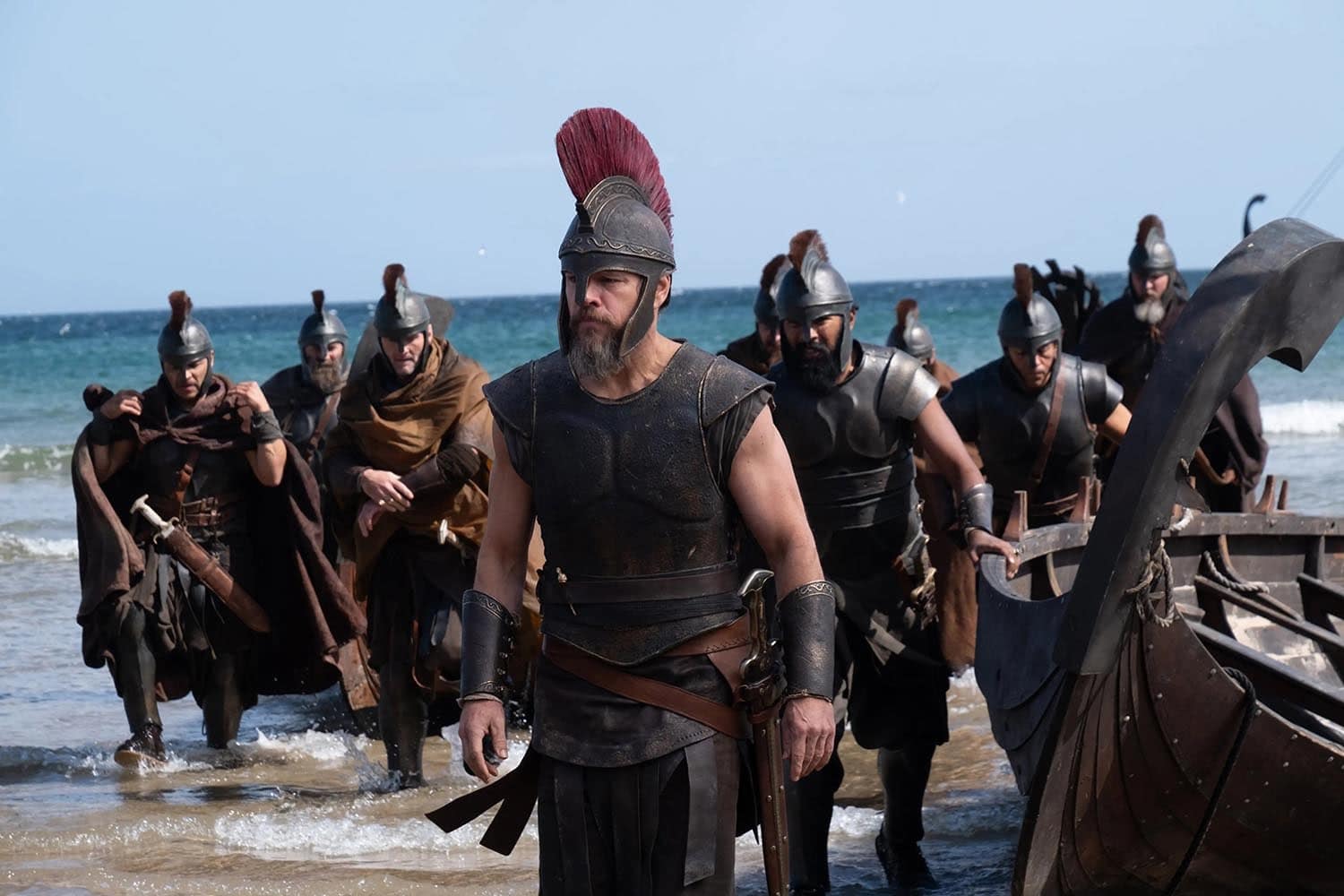
It should come as no surprise that Christopher Nolan would want to tackle Homer’s The Odyssey. The essence of the filmmaker’s protagonists, given their intelligence and cunning, can essentially be traced back to the epic poem’s hero. And in the ever-wandering Odysseus’s (Matt Damon) arduous journey back to his homeland of Ithaca and his wife, Penelope (Anne Hathaway), there are parallels to the stories that Nolan has spun around men whose heroic quests often threaten to forever separate them from what they cherish.
Inspired by Emily Wilson’s nimble (and controversial) translation of Homer’s epic poem, the film is a propulsive chronicle of the trials and tribulations that beset Odysseus and his men on their return from the Trojan War. The film winnows down some of the poem’s most memorable episodes, such as the encounter with the cyclops Polyphemus (Bill Irwin) and the witch Circe (Samantha Morton), distilling them to their most impactful, at times symbolic, elements. In the cyclops, so unthinking in his consumption of humans, we find a brutish reflection of the soldiers’ pillaging ways, while Circe’s manipulation of the men’s skin as she transforms them into pigs foregrounds the body horror that’s latent in the original text.
Intriguingly, the film’s longest and most exhilarating action sequence comes not from Homer’s poem but from Virgil’s Aeneid, with Odysseus’s Trojan Horse used as a gambit to end the Trojan War. Nolan shuns panoramic spectacle throughout this set piece, cranking up the suspense as he tracks how the Trojans are duped into accepting a “gift” filled with Odysseus and his men, who are forced to remain silent for days, swimming in shit and piss, before they can launch a surprise attack and open Troy’s fortified gates to reinforcements. Recalling the opening heist of The Dark Knight, this sequence unfolds with a certain mathematical precision, conveying the minutiae of Odysseus’s planning and quick thinking in the moment in tracing the movements of each member of the ambush party to get ahead of the Trojans’ scrambled counteroffensive.
True to form, Nolan goes to great lengths to avoid CGI where possible. The most striking example of this is the giant puppet used to portray Polyphemus, though the gnarly prosthetics donned by the actors playing Odysseus’s men during the confrontation with Circe are nearly as memorable. But the most striking physical objects in the frame are the natural elements.
The dominant image of the film is the “wine-dark sea” of Homer’s poem as it stretches, seemingly endlessly, into obscured walls of mist and fog, out of which occasionally emerge craggy, foreboding islands that seem somehow even more inhospitable than the water. Even in the sunlit haze of Hoyte van Hoytema’s lush 70mm cinematography, the Mediterranean has never looked so forbidding and desolate. The emphasis on the vastness of the wilderness facing Odysseus reflects the film’s larger focus on the poem’s timespan, conveying the years slipping away from the hero as his kingdom and family grow ever more despondent at home.

The region resembles a purgatory well before Odysseus’s quest leads him to the mouth of Hades. That scene, rendered in an eerie day-for-night Prussian blue dotted with the pitch-black shades of Odysseus’s fallen comrades, is one of the most arresting sequences in Nolan’s filmography, a depiction of hell shorn of all Christian interpretations of torture in favor of the eternal horror of pure emptiness, a place where warriors learn too late the true worthlessness of valor.
Back on Ithaca, Odysseus’s son, Telemachus (Tom Holland), is almost defined by the respect that he feels for the father he barely knows, which seems more like a perfunctory, dogmatic display of honor than true devotion, even as the young man chafes to assume Odysseus’s throne. But it’s Hathaway’s Penelope who most visibly bears the scars of her husband’s long absence. As she did in films like Ang Lee’s Brokeback Mountain and Todd Haynes’s Dark Waters, Hathaway takes a historically underdeveloped role—the wife left behind by the male hero on his quest of self-fulfillment and heroism—and forces us to consider the anguish and resentment that fester when one is taken for granted and left to maintain a neglected home.
Penelope bristles as much at her son as she does at the suitors who exploit her hospitality, castigating Telemachus for never regarding her as a legitimate ruler, even though she’s governed the island in Odysseus’s absence. Hathaway subtly conveys the canniness with which Penelope is playing a long game by stringing along her suitors, most notably Robert Pattinson’s sleazy, manipulative Antinous, but it’s her operatic expression of the character’s anger at being underestimated that are truly unforgettable.
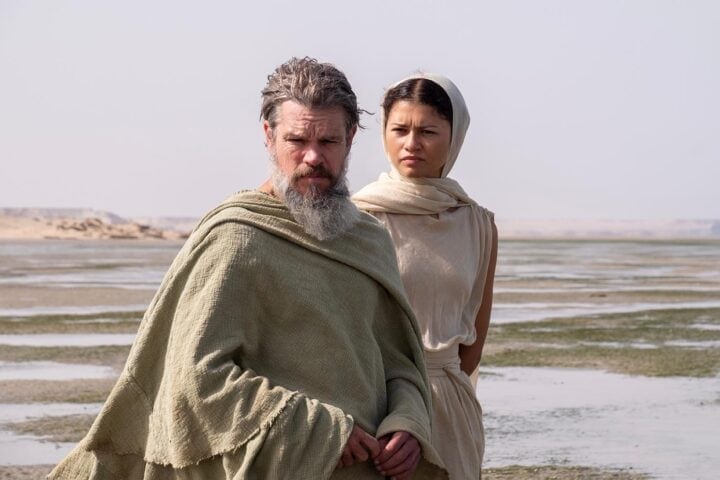
Penelope isn’t the only female character who’s treated with considerably more empathy than in the original text, and another byproduct of using Wilson’s translation as a launching pad is the clear-eyed focus on how much of Odysseus’s struggle is self-inflicted as a result of his hubris. He dooms members of his crew by flouting warnings given to him by subordinates and even Athena (Zendaya), and he occasionally fouls up an otherwise clean escape out of a deluded, antagonistic sense of honor, as when he fires an arrow into Polyphemus immediately after he and his men slip out of the cyclops’s cave. He’s but one of the classical heroes put under a microscope here, with Menelaus (Jon Bernthal) depicted as such an abusive brute that one suspects Helen (Lupita Nyong’o) needed no enchantment by Aphrodite to abandon him, and Agamemnon (Benny Safdie) shown as deserving of the grim fate that awaited him at home.
The original poem is defined by a clash between Bronze Age heroic values and civilized morality, but Nolan also uses that clash to hold a mirror to modern morality, making plain that the virtues that Homer praises look a lot like barbarism. By the end of the film, these critiques build to a significant revision of the mythology of the Trojan War, one that underlines that victory came only at the end of a long, ruinous conflict begun for narcissistic reasons and the usual petty aspirations of old kings to expand their realms, no matter the cost.
Just as the ghosts who speak to Odysseus spit at the notions of honor that once compelled them, the living reckon with the carnage they committed for no reason other than to live on in songs that sanitize the brutality that gave them “immortality.” By focusing on the immutability of consequences and the folly of monomaniacal pursuits, Nolan’s film jettisons much of the romanticism that has crept into interpretations of the text over the centuries. In that sense, The Odyssey is both faithful and deconstructive, embodying the fluidity of the oral tradition that spawned the poem and kept it alive for millennia through shifting tastes and values.
Since 2001, we've brought you uncompromising, candid takes on the world of film, music, television, video games, theater, and more. Independently owned and operated publications like Slant have been hit hard in recent years, but we’re committed to keeping our content free and accessible—meaning no paywalls or fees.
If you like what we do, please consider subscribing to our Patreon or making a donation.