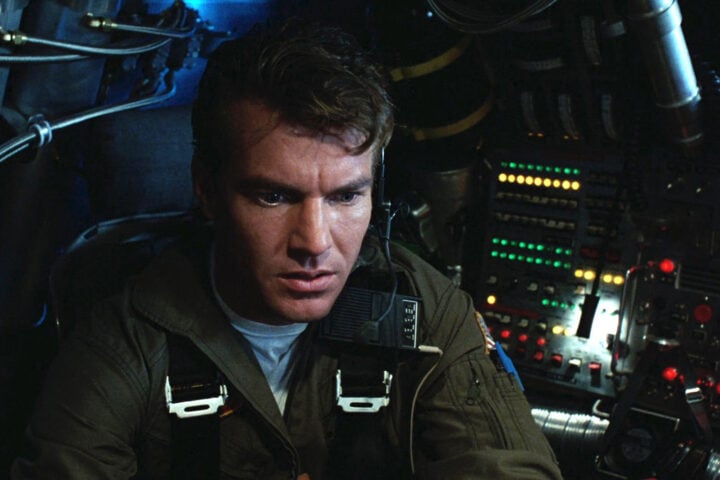
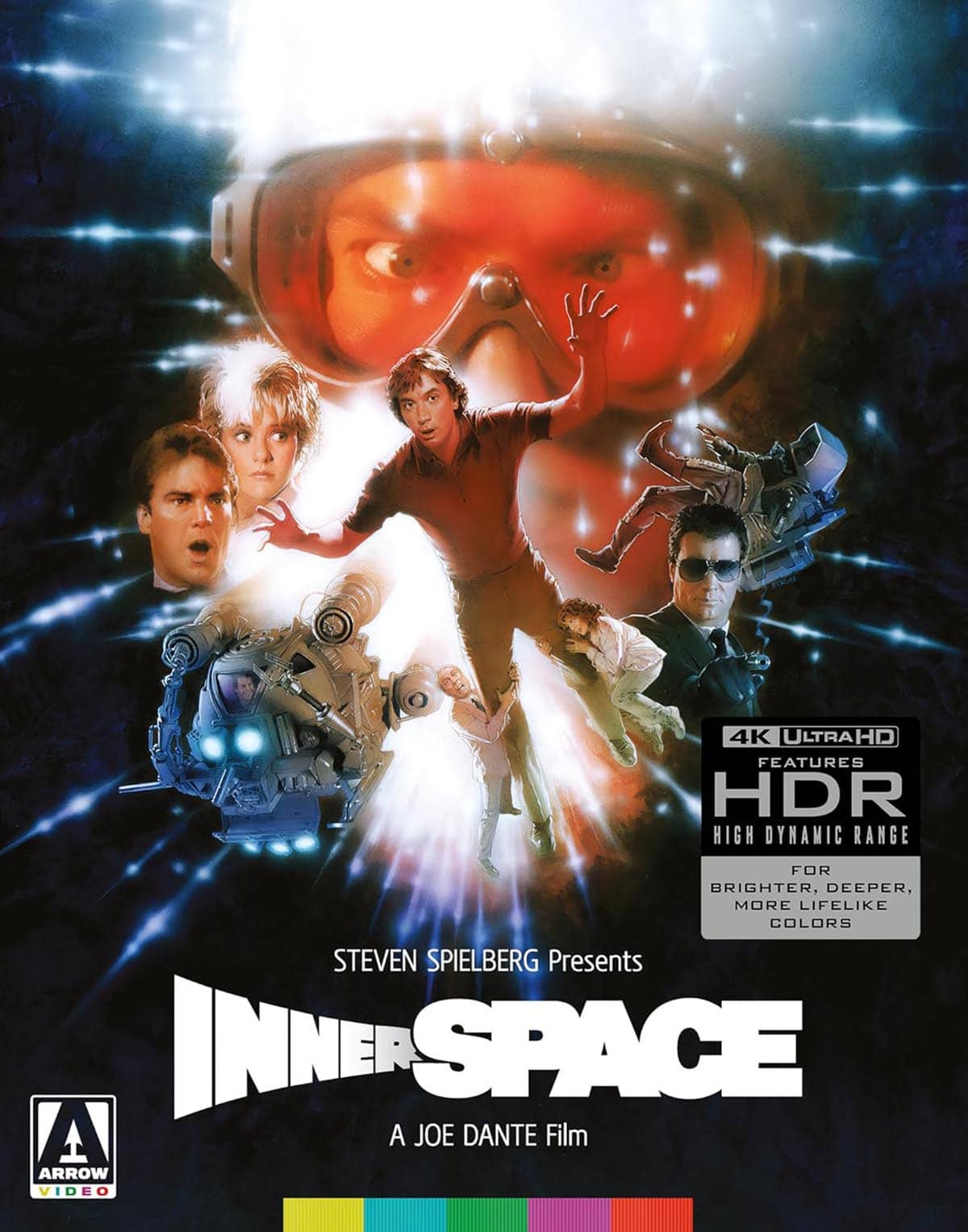
 Originally conceived as a straightforward work of speculative sci-fi about shrinking technology, à la Richard Fleischer’s Fantastic Voyage, Innerspace morphed into a comedy via studio-commissioned rewrites and the hiring of Joe Dante as director. In experimental aviator Tuck Pendleton (Dennis Quaid), the film has a clichéd adventure hero, all strong chin and lady-killer smiles without an ounce of self-doubt. But the true protagonist is Jack Putter (Martin Short), the neurotic grocery clerk into whom Tuck’s shrunken pod finds itself.
From the moment Jack enters the frame, he twitches with discomfort, which is made worse when he begins hearing a voice in his head that a tiny man is now in his bloodstream. As Tuck attempts to get back to normal size and a group of corporate raiders hunt down the pilot to gain access to their rival’s shrinking tech, Jack is pulled at from multiple directions. Short puts all his rubber-limbed physicality to use splaying, jerking, and tumbling to and fro as Jack has a nervous breakdown over the situation, frequently yelling at Tuck to the terror of bystanders watching a man have passionate arguments seemingly with himself.
One of the funniest aspects of Innerspace is how elaborately over-plotted it is, something that doesn’t slow the momentum but becomes a deliberate source of absurdity as the filmmakers pay parodic tribute to the clumsily expository B movies of yore. From the corporate intrigue plot that gets Tuck implanted in Jack in the first place to bizarre developments such as Tuck being able to modify Jack’s face into a disguise through muscle manipulation, Innerspace never once attempts to create a sense of scientific or even basic narrative plausibility. Instead, its cascading nonsense becomes a magnification of Short’s central, splenetic performance, a celebration of too-muchness that makes the film one of Dante’s most purely entertaining works.
Image/Sound
Arrow’s UHD offers a Dolby Vision-boosted 4K restoration that maximizes the discrepancy between the drab location shots and the more explosively colored sci-fi elements. The pointillist dots of yellow, green, and red in Tuck’s pod radiate as intensely as the Oscar-winning effects of the blood cells and tissue that the vessel navigates. Close-ups reveal minute details on faces and objects, and the even grain distribution ensures that the transfer retains a film-like appearance.
The disc includes three soundtracks: a 2.0 stereo and 4.1 surround mix sourced from the film’s original 35mm and 70mm exhibitions, respectively, and a new Dolby Atmos track. The latter impressively upscales the 70mm soundtrack, expertly blending the score with the chaotic sound effects. Dialogue is always situated in front of all three mixes to keep the lines clear.
Extras
Arrow’s disc comes with a 2002 cast and crew commentary track that appeared on earlier releases of the film, as well as a new track by critic and screenwriter Drew McWeeny. The former abounds in reminiscences by the speakers about the film’s long gestation and the supportive relationship between Joe Dante and producer Steven Spielberg, but it offers nowhere close to the level of behind-the-scenes details that McWeeny shares across his well-researched track.
The disc also comes with a new, hour-long making-of documentary that includes interviews with Dante and a number of actors and crew who talk about the film as a transitional point in the filmmaker’s career; a series of new featurettes that showcase previously unreleased footage recorded during production, the most exciting of which offers a glimpse at ILM’s work on the film’s impressive practical effects; and various stills galleries of storyboards and production photos. Finally, the accompanying booklet contains essays by critics Charlie Brigden, Michael Doyle, Josh Nelson, Jessica Scott, and Andrea Subissati, as well as a short guide to Dante’s stock company by graphic designer Scott Saslow, plus the original exhibitors pamphlet.
Overall
Joe Dante’s screwy sci-fi classic from 1987 expectedly gets the red-carpet treatment from Arrow Video, whose release presents a fantastic new restoration alongside a wealth of extras.
Since 2001, we've brought you uncompromising, candid takes on the world of film, music, television, video games, theater, and more. Independently owned and operated publications like Slant have been hit hard in recent years, but we’re committed to keeping our content free and accessible—meaning no paywalls or fees.
If you like what we do, please consider subscribing to our Patreon or making a donation.