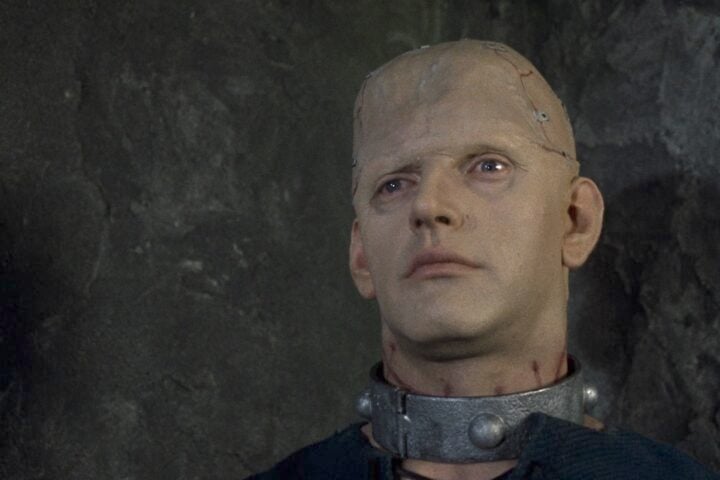
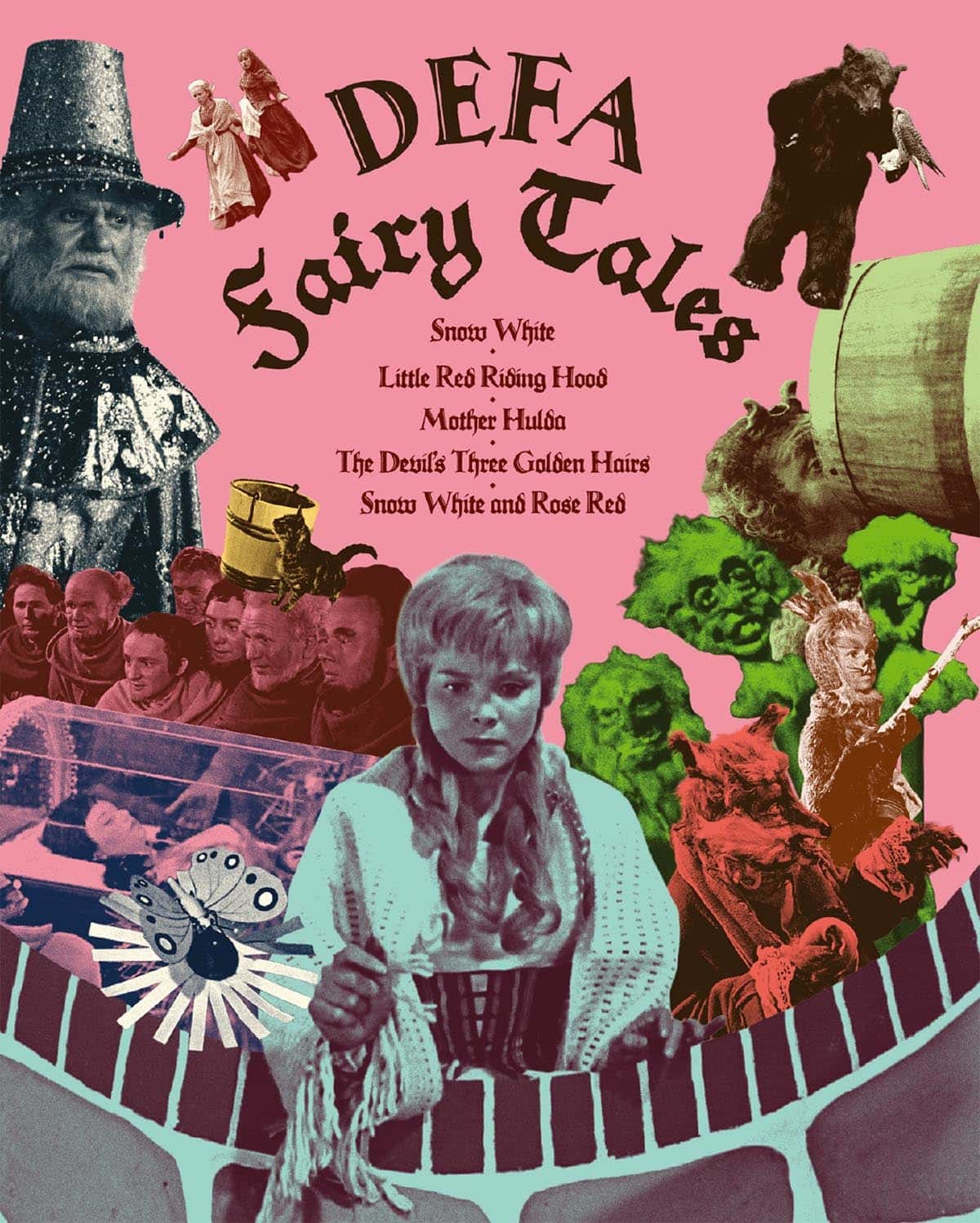
 Formed in 1946 in the wake of World War II, DEFA was the official state-run studio in East Germany until the fall of the Berlin Wall in 1989. Starting in the early 1950s, adaptations of the Grimm brothers’ fairy tales were one of the studio’s most popular subgenres. Shot in vivid Agfacolor, bursting with music and song, and unabashedly geared toward the fantastic, the five engaging and charming films collected in this set nevertheless carry coded material entirely in keeping with the tenets of socialist realism favored by the communist regime.
Snow White, from 1961, sticks closely to the source material, particularly compared to the more sanitized Disney classic, though neither comes close to the gleeful gruesomeness of the original. The story starkly contrasts the decadence and self-absorption of the Evil Queen’s (Marianne Christina Schilling) court with the ebullience and rebelliousness of the castle’s servants. This embrace of the proletariat becomes clearer when it comes to the seven dwarves, who constitute their own communal society, and even break into boisterous song while toiling in the mines. Significantly enough, the queen’s punishment is expulsion from the kingdom, signaling that the individual on their own is at a disadvantage compared to society as a partnership.
Little Red Riding Hood, from 1962, expands on its source material to better sing the praises of collective action, specifically by bringing in several helpers to assist Red (Blanche Kommerell) in her hour of need. These helpers, as well as the two villainous characters, are played by actors in stylized animal costumes. This uncanny blend of human and animal (the animals speak and walk upright), along with the ersatz studio-bound forest environs, contribute to the fabulist, even surreal feel of the production. When it comes to showing the violence inherent in the story, director Götz Friedrich uses some wonderfully expressionistic shadow play and one brilliantly staged jump scare, which squarely situate this version in the realm of horror cinema.
Frau Holle, from 1963, boasts deliberately artificial and exaggeratedly minimalist set designs that make no pretense of realism. Aimed at children, the film boldly underlines its moral about the rewards of hard work and the pitfalls of laziness, characteristics embodied respectively by half-sisters Gold Marie (Karin Ugowski) and Pitch Marie (Katharina Lind), both of whom visit the otherworldly realm of the snowfall-bestowing Frau Holle (Mathilde Danneger). Though Gold Marie is the ostensible heroine, Lind imbues the irascible Pitch Marie with a sardonic sense of humor that’s lacking in her eternally upbeat half-sister, though that doesn’t save her from a particularly nasty (and arguably excessive) comeuppance.
The Devil’s Three Golden Hairs, from 1977, mostly plays as broad slapstick comedy, save for several scenes at that call to mind the grim medievalism of The Seventh Seal. The story is essentially a quest narrative wherein a bumbling peasant, Jakob (Hans-Joachim Frank), in order to win the hand of the daughter (Katrin Martin) of a cruel and deceitful king (Rolf Ludwig) and relieve the suffering the latter has brought to the kingdom, must retrieve three golden hairs from the Devil (Dieter Franke). The most jaw-dropping sequence comes when Jakob arrives in a candy-colored underworld that recalls Mario Bava’s Hercules in the Haunted World, where the slapstick devolves into Jakob dressing up as the Devil’s wife and romping around in his bed.
Snow White and Rose Red, from 1979, more naturalistically portrays its mountain and forest settings, all the better to foreground its forays into the fantastic. The story cannily fleshes out the slender original tale, amping up the folkloric aspects that deal with the dwarfish evil mountain spirit (Hans-Peter Minetti) and his curse, which turns two princes (Pavel Trávníček and Bodo Wolf) into a bear and a falcon. The film emphasizes the isolation of the industrious titular siblings (Julie Jurištová and Katrin Martin), most of whose social interactions occur when they take their handcrafted wares to market. The film views that lack of social integration as having a detrimental effect on the girls’ emotional development. Marriage to the princes brings them into a world as orderly as the nuptial round dances that conclude the film.
Image/Sound
Despite occasional hiccups in the source elements, these HD transfers look incredibly good, especially when it comes to their vivid color palettes. Colors are bold and rich, grain is mostly well-maintained, and fine details of the elaborate costumes and stylized set designs stand out clearly. The audio comes in German LPCM mono mixes that sound clean and clear.
Extras
All of the films, except for The Devil’s Three Golden Hairs, come with a commentary track, with film historians Michael Brooke, Samm Deighan (who contributes two), and Shelagh Rowan-Legg and Anne Golden getting into the Grimm brothers and the folkloric aspect of their fairy tales, the history of DEFA studios, life in East Germany, Freud’s theory of the uncanny, and more. In an expansive 90-minute interview conducted by Deaf Crocodile label founder Dennis Bartok, comics artist and film historian Stephen R. Bissette delves into, among other things, the history of fairy tale films from several regions, the work of Ray Harryhausen and Karel Zeman, and the career of Gottfried Kolditz (the director of this set’s first two films). Finally, the visual essay “Socialist Fantasies, the Bros. Grimm and DEFA Studios: Fairytale Filmmaking in East Germany” by film historian Evan Chester provides a helpful overview of DEFA and a film-by-film assessment of the titles collected in Deaf Crocodile’s set.
Overall
Deaf Crocodile’s DEFA Fairy Tales collection provides fascinating insights into a film culture that remains frustratingly underrepresented on home video.
Since 2001, we've brought you uncompromising, candid takes on the world of film, music, television, video games, theater, and more. Independently owned and operated publications like Slant have been hit hard in recent years, but we’re committed to keeping our content free and accessible—meaning no paywalls or fees.
If you like what we do, please consider subscribing to our Patreon or making a donation.