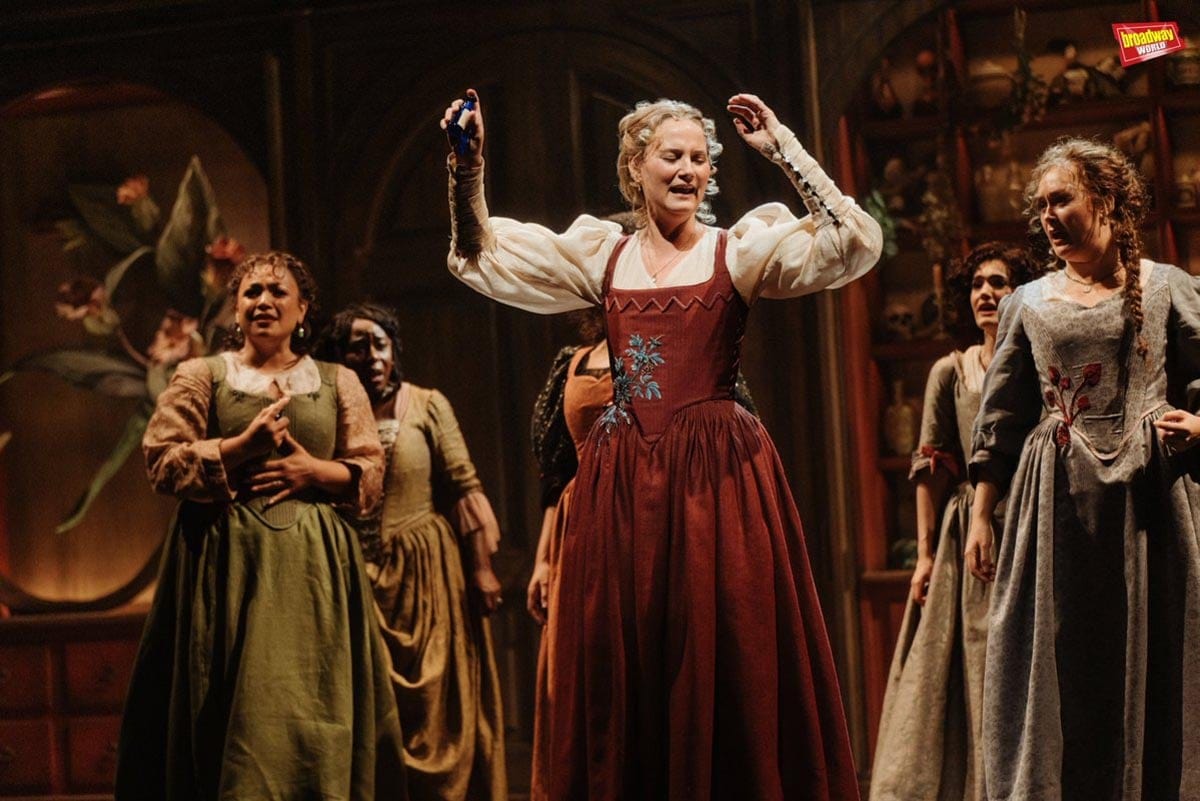
Revenge used to be so fun. Think of Sweeney Todd and Mrs. Lovett, waltzing together as they plot to pop their victims into pies. Or Seymour Krelbourn in Little Shop of Horrors feeding his crush’s abusive boyfriend to a ravenous plant. Begging for more of that delicious devilishness is the gorgeously staged but super-serious Giulia: The Poison Queen of Palermo, now playing at the Perelman Arts Center. Whenever Jennifer Nettles—the country music chart-topper doing quadruple duty as composer, lyricist, bookwriter, and star—gives into her story’s pull toward the playful, Giulia’s ingredients produce something intoxicating.
According to somewhat fuzzy history, the real-life Giulia Tofana had a special arsenic tincture that she would sell to women with horrific spouses until her victims numbered 600. In Nettles’s version of this 17th-century tale, Giulia is a mom trying to make ends meet by running an apothecary since her drunken husband, Carlo (Matthew Amira), can’t support her or her daughter, Vittoria (Naomi Serrano). When Carlo gets out of control, Giulia has just the potion to protect Vittoria from his wrath, which gives her a business/public service idea: Aren’t there countless women in Palermo facing similar domestic suffering?
Much less fleshed out than Giulia, the men with the most power in town are two stock characters who wouldn’t be out of place in Sweeney Todd or The Hunchback of Notre Dame: the syphilitic Cardinale (Quentin Earl Darrington), who whips himself in shame for his sins, and the lascivious Governatore (Christopher M. Ramirez), who lusts after Giulia’s teen daughter. And both the Governatore and the snooty Duchessa (Didi Romero), who wants Giulia’s help in offing her husband just because he’s a bore, are caricaturish villains. Pity, too, that the show has nothing to say about what might happen to the many widows once they’ve liberated themselves, with none of the women who come to Giulia for help getting to share anything about themselves other than the horrors they’ve suffered at the hands of their husbands.
Nettles devotes most of the first act to detailing the abuse these women have faced, either by staging it or in sung testimony or through the bruises they wear. She seems particularly anxious that audiences should sympathize with Giulia’s crimes, but the tone, as a result, remains humidly, weightily severe, even when the plot seems to be calling out for more winking thrills.
When Giulia finally arrives at one young woman’s wedding to a pseudo-reggae beat, poison in hand as she awaits the groom, the musical bursts free from its early grim tethers like the clouds parting for the rain. “I could just kill the groom, but where’s the sport in it/Why not make every last loser, abuser, my subordinate,” she raps on pitch, gleefully expanding her mandate from self-defense into premeditation. “Let mama up the ante/I’m feeling vigilante.”
This Giulia is mischievously good company, but the show returns to a stoic earnestness instead of leaning into kick-ass naughtiness for more than a few minutes at a time. Even this wedding climax is undercut by an unnecessary act-one finale in which Nettles belts mightily about how Giulia’s customers will “flow around every obstruction and break through every obstacle,” while saying very little about the specific sort of empowerment that the character provides.
Nettles herself is an appealingly warm presence with a throbbing, versatile voice, well-built for both musical-theater storytelling and her typical country sound, and there’s an electrically charged charisma when Giulia is at her murderously feistiest. But the pressure of writing a score for herself also seems to pose some, well, nettlesome challenges. Great as she sounds, Nettles has penned too many extraneous ballads for Giulia that bog down the show’s pacing.
And though Cian McCarthy’s canny orchestrations wrap Renaissance tendrils around Nettles’s music, the sound of harpsichord subtly driving some of the numbers at the border of pop and hip-hop, Giulia’s music distractingly evokes Hamilton. Occasionally, Nettles cleverly sets her text in the conversational recitative style that would have actually been coming into vogue during Giulia’s lifetime. But she also jam-packs some of the bass-thumping songs with dense, stylistically unpersuasive rap verses hampered by slant rhymes that make the words harder to follow. Giulia sometimes gives the sense of trying very hard to be something that it is not—Hamilton, for example—while not yet embracing the pleasurably rageful id at its core.
Fortunately, whatever Giulia becomes next, it already inhabits a stunning physical world. Director Mary Zimmerman, best known for classical adaptations and grand opera, centers her staging around a trio of arched doorways, designed by Daniel Ostling, that reveal something new every time they’re opened: the painted fresco of a Palermo alleyway, the towering shelves of the apothecary shop, the specter of a horned sheep that haunts the proceedings. It’s a trick that never grows old, with Zimmerman’s expansive ingenuity outpacing the script’s.
Giulia shows flashes of the more tautly funny show that would be worthy of Zimmerman’s vision. If Nettles embraces what makes the show feel most shocking—its celebration of a community of women who take justice into their own hands with joyful, righteous bloodlust—it could become strikingly special. As Giulia says herself, let mama up the ante.
Giulia: The Poison Queen of Palermo is now running at the Perelman Arts Center.
Since 2001, we've brought you uncompromising, candid takes on the world of film, music, television, video games, theater, and more. Independently owned and operated publications like Slant have been hit hard in recent years, but we’re committed to keeping our content free and accessible—meaning no paywalls or fees.
If you like what we do, please consider subscribing to our Patreon or making a donation.