Perhaps you were a fan of Susanna Kaysen’s 1993 bestseller Girl, Interrupted, which launched a mini memoir boom after its publication. Or maybe you came to the story via James Mangold’s 1999 Hollywood adaptation starring Winona Ryder, which gained cult status and nabbed Angelina Jolie an Oscar. Perhaps it was Aimee Mann’s 2021 concept album Queens of the Summer Hotel, a chamber-pop song cycle that she recorded and released after the development of the Girl, Interrupted musical stalled during the pandemic. Now, 30-plus years since the memoir’s initial publication, a new iteration of the story is premiering on stage at the Public Theater, with a script by Martyna Majok and directed Jo Bonney, using Mann’s songs.
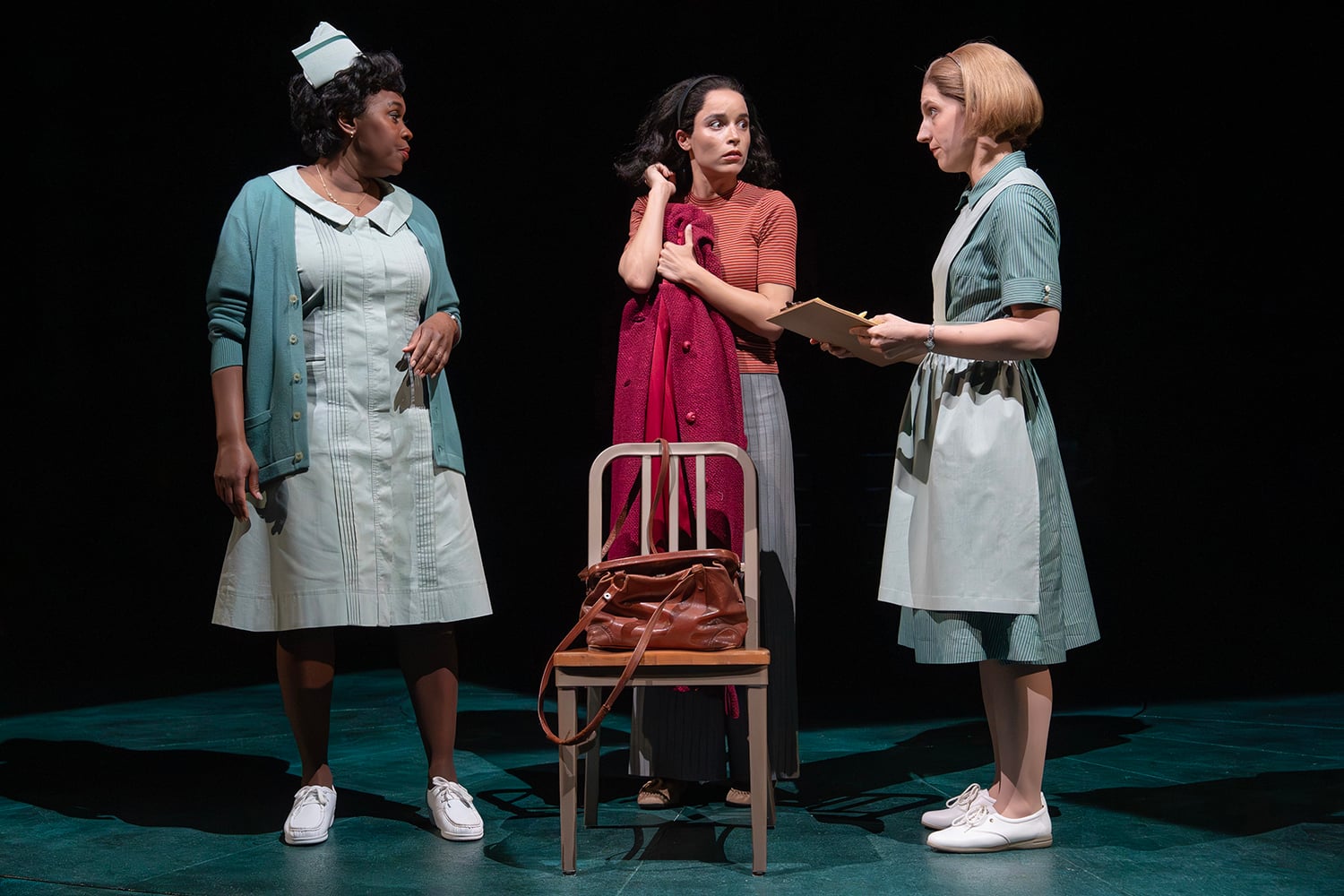
The animating facts are the same: In the late 1960s, after a brief consultation with a doctor, Susanna Kaysen was sent to McLean Hospital in Massachusetts for treatment, spending nearly two years on the ward. The conceit in this production is that Susanna, at 38, is looking back at her 18-year-old self, a framing device allowing the character to snap in and out of her past and present. As Susanna, Juliana Canfield handles the switches with clarity and precision, assessing how and why she ended up in McLean and what it was she found through her experience.
Billed as a play with music, the show uses many of Mann’s compositions, which Todd Almond orchestrates for the company. You can hear Mann’s musical DNA strongly in this selection of songs, many great character pieces that have the economy and precision of a self-contained short story. The strongest are the show-opening “You Fall,” which highlights just how someone from Susanna’s fairly privileged background could end up in a psychiatric ward, and “Suicide Is Murder,” a pointed condemnation of the act and the suffering in the aftermath of the act.
Girl, Interrupted’s first half consists of a lot of place setting, and the problem with a character stuck within a place (and out of time) means that the production can feel stuck by extension. Those early scenes establish what day-to-day life is like at McLean Hospital for the patients: group therapy, bed checks, ingesting medications, and watching the horrors of Vietnam on the TV in the lounge. The show is more compelling when it begins to look at other characters besides Susanna, and how they deal with the pressures of the outside world—or don’t. Still, Majok tries to thread the needle between recapturing the interiority and fragmentary storytelling of the memoir and the Hollywoodized drama of the film with uneven results.
The script is at its best when it examines the same questions that Kaysen did in her book. What does it mean to be ill, and subsequently “recovered”? The show wants us to see these women beyond a diagnosis. It also underscores the ways in which care was gendered, highlighting the medical misogyny of the era, as in the song “Give Me Fifteen,” where a male doctor sings, “In the time it takes to walk around the block/I can have you scheduled for electroshock.”
Less successful are the script’s attempts to make connections between art and sensitivity, and push the idea of Susanna as a burgeoning writer, since McLean Hospital played host to other creative patients like Sylvia Plath, Robert Lowell, Ray Charles, and James Taylor, all of whom are name-checked in the script. Throughout the show, Susanna is repeatedly discouraged from calling herself a writer, told that pursuing that occupation is unrealistic, which feels like Majok emphasizing that obstacle just for Susanna to have something to resist. “Robert and Sylvia. James. Ray,” Susanna’s roommate Grace (Mia Pak) tells her at one point. “Knowing I’m not the only one. And knowing that someone, y’know, did something with it. That you can do something with it.” Those lines come across as slightly clumsy, like a pep talk across time.
The small cast is uniformly excellent, and as with the film, Lisa is the showiest role, performed with swagger by the musician King Princess, sporting a mullet and striped trousers. The script offers most of the characters moments of vulnerability and insight, along with stellar songs that showcase Mann’s singular wit and economy, standouts being Polly’s (Sally Shaw) number “Burn It Out” and Daisy (Katherine Reis) singing “Home by Now.” Though as Dr. Wick, the hospital psychiatrist, Emily Skinner isn’t given much to do but prod and disapprove.
The show ultimately succeeds, despite its occasionally muddled narrative structure, due to its seriousness and sensitivity. Kaysen’s story is one that inspires fierce identification and protection, and has made people feel seen. Like the lyrics in the show’s final song, “I see/And I believe,” this production manages to harness what connects audiences to each version of story: the acknowledgement of its characters’ struggle, their frailty, and their humanity.
Girl Interrupted is now running at the Public Theater.
Since 2001, we've brought you uncompromising, candid takes on the world of film, music, television, video games, theater, and more. Independently owned and operated publications like Slant have been hit hard in recent years, but we’re committed to keeping our content free and accessible—meaning no paywalls or fees.
If you like what we do, please consider subscribing to our Patreon or making a donation.