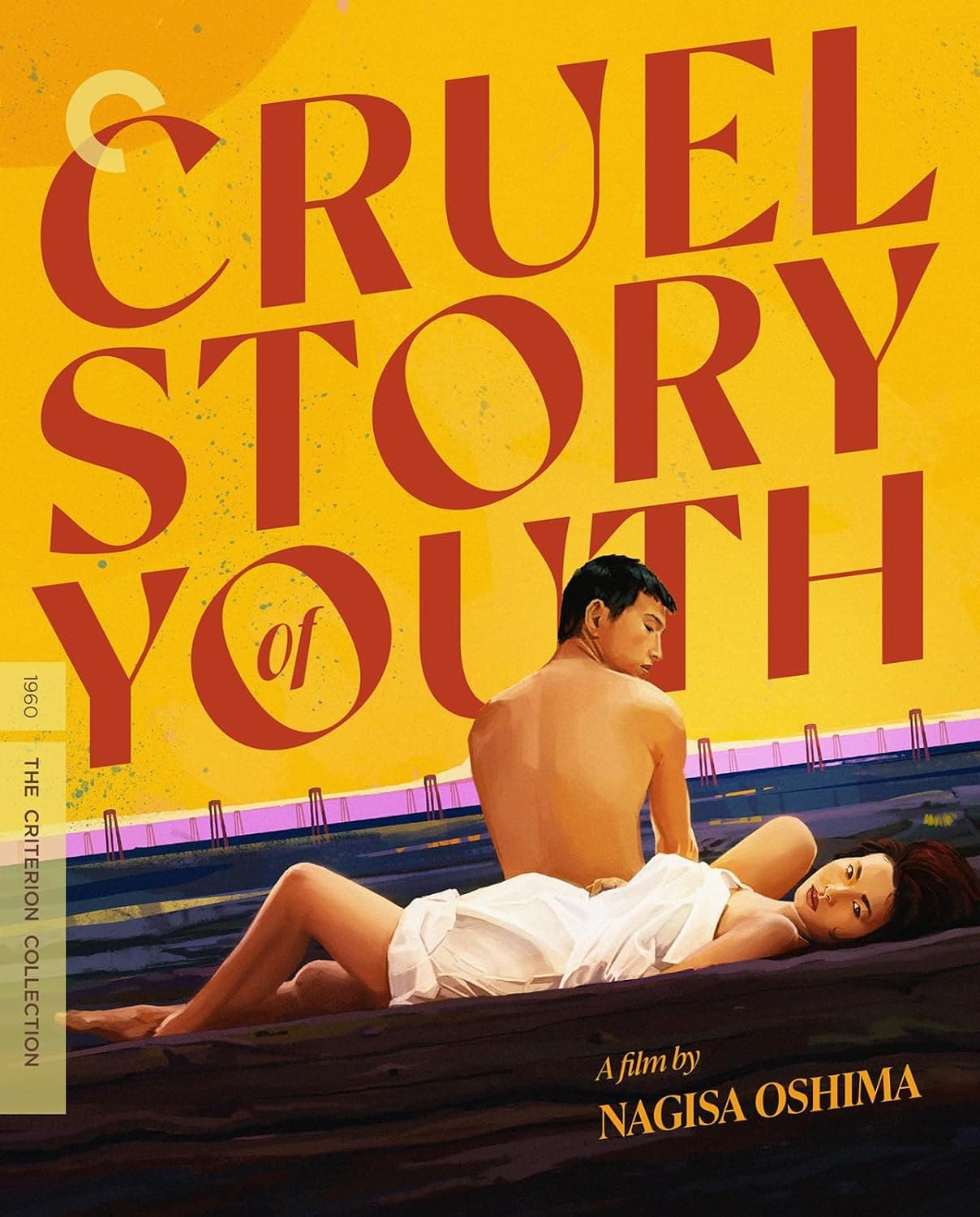
 Ōshima Nagisa’s Cruel Story of Youth was one of the first successes of the Japanese New Wave. Its mix of bright, pink-heavy cinematography and raw, often handheld direction simultaneously lends the story a sense of gritty realism and escapism. The extreme clash of styles matches the film’s vision of Japan, where the divide between the haves who reaped the benefits of the nation’s post-war recovery and the have-nots huddled in the dark corners that the nation’s ubiquitous neon signs do not light is as plain as day.
Like Luis Buñuel before him, Ōshima depicts poverty as the opposite of ennobling. The film begins with Kiyoshi (Kawazu Yūsuke) saving hitchhiker Makoto (Kuwano Miyuki) from being assaulted by the driver giving her a lift, only to himself rape her while on a date. Rather than spurn him, Makoto enters into a codependent relationship with Kiyoshi in which they physically and emotionally abuse one another.
Ōshima emphasizes the ways that people who feel powerless cope by asserting domination over the nearest person they can find who sits even lower on the social hierarchy. Kiyoshi is but one of the men who can be seen taking out their resentments on women, and Makoto assents to Kiyoshi’s scheme of seducing drivers to extort money from them, bleakly reasoning that she will suffer the predations of such men regardless and may as well weaponize it for her profit.
As the film continues, though, it complicates this acidic commentary through a shift in Kiyoshi and Makoto’s relationship. They at times approach each other with the suggestion that they find a way to be kinder to one another, even if it means splitting up. Kiyoshi maintains his detached exterior, but he expresses increasing concern for Makoto. Cruel Story of Youth ends on an at once nihilistic and hopeful note, an annihilation that’s also a willful act of breaking the cycles of the old and new Japan that make outcasts like Kiyoshi and Makoto feel like slaves to the system.
Image/Sound
Criterion’s transfer of a 4K digital restoration really showcases the beauty of Kawamata Takashi’s cinematography. From the vivid, unnatural-seeming hues that dot otherwise drab landscapes, to the inky blacks in the shadows of nighttime interiors, the range of colors is exceptional. There’s no evidence of washed-out areas or crushed blacks. The mono soundtrack is filled with the street noise of a bustling city—honking cars, pedestrian chatter, ubiquitous construction projects—and the dialogue is consistently clear in the center of the mix.
Extras
Criterion’s disc comes with two of Ōshima Nagisa’s early films. The 1959 short “Tomorrow’s Sun” is a gentle parody of studio promo reels, introducing Shochiku’s crop of recently signed young talent in a frothy montage of jet-setting and modeling on a beach. Ōshima’s debut feature, Street of Love and Hope, is an hour-long social drama that introduces the director’s longstanding interest in the figures who fell through the cracks of Japan’s economic miracle. The film covers a remarkable amount of thematic ground, criticizing the government’s inadequacy in lifting up all of its citizens, the blithe behavior of do-gooder bourgeois figures who attempt to help the poor mainly to boost their own egos, and the morally debasing nature of people needing to go to great lengths to survive. In an archival interview, critic Tony Rayns provides an overview of Ōshima’s career and his position in the Japanese New Wave. A booklet essay by critic Chris Fujiwara places the film within the context of Japanese studio filmmaking of the time, as well as the broader movements in art cinema around the world in 1960.
Overall
Ōshima Nagisa’s breakthrough sophomore feature is a vicious social commentary and a desperate, warped romance, and its savage beauty is maximized on Criterion’s gorgeous 4K disc.
Since 2001, we've brought you uncompromising, candid takes on the world of film, music, television, video games, theater, and more. Independently owned and operated publications like Slant have been hit hard in recent years, but we’re committed to keeping our content free and accessible—meaning no paywalls or fees.
If you like what we do, please consider subscribing to our Patreon or making a donation.