
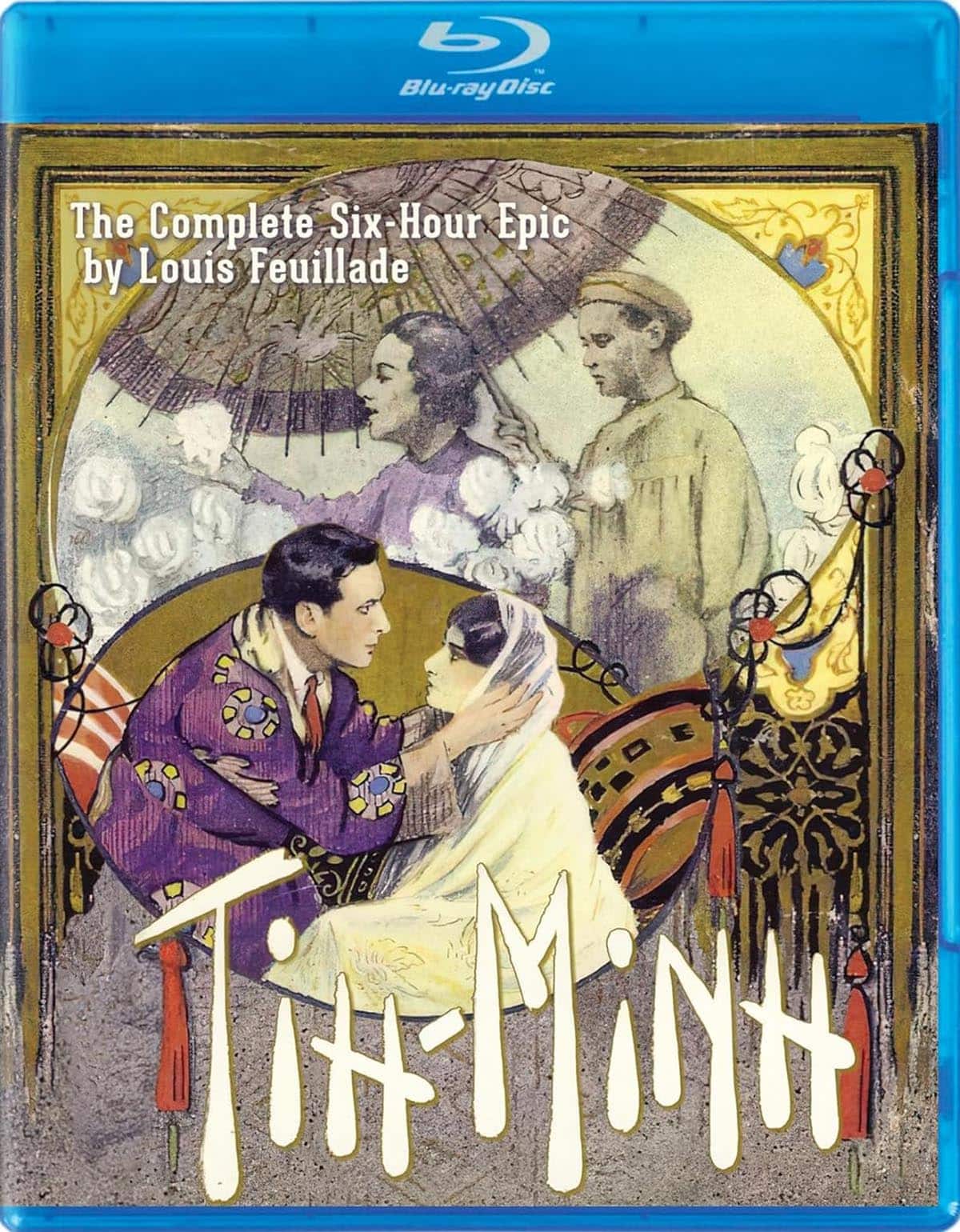
 Released in 12 episodes during the early months of 1919, Louis Feuillade’s Tih-Minh is perhaps the first espionage thriller, predating Fritz Lang’s Spies (often held up as a generic progenitor) by a full decade. It’s also a rollicking roller coaster of a ride, with numerous surprising switchbacks of narrative development that encompass tropes from several different genres (including horror), and boasting some of the most jaw-dropping stunts ever performed, largely without the aid of camera trickery.
The narrative’s broad strokes are a deceptively simple springboard: Intrepid explorer Jacque d’Athys (René Cresté) returns from an excursion to Indochina accompanied by his redoubtable manservant, Placide (Georges Biscot); a mixed-race woman who saved his life, Tih-Minh (Mary Harald); and a fabled volume of Oriental lore that contains an encrypted message concerning an invaluable treasure. The last is coveted by a trio of German spies who happen to reside next door: the Marquise Dolorès de Santa Fe (Georgette Fabioni), her ersatz Hindu servant, Kistna (Louis Leubas), and Dr. Gilson (Gaston Michel), who exerts a kind of hypnotic mind control to make the marquise do their bidding. Their method of obtaining the sought-after document is to repeatedly kidnap Tih-Minh or otherwise make felonious excursions into the d’Athys family’s villa.
Tih-Minh is presented in its opening credits as a “grand ciné-roman,” a film with all the sweep of a great novel. What’s more, the designation cannily references the central importance to the narrative of books and writing in general. It also refers to the weekly installments, called fascicules, of a serial novelization that accompanied each episode’s release.
Tih-Minh is a fascinatingly liminal character. Daughter of a French official and a local woman, she’s first presented almost as an exotic object that Jacques has acquired, who must be redressed as a Frenchwoman and taught the requisite social graces, a task that falls to the civilizing feminine influence of Jacques’s sister, Jane (Lugane). Initially a simple damsel in distress, kidnapped and drugged into amnesiac silence by the German spies, she later takes a far more active hand in avenging the wrongs done to her, even if she still finally needs Jacques’s help to extricate herself from a quite literal cliffhanger.
For all the surface realism of its mise-en-scène, especially some stunning outdoor action set pieces, Tih-Minh contains more than a whiff of the fantastic (and even horrific) elements that characterized earlier Feuillade serials like Fantōmas and Les Vampires. After her initial return, Tih Minh’s drugged unresponsiveness is visualized in a brief vignette with her wandering alone in a dark fairy-tale landscape of shadows and ghostly trees. Later, when Jacques and Placide infiltrate the Villa Circe that the villains have recently abandoned, they encounter numerous other kidnapping victims, clad in diaphanous white gowns, running wild on the grounds and milling dazedly around indoors. An intertitle describes them as “the living dead,” and they certainly appear as spectral as the vampire brides in a Hammer film.

This pervasive aura of the fantastic extends to certain narrative incidents. The Marquise uses a poisoned necklace pendant to drug Jacques. His ally Sir Francis Grey (Edouard Mathé) is falsely committed to a lunatic asylum in an effort to sideline him. And both sides of the pitched battle for the encoded Document 29 use hypnosis or “magnetic powers” to manipulate the marquise to their own purposes. There’s the surreal moment when tea party attendants are drugged and posed in an eerie tableau vivant. And in what is perhaps the film’s most visually potent sequence, Kistna impersonates a gun-toting nun to insinuate himself into Villa Luciola.
Tih-Minh finds Feuillade expanding his grammar of film language by using many of the techniques pioneered by D.W. Griffith. At times, he crosscuts dramatically between concurrent moments of action. He often uses a contracting and expanding iris to signal the transition between scenes. And he frequently employs various shaped mattes (keyholes and arches abound) to multifaceted purpose. The keyholes help focus our eye on significant details, while the arches serve to symbolize the theme of personal happiness.
Perhaps Feuillade’s most impressive innovation concerns his handling of the narrative timeline. At certain points in the film, he rewinds the action a little way to explain how a dramatic event happened, particularly when it comes to several dramatic escapes. Most strikingly, almost the entirety of episode seven is an extended flashback to French-controlled Indochina in 1911 that explains several essential plot points about Tih-Minh and how the villains know about Document 29, which is the film’s MacGuffin.
Likely as a response to criticism by both public and police representatives that his earlier films had glorified criminality, Feuillade dispatches his villains quite definitively: Gilson murders Kistna by dropping him from a cart high above a stone quarry, before himself succumbing to an ill-timed avalanche. (And Marquise Dolorès, freed from their spell, nevertheless commits suicide out of remorse.) Not content with justice being done, Feuillade ends the film with a deliriously happy triple wedding under one of those symbolic matte arches.
Image/Sound
Kino Lorber presents Tih-Minh in a 2018 4K restoration from Gaumont, sourced from original film elements, that looks simply exquisite. Aside from the occasional stutter of missing frames, the image is crisp and clean, with some really nice fine details visible in the costumes and set designs. Audio comes in a Master Audio mono mix that nicely captures the sound effects and wonderfully evocative modern score contributed respectively by Julien Boury and Audionetwork. English subtitles are provided for the intertitles and texts seen during the film.
Extras
Novelist and critic Tim Lucas provides audio commentaries for eight of the 12 episodes. Lucas is a veritable font of information about the film’s production history, its themes and subtexts, connections to other Louis Feuillade works, and the careers of cast and crew. He also reads lengthy extracts that he has translated from the extremely hard to find French-language serial novelizations (or fascicules) that accompanied the weekly release of each episode. These provide fascinating context in the way that they flesh out the characters and action of Feuillade’s film.
Overall
Given an immaculate 4K transfer and some essential extras on Kino’s new Blu-ray release, Louis Feuillade’s Tih-Minh is a narratively sprawling, superbly visualized, and consistently action-packed early example of the spy thriller.
Since 2001, we've brought you uncompromising, candid takes on the world of film, music, television, video games, theater, and more. Independently owned and operated publications like Slant have been hit hard in recent years, but we’re committed to keeping our content free and accessible—meaning no paywalls or fees.
If you like what we do, please consider subscribing to our Patreon or making a donation.


Thanks to Mr. Wilkins’ review, this has now been added to my buy/watch list.