The House


Coming Up In This Column: Contagion, Detective Dee and the Mystery of the Phantom Flame, Drive, Backstory 5: Interviews with Screenwriters of the 1990s (book), Up All Night, Free Agents, How I Met Your Mother, Two and a Half Men, 2 Broke Girls, Castle, but first…

Fan Mail: I was rather disappointed that none of you folks took the bait and commented on item in #81 on the Cirque du Soleil production Iris. I figured some of this column's readers would feel strongly one way or the other on my whacking the Canadians, but as I have learned over the years doing this column, you never know what people are going to respond to.

For our Korean fans, the Korean language version of my book Understanding Screenwriting: Learning from Good, Not-So-Good, and Bad Screenplays has just been published in South Korea. Given the interest by some people in the North Korean regime, I am sure a few copies will drift across the border.

Contagion (2011. Written by Scott Z. Burns. 106 minutes)

Contagion

The (cough, cough) feel-bad movie (cough, cough) of the fall: There is no narrator here. Thank goodness Scott Z. Burns got that out of his system, for now anyway, with The Informant! (2009, see US #54). Here is he is telling the story with the same speed and skill that he brought to The Bourne Ultimatum (2007), and it works for about the first three-quarters of the movie.

You know a movie is starting fast when they kill off one of the several Academy Award winning actors (Gwyneth Paltrow) in the first ten minutes. It also tells you that nobody is safe, and indeed another Oscar winner bites the dust partway through the film. Beth (Paltrow) has been on a business trip to Hong Kong, comes home to Minneapolis, has what she thinks is jet lag, and boom, she's gone. But nobody can figure out what it is that has killed her as well as several other people around the world. So Dr. Ellis Cheever, the head of the Center for Disease Control and Prevention, starts an investigation, sending people all over the place. The film moves at the speed of the disease, which does not give us any time to get to know the characters. Here's where it's very useful to have an all-star cast. If it's Matt Damon, we must be in Minneapolis.

The character who comes across most strongly should not, by all the rules of screenwriting. She is Dr. Ally Hextall, and she is a research scientist for the CDCP. She never says a conventional line of dialogue in the first hour or more of the film. She talks non-stop in medical and scientific terms. I have written often about the need to avoid techno-babble in screenplays. This is the exception, and partly that is because Ally is played by Jennifer Ehle. In the first Jurassic Park (1993) Samuel L. Jackson just barrels his way through the techno-babble in his speeches, but Jeff Goldblum gives his all kinds of twists and turns. It would not surprise me to learn that Ehle studied Goldblum's performance in that film, but she does more than that. She makes a character out of that dialogue. Well, Ehle is brilliant actress, a two-time Tony winner on the stage, and some good work in films (Sunshine [1999)]) and television (she was Elizabeth to Colin Firth's Mr. Darcy in Pride and Prejudice [1995]), so she knows her trade. I have only heard her dialogue once, but it does not strike me that there is anything in the medical discussion that obviously reveals her character. What Ehle does is make the character both open and driven. You generally do not see those two elements combined. Open characters are fun and likable, and driven characters in films are dark and closed off.

Burns's script focuses on the story: the race to figure out what the disease is and to try to find a vaccine. There are multiple medical people listed in the credits and the filmmakers have talked in interviews about how scientifically accurate they have tried to make the film. (For a great discussion of the medical details, look at this interview with three doctors in the Los Angeles Times—and read all the way to the last line.) The first hour and a half gets it reasonably right. Then the script at least partially falls apart when Dr. Hextall creates a vaccine that works. All the care that has gone into the medical details gets swept away. One local Minneapolis bureaucrat, early in the picture, asks one of CDCP people, "Is this coming out of your budget or mine?" She is portrayed as evil, but it is a legitimate question. The film never comes back to it. The vaccine is produced a big hurry, without a lot of medical trials; doesn't anybody remember all the political hassles over trials for AIDS drugs? A blogger who is promoting a homeopathic cure raises the question in the first half of the film as to whether the CDCP is "in bed" with the drug companies, but the film never comes back to that. The film goes from running on all cylinders in the first part to sputtering along on just a couple in the last half-hour.

Movies of course have a long gestation period, and we really cannot expect a movie to know what would be going on when it is released, but it still seems to me that the film misses a great opportunity for some interesting social and political comment. The heroes in this film are all federal workers (plus a representative of the World Health Organization). This film came out about the same time that Texas Governor Rick Perry totally abandoned his principle that the Federal Government is an evil that ought to be downsized if not eliminated to beg the Feds for help dealing with the fires in Texas. It would have been nice if Burns had thrown in a "tea party" politician to pull a Rick Perry.

Detective Dee and the Mystery of the Phantom Flame (2010. Written by Jailu Zhang. The IMDb also lists Kuo-fu Chen in the writing credits with no specifics, and Lin Qianyu as the author of the original story, but unless I missed it, Zhang is the only one credited on the film. And this being a Chinese film without the Writers Guild rules, his credit does not appear in the main credits, but only the end credits; China obviously needs a Writers Guild. And somebody doing a column like mine. 119 minutes)

Detective Dee and the Mystery of the Phantom Flame

So there, Industrial Light and Magic: The producer and director here is Tsui Hark, who has been making terrific movies since the early '80s. His 1986 film Peking Opera Blues is the film that turned me on to Chinese action movies. One thing I have generally loved about the Chinese films is that they are done fairly simply, without a lot of elaborate special effects. Good stories, some wire work in the action scenes, and quick cutting has been enough. Well, along with great production and costume design. And great cinematography. We get all that here, but Tsui has gone for CGI work in a big, I mean BIG, way. There are effects houses from China, Korea and Hong Kong listed in the end credits.

And Tsui has used all the effects shots better than most overblown American films. As he told Anne Thompson in an interview, "The CG looks similar in a lot of shots in movies. Whenever we in the industry use CG or a technique, software or hardware, we must be very careful to design in such a way to give the audience something unexpected and unpredictable, not always the same thing. It's about how to make a story interesting and fun to watch… Sometimes the audience wants to be entertained with a more realistic treatment of a story. The effects sometimes get too far-fetched and the audience gets distracted and not involved in what's going on. I like to create the kind of effects shot that's relevant to the story and style of the movie."

Ah, yes, the story. Detective Dee is an actual historical character, although he was more of a judge than a detective. Tsui told Thompson that Lin Qianyu is a novelist who worked up the character of Dee into more of a Sherlock Holmes character (very much in the style of the Holmes we saw in the 2009 Sherlock Holmes [US#40]). It is 690 A.D. and Dee has been in jail, or rather a large bureaucracy where he assigned to burn "memorials," which are apparently like daily reports of assorted officials activity. He reads them, of course, which means we do not have a lot of pokey exposition when he is freed from captivity to investigate the rather alarming fact that government officials are spontaneously combusting. We get Dee investigating, followed by Jing'er [sic], the Empress's head of security, and not only are there a lot of great action scenes, but some examination of the charred corpses straight out of CSI.

Most of the dead men were involved in the construction of a 66 yard high statue of Buddha, being put up in honor of the first woman to be crowned Empress. You could do the fires with old-fashioned effects, and possibly the interior of the statue with mere production design, but it is a lot more elaborate and entertaining to watch with all the details you could probably only do with CGI. It will not surprise you to learn at the end of the film the statue topples over. I was reminded of the falling statue in De Mille's 1949 Samson and Delilah, but De Mille's FX looked rather crude even then. Tsui's are spectacular. I mentioned in US#72 in writing about The Crusades (1935) that De Mille as director filled the screen with everything. Tsui does that here as he always has, but unlike De Mille, he and his writers come up with lively characters and dialogue. I don't speak Mandarin, but the subtitles are deliberately funny.

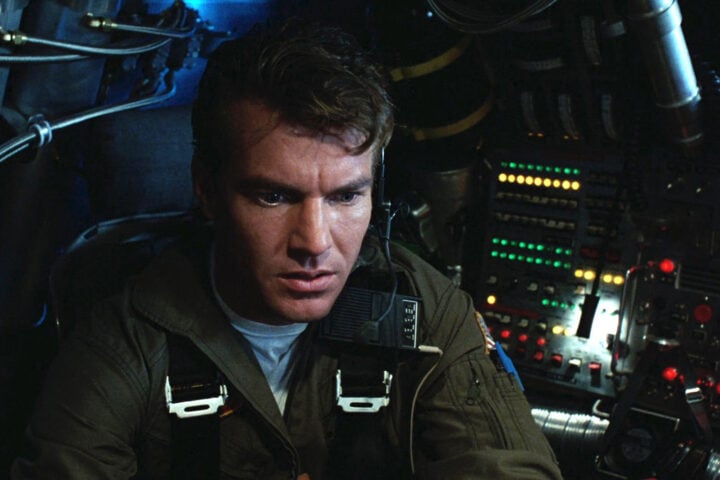
Drive (2011. Screenplay by Hossein Amini, based on the novel by James Sallis. 100 minutes)

Drive

Rain Man meets Goodfellas: In 1978 Walter Hill wrote and directed The Driver. It is about a getaway driver called The Driver. He is chased by a detective called The Detective. He is involved with a woman called The Player, and another woman called The Connection. There are a lot of car chases. Hardly anybody says anything. Pauline Kael rightly described it as "Comic book cops and robbers existentialism." The same could be said of Drive.

Here it is only the driver who is not identified by name, and it produces the same kind of silliness that it did in The Driver. In the new film Irene (at least the other characters are named) introduces Driver to her friend, but awkwardly avoids mentioning his name. You can get away with that in prose ("She introduces them") but it sticks out like a sore thumb in dialogue. Amini, who did the great screenplay for the 1997 film The Wings of the Dove, is also minimalist about Driver's character, I presume following the book. The opening scene promises a lot more. We hear Driver talking on the phone about his rules as a getaway driver, then we see how smart he is at finding a variety of ways to avoid the cops. We assume he is quick and smart, but very little in the rest of the picture confirms that. At first we guess he is maybe an idiot savant, like Raymond Babbitt in Rain Man (1988), except that instead of counting, his skill is in driving, but he does not seem autistic. He connects with Irene, who lives down the hall, and her son Benicio, but he's rather slow about it. His rhythms, as Ryan Gosling plays him, make it seem more like he has Down's Syndrome. In 1979, a student of mine, Ron Ellis, made an Academy Award winning short film, Board and Care. It was about two kids with Down's who fall in love and he used non-actors with Down's for the characters. This was long before Chris Burke showed up on the TV series Life Goes On. What Ron discovered, particularly in the editing room, is that the kids had their own rhythm, and it was similar to Gosling's rhythm here. After the opening scene, it does not make him a convincing getaway driver.

The other characters show a bit more flare, particularly a garage owner Driver works for and a couple of mobsters. On the other hand, Christina Hendricks shows up briefly, but it's a nothing part, and she comes to a messy end. Irene is a bigger part, but most of what she gets to do is smile sweetly. Carey Mulligan does that well, but it's a criminal under-use of her talent. Irene is married to a guy in prison, so presumably the character has some toughness, but we don't see it. When Driver smashes a guy's head (literally) in front of her, she appears to have no reaction, not unlike the moment in Goodfellas (1990) where Henry gives Karen a gun to hide. Karen has no reaction either. Surely there could be shock, awe, sexual excitement, something. And in Drive, we never find out what happens to the body of the guy. It was left in a public elevator for God's sake. Somebody would have noticed.

The picture really goes downhill in the last half hour, when characters are turned into bodies at a furious clip, so fast that it begins to get funny. The film is so portentous, not unlike The Driver, that we can't help laughing. Charles Bennett's Fat English Friend understood we sometimes need a relief from the suspense, as in Marion's car sinking partway into the swamp…and stopping. Better the filmmaker provide the laugh than risk the audience laughing on their own.

Backstory 5: Interviews with Screenwriters of the 1990s (2010. Book edited by Patrick McGilligan. 252 pages)

Drive

How did I not know about this?: I have mentioned the Backstory series of books a number of times in this column. I quote from them all the time, since they are the gold standard of screenwriter interview books. The series has been going on since in 1986, organized and edited by Pat McGilligan. Pat rounds up a great bunch of interviewers and turns them loose on groups of screenwriters. Given how highly I think of the series and how much stuff about screenwriting I read, you would have thought I would have known about the book as soon as it came out. But I didn't. Why not?

Well, it may just have been that I am slowing down in my old age, but I think it also has to do with the way the recession has hit the publishing business over the last three years. This is especially true for serious books about screenwriting, as opposed to the "Write a Screenplay Following My Rules and By Tuesday You Will Make a Million Dollars" type. My friend, the Austrian film scholar Claus Teiber (see US#20), has now published two books in German on screenwriting, the last one about screenwriting in silent film, but has been unable to get an English language version of either one published. I know other authors and would-be authors having the same problem. There is also the question of the lack of advertising. Often I have learned about books from ads in assorted magazines and journals, but there is less advertising now. There are also fewer reviews in publications such as the Los Angeles Times, which dropped its Sunday book section a few years back. Pat and I email back and forth from time to time, but he probably assumed, like I did, that I would know about the book.

So I finally came across a reference to it while looking up some information on Pat's book on Fritz Lang (see US#79). After I got over the shock of not knowing about it, I got my favorite film bookseller, Jeff Mantor, the owner of the Larry Edmunds Bookshop in Hollywood, to round up a copy for me. And it is, not unexpectedly, wonderful. It has one of the best interviews I have ever read with John Sayles. It has a rare interview with John Hughes. You want dinosaurs and gorillas? David Koepp, who wrote the first two Jurassic Park films, tells you what it's like to work with an 800-pound gorilla like Spielberg. Barbara Turner tells about working with another 800-pound gorilla, Robert Altman, who deliberately cut out Turner's favorite scenes in her script for The Company (2003). The book collectively gives you a sense of the collaboration that goes into making films, and the screenwriters' role in that. Koepp also tells you why directors all wear baseball caps.

Pat has more non-American screenwriters this time around, so we get Tom Stoppard on Spielberg as well. I am glad Pat found an interview with the great French screenwriter Jean-Claude Carrière. In 2006 I mentioned to Pat I was going to Italy and England and he asked me if I wanted to swing by Paris and interview Carrière. I told him I would have to pass, since I felt I couldn't do justice to Carrière without spending at least a year reading all his stuff. Pat and I have talked about my doing an interview or two for the series, but so far it has not worked out. So far.

Ah, one other thing. Richard LaGravenese is the only, the ONLY, screenwriter interviewed to mention the hero's journey. And it is without capitalization. He does not mention Joseph Campbell at all, but a psychologist named Robert Johnson, who wrote about Jungian archetypes. Johnson's work helped LaGravenese get a grip on The Fisher King (1991). None, and I mean NONE, of the other writers mention the Hero's Journey. And these are writers who written some of the best and most successful screenplays of the last thirty years. If you really want to understand screenwriting, forget Joseph Campbell, and read all five of the Backstory books. And this column, too, of course.

Up All Night (2011. "Pilot" created and written by Emily Spivey. 30 minutes)

Up All Night

Not that funny: The idea for this new series could be funny, but it's not. A couple in their thirties, Reagan and Chris, have just had a baby. He is going to be a stay-at-home dad and she is going back to work as a producer on a daytime TV talk show with a star, Ava, who bears a more than passing resemblance to Oprah. In the pre-credit sequence they are talking to the baby, but swearing, which is bleeped and a fuzzy patch is put in over their mouths. OK, it's NBC, not cable, but why bother bringing up the language issue at all if you cannot deal with it? It gives us a bad first impression of the couple.

They don't make a better impression later. When Reagan and Chris argue, the arguments are not funny. Then they decide to have a night on the town like they used to have when they were young, karaoke and all that. And they are hung over the next morning. Well, duh, of course you are. And you still have the baby to take care of. We think Ava is going to be a bitch with Reagan, but when Reagan has to pull out of a celebrity BBQ to be with her kid, Ava/Oprah perfectly understands. Yeah, right. Where's a little Billy Wilder ruthlessness when you need it?

Free Agents (2011. "Pilot" developed for American television and written by John Enbom. 30 minutes)

Free Agents

That funny: This new show was based on a British series of a couple of years ago. BBC America ran the first two episodes (written by Chris Niel) of the British series in early October, just about the time NBC cancelled the American version after just four episodes. The first episode of both versions opens in the same way. Alex and Helen wake up in bed together. He's a bit put off by all the pictures of her late fiance. He starts to cry about his kids; he's recently divorced. Obviously these are two strangers who stumbled into bed by accident.

No, they aren't, in either version, and that was what made the American version so promising. They are co-workers in an ad agency (a talent agency in the Brit version) and in the American version have been friends for a long time. The Brits are more just co-workers. This is the first time they have slept together, and they both feel very uncomfortable about it, since they both bring the baggage we learned about in that first scene. So they go to work, but Alex is enough of a mess that the guys in the office assume he has had sex. In the British version it is just his boss who asks. Since they know this is his first time since his divorce, they want all the details. He obviously cannot tell them it was Helen, so he makes up an outrageous tale of wild sex. Here is where the American version is better: Helen joins in just like one of the guys asking him questions. It's not only a funny scene, it is charming because Alex and Helen are long-time friends trying to protect each other as well as themselves. While Up All Night does not use the charm of its two leads, Christina Applegate and Will Arnett, this one gets the most out of Hank Azaria, who can probably do anything, and Kathryn Hahn, who like Azaria has been mostly a character actor. And they both bring great acting chops as well as charm to the show. We believe these two as real people. The two actors in the British version are a bit more "real," i.e. scruffy, but they are not as charming as Azaria and Hahn.

In both versions, Helen tells Alex she does not want to continue the sexual relationship, but go back to being friends, as they were before they slept together. She thinks he is "a mess," but we see she is not much better off. The British version pretty much leaves it at that, with them talking about sex. A lot. The British version has tons of very explicit language, more so than I think they need. And when BBC America showed it, they bleeped a lot, which made some speeches incomprehensible. The language simply took away from the humor of the characters and the situations.

In the American version, Helen helps him pick out new clothes so he can start dating again. He disagrees with her choices, pointing out that one shirt "would be great if I was going to an Armenian gangster's acquittal party." The line is off the wall, but not so far that we would not believe these characters would say it. They are obviously still attracted to each other and decide they need a "safe word" if one or the other is getting too romantic. What would you pick as the safe word? The choice here is "potato," which, like the characters is down to earth. So later they are staring at each other and he says, "Potato." Guess what we cut to. They are in bed and he says, "We need a new safe word." There is no safe word in the British version.

Up All Night got huge ratings and Free Agents didn't and was cancelled. I suspect Up got huge ratings because Christina Applegate is a beloved TV star and the show's franchise is more immediately clearer than Agents'. I wish NBC had held onto Agents a little longer. The other three episodes were not quite up to the pilot, but the show still had potential.

How I Met Your Mother (2011. "The Best Man" written by Carter Bays & Craig Thomas, "The Naked Truth" written by Stephen Lloyd. 30 minutes each)

How I Met Your Mother

Nope, still haven't met her: The last episode in the spring left us with a flashforward to Barney's (of all people) wedding. So we pick up at that wedding in "The Best Man," but in keeping in the grand Bays/Thomas tradition, we never find out whom he is marrying. The setup is just bringing us back to the present, with some flashbacks to Ted's disastrous best man speeches, then on to Punchy's wedding, where people have come from Finland to see Ted screw up the toast. His best man speeches have made him an Internet star to them. This time he cries when he makes the toast, since he and the gang have just learned that Lily and Marshall are pregnant. In "The Naked Truth" Marshall is up for his dream job at an environmental law firm run by Garrison Cootes, but is afraid You Tube videos of his streaking in college will lose him the job. They don't of course, since Cootes is played by Martin Short, who may be a lively addition to the cast. Meanwhile Ted has gone of to the Architect's Ball where he's insisting to Robin he wants to see someone and be swept off his feet. He spots…Victoria. Yeah, except she's been around the show for several years, so she's probably not Mother.

Two and a Half Men (2011. "Nice to Meet You, Walden Schmidt, Part One" written by Chuck Lorre, Lee Aronson, Eddie Gorodetsky, Jim Patterson. 30 mintues)

Two and a Half Men

Nice Funeral: The question before the house is: when your leading man leaves a series, how do you handle it? Assuming the network wants the show to continue. Given the way Charlie Sheen left Two and a Half Men, it does not surprise us to learn the creators, whom Sheen did not have kind words for, have killed off Charlie Harper. So do you mention his death in passing, as some shows have done, or do you get some comedy mileage out of it? You can guess which way Lorre, the showrunner, goes. We open on Charlie's funeral, with Alan trying to say nice things about Charlie. The crowd is not having any of it. The crowd is made up mostly of Charlie's old girlfriends. From a sheer production standpoint, I was in awe of the show being able to assemble in one place and one time, presumably at a semi-reasonable cost, an incredible number of the actresses who had played those parts over the last eight years. Courtney (Jenny McCarthy) is irritated that the casket is closed, depriving her of the chance to spit in his face. Spitting on a casket is not the same thing. When Alan mentions that Charlie was a giving person, different women talk about the sexually transmitted diseases he gave them. Then there is one who says Charlie used her panties to strain tea. I would have loved to have been there the day that was shot, and I trust that on the DVD there will be a lot of outtakes of the scene. In the middle of the funeral Evelyn, Charlie's mom, starts promoting the sale of his Malibu house, telling the crowd to pick up brochures on the way out and come to the open house. Where can you go from there? Well, Alan introduces the last person to see Charlie alive, a woman dressed in black with a veil. The veil comes up and it's Rose, Charlie's stalker. She and Charlie had a great time in Paris until she found him in the shower with another woman. She was with him when he fell in front of a Paris Metro train. We can tell from the crowd's reaction that nobody believes Charlie "fell."

It's a great opening. But then…well, some other good stuff. At the open house the first person we see is an unnamed guy played by John Stamos, who realizes he has been in the house before. He and Charlie had a threesome with a girl and when she fell asleep they continued. Well, we never saw that on the show. Maybe more payback to Sheen by the writers. Next up is a couple, Dharma and Greg, from the 1997-2002 series of the same name co-created by Chuck Lorre. Played by the stars of that show, the couple's marriage has completely fallen apart. OK, you could replace Charlie Harper with a married couple, but would they let Alan and Jake stay there? Nope.

So, halfway through the episode, morose billionaire Walden Schmidt shows up at the window to the patio. He just tried to kill himself by walking into the ocean, but it was too cold. Obviously he is going to be a barrel of laughs. Not. I think the idea is that he is even worse off emotionally than Alan, who takes pity on him. The writers don't appear to find much humor in that. Alan takes Walden out to a bar, where Walden and Alan pick up two bimbos (we are miles from the smart women in the funeral scene) and take them home. Walden is depressed over his wife leaving him, and the bimbos sympathize with him. They take him off to bed upstairs while Alan is making drinks. Alan comes back into the empty room, hears sounds from upstairs. He says, "This is depressingly familiar," then picks up the Dustbuster he has used to clean up Charlie's ashes and says to it, "Shut up." Well, there are some laughs with Walden, but not very many. It is not clear now where the humor sweet spot is going to be with him. There is also the problem of Ashton Kutcher as Walden. Earlier this year I thought he was OK in No Strings Attached, but here he is just stolid. That might not matter much if he were not walking into a show that functions at such a high level. Jon Cryer is working Alan all he can, but Kutcher is not yet getting the ball back across the net. In spite of the scenes where Walden is stark naked, the writers have not given Kutcher the right balls to play with.

2 Broke Girls (2011. "Pilot" written by Whitney Cummings & Michael Patrick King. 30 minutes)

2 Broke Girls

Now those are some balls: In the opening minutes we learn Max, a waitress in a small diner, is a tough cookie. She verbally takes down a couple of obnoxious guys in one booth. The Russian waitress screwing in the walk-in fridge doesn't seem to bother her. OK, who are you going to pair off with her to make an interesting show? The Russian waitress gets fired and the boss, "Bryce" Lee hires the thin blonde Caroline. It is immediately apparent to Max that Caroline has NO experience as a waitress. Well, of course not. She's a rich girl, whose father pulled a Madoff-type scam. Caroline cannot get at any of her money, and none of her friends will let her stay with them. Now given that Max is so smart, obviously Caroline will be dumb. Here is the intelligence of the show: she's not. She went to college and studied business. Now she is just not in the world she's lived in. She reminded me of Annabelle Lee in Keaton's The General (1926). Annabelle Lee is a nice Southern belle who happens to find herself on a train driven by her former boyfriend Johnny as they are escaping the Union soldiers. What does she know about trains? Nothing. She tries to be helpful by tying a rope between two trees to stop the trains chasing them. Johnny is exasperated; the rope can't stop the trains. But it does. It pulls the trees it is tied to onto the tracks and into the wheels of the engine. Annabelle is not stupid, she's just inexperienced in Johnny's world. The same is true for Caroline in Max's world. Max makes cupcakes she sells to the diner. Caroline tells her she can charge more than she does. Max doesn't believe her, until Caroline pulls out the money she made selling the cupcakes to customers at the higher price.

By the end of the pilot Caroline has moved in with Max and come up with a scheme for them to save money and start their own cupcake shop. Of course, she's also stolen her own horse and is hiding it in the exceedingly minuscule back yard to Max's apartment…

Castle (2011. "Rise" written by Andrew W. Marlowe. 60 minutes)

Castle

Darker: At the end of last season Beckett was shot by a sniper at Captain Montgomery's funeral. As she lay seriously wounded Castle told her that he loved her, a big step up for their relationship. This episode picks up with Beckett being brought into the hospital, where her boyfriend doctor works on her. She eventually recovers, but tells Castle she cannot remember anything after the shots were fired. Whew, they dodged a bullet there. Because this episode is dealing with Beckett's near-death experience, it is a lot darker in tone than their usual episodes. And it's darker visually as well. Beckett eventually gets back on the job, although she freezes the first time she has to face a perp with a gun. Not the second time, though. The new captain, Gates, has stopped Beckett's partners from continuing the investigation into the shooting, since no new information has come up. They of course have not told her about Captain Montgomery's involvement and the connections to Beckett's mother's death. So Beckett and the guys have to investigate that on their own. Castle convinces Beckett she's a little too emotionally fragile to work that case, but indicates when the time comes he will help her. He goes home, opens up his computer and we see he has all the information on the mother's death and related stories on it. Beckett goes to the department shrink and admits she lied the last time. She remembers everything about the shooting. So we are going to be dealing this season with the mother's case and how Beckett deals with Castle. And the next-to-last scenes bring back a bit of the light touch we love in the series.

Tom Stempel is the author of several books on film. His most recent is Understanding Screenwriting: Learning From Good, Not-Quite-So Good, and Bad Screenplays.

  • print
  • email

TAGS: 2 broke girls, backstory 5: interviews with screenwriters of the 1990s, castle, contagion, detective dee and the mystery of the phantom flame, drive, free agents, how i met your mother, two and a half men, understanding screenwriting, up all night


The HouseCategories


Site by  Docent Solutions