Single Review: Mariah Carey's "Bye Bye"

Leave it to Mariah Carey to release the two weakest songs from her otherwise solid Energy Equals Mass Times the Velocity of Light Squared as the first two singles from the album. A sequel to "One Sweet Day" by way of every track produced by Stargate in the last 24 months, "Bye Bye" is the most treacly, cloying ballad the singer has recorded in years, a reluctant ode ("We will never say bye," she sings…and then proceeds to say it…incessantly) to the faithful departed. If there were a popular boy band around, she would have brought them on board for some extra crossover insurance. (Hey, it's not too late for a remix featuring GLOWB…or better yet, NKOTB!) When every single creative decision is made to boost your stock, you're no longer an artist, you're a glorified commodity, and it's telling that of all the things Mariah wishes she could share with her late, long-estranged father, seeing her "back at #1" tops the list. With a hook that consists solely of the song title repeated ad nauseam, "Bye Bye" exemplifies the worst aspect of the songwriting on the album: The usually eloquent Mariah panders to the demographic she's been courting since O.D.B. astutely equated her with a pacifier on the "Fantasy" remix by dumbing down her lyrics, referring to her "peoples" and reminiscing about "them times."
If possible, Mariah has made a music video even more affected and sentimental than the song itself. Intercut with pictures of lost loved ones (including pets), gratuitous shots of Mimi showing off her newly svelte bod (because even though she's sad, the strip-show must go on!), and an inexplicable storyline featuring her new husband, Nick Cannon, that will supposedly be continued in her next video are scenes of Mariah writing song lyrics in her notepad (which, if Glitter and the upcoming Tennessee are any indication, is apparently a script requirement for Mariah) that doesn't so much legitimize her as a songwriter in the viewers' eyes as it makes her look as if she has a compulsion for journaling. Not to mention looking off into the distance as she ostensibly composes music in her head. And wiping a nonexistent tear from her miraculously unstained face.
Single Review: Sugarland featuring Little Big Town and Jake Owen's "Life in a Northern Town"

For well over a decade now, much of mainstream country music has been using adult contemporary radio circa 1985 as its sonic template, with Rascal Flatts leading the charge as the REO Speedwagon for the new millennium. But the influence of '80s pop on today's country has never been as explicit as it is on the new single by Sugarland, who are joined by tourmates Little Big Town and Jake Owen on a cover of the Dream Academy's one hit, "Life in a Northern Town." This isn't a case of transforming a pop song into a country song like Sugarland's bluegrass rave-up version of Beyoncé's "Irreplaceable": Other than Jennifer Nettles's increasingly hard-to-buy drawl, there's nothing recognizable as actual country music about the single. From its use of a tinkling electric piano as the lead instrument and the tasteful orchestral swells and heavy percussion that kick in on the chorus, to the fact that the song (originally intended as an elegy for Nick Drake, someone I'd love to hear Owen name one song by) eschews the narrative-driven structure of most country songs and uses a wordless chant as its refrain, it remains a straight-up pop production. And with a nearly note-for-note faithfulness to the original version, the cover should be utterly inessential. And yet, is there any current act in any popular genre who arranges more exquisite harmonies than Little Big Town? The song's lilting melody and the presence of Sugarland and Owen both give the group the opportunity to build intricate up-to-seven-part harmonies that more than justify releasing the single and that highlight just how well that wordless chant works as a hook. It's no surprise that it's taken off at country radio, but "Life in a Northern Town" should give its unique ensemble a real shot at a crossover hit as well.
Tribeca Film Festival: The Aquarium

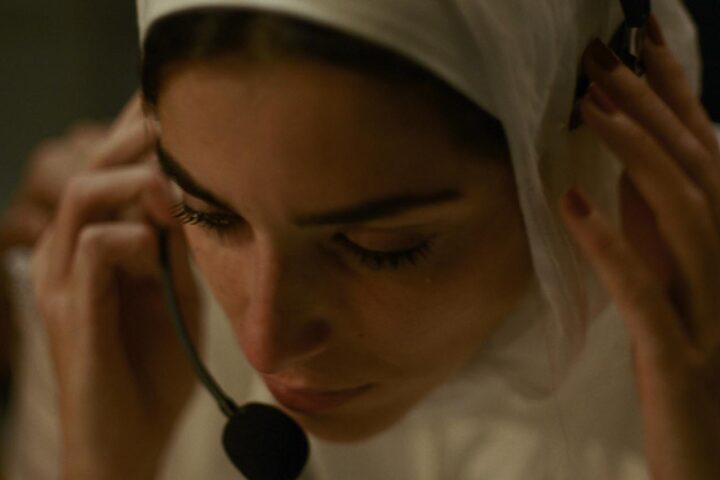
In The Aquarium, a fishbowl carved out of desert rock gives Yousry Nasrallah's film its title as well as its presiding image of urban malaise. Fittingly, the characters are loose metaphors floating through a modern, Cairo-set panorama, none more symbolically than the two serenely discombobulated protagonists. Leila (Hend Sabri) hosts a late-night talk radio show called Night Secrets, while Youssef (Amr Waked), one of her loyal listeners, is a successful anesthetist. She gives advice to lovelorn (and sexlorn) callers, he blithely injects himself with morphine to convince his most stubborn patients (including his own ailing father) to take their sedatives, and both are essentially listeners and healers in a city in flux, but they're also voyeurs bouncing off other people's revelations ("Your generation is strange…No restraint. Everything is public domain," Leila's mother complains). Nasrallah has the material for a poetic, nocturnal meander along the lines of Alan Rudolph's Choose Me, but he tricks out the narrative with so many scattershot digressions and footnotes that the picture instead comes off like the Egyptian version of I Heart Huckabees. In lieu of Dustin Hoffman using a bed sheet to illustrate life's connective tissue, there's the obscure link between sautéed camel's liver, fourth wall-breaking monologues, and a lion-taming circus act. Bird-flu panic fills the air while protesters line the streets, a debate about rape and abortion is followed by a song, and Leila's fairy tale about a princess in love with a pigeon takes the form of a silent-movie fable. Just connect? Stacked as high as the Leaning Tower of Pisa, Nasrallah's interlocking meta-episodes are nevertheless kept from collapsing by the director's light touch, though, considering how claustrophobic this tank ultimately becomes, cracking its walls might not be such a bad thing.
The Aquarium @ the Tribeca Film Festival
Tribeca Film Festival: The Zen of Bobby V

Bobby Valentine, American emigrant baseball manager in Japan, beams as he watches batting practice, "I never have to worry [if the players are] here. Everybody's here." A pennant winner with the New York Mets and an iconoclast with a history of alienating front-office execs, the publicly gregarious and preternaturally confident Valentine is given a tad-too-slick ESPN-produced encomium in The Zen of Bobby V, a documentary chronicle of his 2007 season helming the Chiba Lotte Marines. Two years after becoming the first foreign skipper to win the Japan Series title, the 57-year-old transplant is an omnipresent endorsement face and motivational speaker, lobbying the media and industry to upgrade the Japanese game's drafting and development of players, while from the dugout attempting to meet the high expectations of Chiba's fans, seen here as a rabid mass reminiscent of Texan college football rooters. (One cheerleader-mascot—a howling, shirtless young man—could pass for Ichi the Killer's slightly more sociable cousin.) Valentine's punctual players don't seem to be in need of more than one rah-rah pre-playoff speech per year, given that they take the field for a 5-to-6-hour workout on an off day. Cross-cultural mishaps get their share of exposure, and in the film's comedic highlight, a Dominican infielder for the Marines recounts a marathon effort to get a Kobe restaurant's rigid staff to hold the "green stuff" (he suspects seaweed) from his spaghetti dinner.
Zen is overloaded with footage of camera-phone-toting admirers swarming Bobby V on his morning bike jaunts; directors Andrew Jenks and Jonah Quickmire Pettigrew fare better sticking to the nuts and bolts of Valentine's job. Judging by a post-game media session, Valentine regards sportswriters as the dimmest professionals of the East or West; besides his field-managing duties and appearances in the PR spotlight for Chiba, his passion is in warning of the future attrition of Japan's pro leagues if star players continue to leave for America, and proposing an international series between the U.S. and Nippon champions. Understandably a partisan for expanding the sport in a nation where his salary has reached $3.5 million, Valentine sounds a lament that "baseball" (presumably the increasingly globalized American industry) shouldn't let the Japanese leagues be subsumed or weakened. It may be a generation before we know if he's a prophet or a worrywart; in the meantime, lobbying to replace the abundant artificial-turf fields that have been all but abandoned in the States with grass would be an excellent move.
The Zen of Bobby V @ the Tribeca Film Festival
Tribeca Film Festival: Somers Town

At its best a winning anecdote of adolescent male awkwardness adapting to the big city, Shane Meadows's Somers Town follows its pair of "idle" youths through their energetic trial-and-error application of the undervalued skills of layabout, romeo, and artist. Thomas Turgoose, impish star of Meadows's curiously overpraised juvenile skinhead remembrance This Is England, is Tomo, a tracksuited Midlands lad who is almost immediately beaten and robbed by teenage yobs after running off to London. Penniless but determined to stay (he replies to an adult who offers only to pay for his return to Nottingham, "Can I pretend it's for a train ticket?"), Tomo bunks with newfound Polish immigrant friend Marek (Piotr Jagiello), who's so anxious to hide the guest from his construction-worker dad (Ireneusz Czop) that he'll only provide his English pal with a plastic bag to take a crap in. Both boys cultivate and peacefully share the chaste affections of shutterbug Marek's muse, a Parisian waitress (Elisa Lasowski); are regularly enlisted for odd jobs (like renting beach chairs in a windy park) by an enterprising neighbor; and have mixed results when getting rip-roaringly drunk on wine intended for their love object, or pinching a laundry bag to clothe Tomo (in a flowered frock/plaid trousers ensemble, he mutters, "I feel like a female golfer"). Frequent Meadows collaborator Paul Fraser's script adds up to little more than a shaggy 70-minute tour of Ken Loachland without the life-turning crises and agitprop, in tone pitched somewhere between Jarmusch and a half-pint Laurel & Hardy feature. Jagiello has something of the deadpan, dweebish sensitivity of Jean-Pierre Léaud, and Turgoose's more cocksure, lispy doughboy is a natural comedic lout. That the black-and-white grit of the immigrant, working-class milieu gives way to a finale of grainy color wish-fulfillment is no big surprise, but still looks like feel-good pandering when one recalls the early scene of Marek and his dad exchanging newly learned English profanities at the kitchen sink.
Somers Town @ the Tribeca Film Festival
NYU Strikes Again!

According to the New York Times, New York University, the alma mater of Slant Magazine's publishers, is proposing to demolish the Provincetown Playhouse, which is adjacent to Washington Square Park, the heart of NYU's "campus." A stable and bottling plant before being turned into a theater in 1918 by the Provincetown Players (among them, Eugene O'Neill), the playhouse was where Bette Davis made her New York stage debut at the start of the Great Depression. NYU has a long tradition of swallowing up real estate and putting profit before culture and community: Some of the school's most recent acquisitions include the decades-old concert hall and nightclub Palladium, which was torn down and then courteously christened "Palladium Hall Dormitory," and the Bottom Line, one of the very first concert venues I went to when I moved to New York 10 years ago, which was put out of business after NYU refused to agree to a reasonable payment plan for the back rent that was owed to them (which amounted to little more than one student's tuition over the course of four years). Then, of course, there's that monstrosity of a student center that was erected shortly after I graduated, which didn't result in the destruction of any landmark building but, with its gigantic staircase and looming shadow, sticks out amidst the tasteful turn-of-the-century Greenwich Village architecture like the obscene monument of bureaucracy that it is. It's almost as bad as that glass-shaft eyesore on Astor Place that, according to its advertisements, promised to be "provocative!" and "undulating!" and which now houses a Chase Manhattan bank (the "Mercedes-Benz of banks," I was told by a customer service agent when I closed my account there several years ago) on its ground floor. But I digress. In the Times article, the architect for the new building claims that his design "looks more similar to what was there [originally] than when it was renovated in the 1940s." Oh, well in that case, bring me a bulldozer!
Tribeca Film Festival: Boy A

The past is a terrible secret that can't be suppressed in Boy A. The means by which Intermission director John Crowley and writer Mark O'Rowe (working from Jonathan Trigell's novel) dramatize one man's efforts to conceal a skeleton in the closet, however, too often takes the form of convenient coincidences and tidy echoes. In England, a man is released from juvenile prison after an adolescence of incarceration with a new name, Jack (Andrew Garfield), a new flat and job at a delivery company, and the support of devoted guidance counselor Terry (Peter Mullan). Jack was confined years earlier for killing—along with a delinquent friend—a young girl, and as Crowley's understated, evocative use of constricting doorways, hallways, and bridges indicate, he remains emotionally and psychologically imprisoned by this heinous crime. Upon reentering society, Jack finds himself a best mate in Chris (Shaun Evans) and a feisty girlfriend in Michelle (Katie Lyons), a hopeful turn of events that the crushingly grim tone makes clear will be fleeting. It is, but not before the filmmakers have indulged in flashbacks to Jack's youth that tidily mirror the present-day action, an example of artificial structural neatness that extends to the calamitous tension that arises out of Terry's dueling devotion to both surrogate son Jack and his own wayward biological boy. By shrouding first the what, and then the how and why, of Jack's misdeed (which is never fully shown or explicated), the film dishonestly courts our empathy through sheer denial of key facts, a situation that eventually breeds inescapable suspicion regarding the sympathy granted Jack by the story. Garfield embodies his protagonist with a tremulousness that evokes guilt, shame, fear, and alienation from the culture into which he's now been thrust, his reticent mannerisms bestowing Jack with a fragility that's most endearing during intimate moments with Michelle. For all its sensitivity, thoughtful sobriety, and sound performances, though, Boy A finally permits itself an excessive number of contrived and/or clichéd gestures, so that the sneakers Jack receives from Terry upon entry into the world are "Nike Escapes," his euphoria is expressed via ecstasy-fueled nightclub dancing, and— clunkiest of all—his climactic destination on a train is "the end of the line."
Boy A @ the Tribeca Film Festival
Tribeca Film Festival: Before the Rains

Mechanical through and through, Before the Rains commences with English spice trader Henry Moores (Linus Roache) gifting a gun to right-hand man T.K. (Rahul Bose), thereby immediately turning the story into a listless waiting game to see how said firearm will change the lives of these two men. That wait isn't as long as one might expect, but such minor timing surprises aren't nearly enough to prop up Santosh Sivan's been-there-done-that colonial drama. In 1937 Kerala, India, the entrepreneurial Moores endeavors—thanks to a bank loan, and in part to prove his doubting father-in-law wrong—to build a mountainside road to facilitate the transportation of tea and spices. This professional goal is complicated by his clandestine affair with married Indian housemaid Sajani (Nandita Das), especially once two children spot the couple, whose cross-cultural relationship would cause unrest in the local village, during their tastefully shot sexual rendezvous at a jungle waterfall. Moores's dainty wife and child soon arrive from England, and shortly thereafter Moores and Sajani's romance is uncovered, leading to that fateful gun-related incident, an unpleasant cover-up, and stolid moral dilemmas involving Moores and the loyal yet increasingly discontent T.K. Minor references to India's accelerating resistance to British rule provide a dash of historical flavor. More relevant context for Before the Rains, however, is its myriad cinematic period piece predecessors—many from Merchant Ivory (which "presents" Sivan's latest)—whose straightforward structure and prestigious tone are here dutifully replicated. Close-ups of frogs jumping off rocks into ponds and bees crawling over honeycomb are the director's means of conveying the atmosphere of his locale, though aesthetic adequacy and fine performances by the cast (in roles that are all thoroughly without interest) don't alter the fact that this film about illicit love and spice trading is almost completely devoid of heat or flavor.
Before the Rains @ the Tribeca Film Festival
Tribeca Film Festival: The Wackness

The lyrically nostalgic romanticism that characterized Jonathan Levine's All the Boys Love Mandy Lane is reconfigured for the '90s—specifically, 1994—for his sophomore feature The Wackness. Levine's distinguishing aesthetic hallmark is a washed-out visual palette dappled with blinding sunflares and slow-mo sequences set to enveloping pop and hip-hop tracks. The latter, courtesy of A Tribe Called Quest and the Notorious B.I.G. (among others), dominate this story about the unlikely friendship struck between weed-dealing Manhattan teen Luke (Josh Peck) and the wacko psychiatrist, doctor Jeff Squires (Ben Kingsley), whom he sells drugs to in exchange for therapy sessions during the blisteringly hot Manhattan summer after high school graduation. Luke and Dr. Squires share an affinity for getting high, a lust for sex, and substandard home lives, and through their relationship both learn the very lessons Squires preaches: to experience each moment to the fullest, and to not sweep pain and heartache under the rug with pills and pot—superficial methods of coping that the script equates with new mayor Giuliani's efforts to clean up Times Square—but to accept them as natural, vital parts of life.
In its basic structural form, which also focuses on Luke's fling with Squires's popular stepdaughter Stephanie (Olivia Thirlby), the film delivers a rather predictable indie coming-of-age narrative, and Levine's music video-ish sentimentality, even in an affectingly hazy sequence in which Luke stares at Stephanie frolicking in the ocean, doesn't help alleviate such familiarity. Still, in its details, there's something disarming about Wackness: Its period slang is at times inelegantly underlined but its intimate moments are refreshingly unaffected, its scenarios are sometimes contrived but its cast's silent reactions to comments and incidents are convincingly unpolished, and its tale is rife with corniness that's nonetheless smartly relieved by the director's unwillingness to cast off humor during the mildly mawkish third act. In many respects, the film trades in dissimilar elements, with its jokiness and sappiness tenuously but effectively coexisting thanks to its collection of lived-in period particulars (the profusion of mixtapes, Luke blowing air into his Legend of Zelda NES cartridge). Contrast is certainly the lynchpin of Kingsley's turn, who—boasting long hair and a weird quasi-New York accent—never quite seems like an earthling but nonetheless wrings a bit of charming eccentricity from the differences between his depressed, narcotized former-hippie mess of a character and his knightly real-life reputation.
It's Peck, though, whose performance (as the "most popular of the unpopular") holds the film together amidst all its audio-video mannerisms and increasingly sappy developments, capturing the awkwardness of not quite fitting into high school hierarchies, the frustration of teenage desire, and the foundation-shaking post-graduation fear spawned by learning that parents are fallible at just the same moment that one is tasked with facing the unknown adult world alone. His jovial relationship with a Jamaican drug supplier (Method Man, whose cameo is accompanied by the sound of his "The What?" duet with Biggie) rings false, as do both a night on the town in which a stoned Squires makes out with a dreadlocked Mary-Kate Olsen, and the clichéd voicemail messages (increasingly desperate, pathetic, and heartfelt) that Luke eventually is compelled to leave for Stephanie. Yet in the way his cocky glares mask trembling insecurity and his slang and swagger barely conceal his escalating anxiety and misery, Peck crafts a recognizable portrait of adolescence on the precipice of great change, in the process earning not only our sympathy but our support in following Squires's advice to go to college and seize the day…which, in the dirty old shrink's coarse way, comes out as "Try and fuck a black girl."
The Wackness @ the Tribeca Film Festival
Dance Song of the Week: "It's Not a Compound"
Tribeca Film Festival: Mister Lonely

It's been years since Harmony Korine burst upon the scene with Gummo and Julien Donkey-Boy, two expressionistic collages that straddled the line between prankster cinema and poetry. What was refreshing about those films was that there was almost nothing else like them out there, and Mister Lonely starts out in a similarly bold, almost vaudevillian style, announcing itself as a Korine film the moment you see a Michael Jackson impersonator (Diego Luna) strutting his stuff on the streets of Paris. At a retirement home, entertaining the elderly as they croak along to his enthusiastic singing, he meets his match in a fetching Marilyn Monroe imitator (Samantha Morton). Their dialogue scenes seem like it was written using a child's crayon, which perhaps accounts for why the romance feels so pure. The unrelated subplot about skydiving nuns and a padre (Werner Herzog) trying to fly them to Rome to have a drink with the Pope contains vivid images (how can you go wrong with skydiving nuns?), but the main narrative of Monroe and Jackson traveling to a Scottish isle to join a talent show featuring other impersonators feels like a parade of skits. The pleasure of Korine's films is in their free-form narrative style, but once we're on the island, Mister Lonely gets stuck and begins to feel repetitive. While the film falls short in comparison to his other films, Korine remains one of the most innovative and surprising new voices in American cinema. As a champion for the beautiful and the strange, I'll take bottom-shelf Korine over just about anything else currently playing in theaters.
Mister Lonely @ the Tribeca Film Festival
Tribeca Film Festival: 57,000 Kilometers Between Us

It qualifies as an old-fashioned touch that 57,000 Kilometers Between Us is shot on 35mm film, since it belongs to the burgeoning online-life genre where characters are consumed and often defined by webcams, vlogs, and role-playing games. French teen every-girl Nat (Marie Burgun) and family are in thrall to her obsessive stepfather's recording of every meal, outing, and occasion with his mini-cam for uploading to the household's website; even Stepdad's breathy, pre-coital whisperings of "je t'aime" to needy, emotionally masochistic Mom (Florence Thomassin) are staged for electronic consumption. (Disappointment follows when viewer emails read "perverse" and "Get your tits out.") Nat copes by retreating to her garishly cluttered room for gaming and chatter with a gravely ill boy (Hadrien Bouvier) in a hospital, whose wealthy mother keeps her own monitor shut off so she doesn't have to look at her dying son's face. Delphine Kreuter, a prize-winning photographer directing her first feature, regularly keeps her handheld shots tight on the actors' pores and gets sufficiently charming portrayals from young Burgun and Bouvier to frequently camouflage the script's Sundancey quirk—not, however, when Nat's transsexual natural father dons a chador to stash shoplifted goods or joins a pack of fellow glam MTFs for a boating excursion scored to a Dolly Parton cover of Bread's "If." Similarly, Mathieu Amalric's glorified cameo as a thumbsucking baby-behavior fetishist is evidence that Kreuter uses her silly streak to enforce simplistic narrative roles: adolescent and gender-dysphoric cybernauts cool, all others ludicrous.
57,000 Kilometers Between Us @ the Tribeca Film Festival
Tribeca Film Festival: Savage Grace

Savage Grace, Tom Kalin's first feature since 1992's Swoon, is a dull pastiche about the life and murder of socialite Barbara Daly Baekeland. "A master of the understated" is how Tony (Eddie Redmayne) describes his mummy in the film's opening voiceover, and her cunning is demonstrated at a dinner party during which the barriers of language and rules of etiquette collide: After a man presumes Barbara (Julianne Moore) doesn't understand French and makes a crude remark about her rump, the woman tries to get a younger Tony (Barney Clark) to read from a George Bataille-approved copy of the Marquise de Sade's Justine. The scene is dizzying, even if it's unclear if Barbara is reacting against the rules of bourgeois engagement or to the Frenchman's affront, but Kalin presumes his aesthetic mode is as provocative as Barbara's wild couture: He wants to provoke but his angles are often confusing, as in a scene where Barbara's husband Brooks (Stephen Dillane) fucks her in the ass and it's uncertain if she's looking into a mirror or down a hallway. From New York in 1946 to London in 1972, the story jostles from one jet-setting locale to the next at an ugly pace, all set to a meaninglessly smoky soundtrack, picking up and losing characters without fanfare until Barbara and Tony's incest is flung at audiences like some putrid animal skin. If the much-ballyhooed scene is hardly disturbing it's because Kalin is more committed to pushing trite metaphor (a dead dog's collar becomes a symbol for the lack of constancy in these people's lives) than he is to sketching credible character motivation (history tells us that Barbara wanted to cure Tony's homosexuality, but her agenda feels vague here). Rather than imitate the postmodernism chic of Far from Heaven or the parodic silliness of Die, Mommie, Die!, Kalin settles for a nondescript style whose sole function is to stay out of Moore's way. Just as Die, Mommie, Die! is Charles Busch's stomping ground, the similarly one-note Savage Grace is only special for Moore's delicious performance, though this great actress does not settle for facile vamping, conveying a chilling combativeness and tragic sense of emotional resignation with nearly every gesture, whether she is exhaling a sinister plume of cigarette smoke or chomping on an olive, bringing glints of life to Kalin's comatose artistry.
Savage Grace @ the Tribeca Film Festival
Tribeca Film Festival: Profit motive and the whispering wind/Hidden in Plain Sight

A lone headstone laid in a field, weeds nearly obscuring the inscribed words "Gone but Not Forgotten," is perhaps the key thematic scene in John Gianvito's hour-long video elegy Profit motive and the whispering wind. Simple graves, imposing tombs, historical markers, and commemorative signs dedicated to the memory of American progressive or radical heroes and martyrs are observed in long shot, then sometimes in leisurely close-up to absorb the epitaph or marker's text in full. (Occasionally Gianvito will zero in to note decay, in the illegibility of aged words on marble, or the worms crawling on William Lloyd Garrison's crypt.) Always recorded in what appears to be high spring or summer, the succession of memorials is reverent but never somnambulant; the winds don't only whisper, but occasionally roar violently through the lush grasses and tree-limb canopies. The conspicuous sound design is also loaded with hissing sprinklers, whirring mowers, and noisy ambient traffic; several totems honoring massacred Native Americans or miners stand on highway shoulders or at rest stops. Have these suffragettes, union workers, educators, and activists been given special places in the memory and the landscape, or are they neglectfully lost in cemeteries, state-sanctioned statuary, and dutiful, academic lip service?
Beneath the meditative procession of sites, Gianvito layers an anxiety built into most viewers' gaps in 17th-to-20th-century U.S. history; for every Mother Jones, Cesar Chavez, Malcolm X, and Thoreau, there are several names likely to puzzle all but the best-read buffs, at least until you can check Google (or Howard Zinn's A People's History of the United States, from which Profit was inspired). Bursts of animation—washing hands, arguing and bellicose men—and the cumulative sense of endurance of the longstanding monuments and their honorees keep the act of posthumous witness vibrant, not ossified or ritualistic. Unfortunately, Gianvito concludes with an overreaching link to contemporary activism, introduced by foliage-obscured shots of facades of Shell, Wal-Mart, and McDonalds. (There's no legacy, or transcendent epiphanies, in the failures of anti-Bush activism of recent years.) An unfortunate reminder of Gianvito's hamfisted polemical fiction feature The Mad Songs of Fernanda Hussein, it's a concluding misstep. Profit otherwise keenly connects these giants of America's past to the living more quietly, in the presence of labor and feminist buttons next to flowers on gravesites, or the plea etched on a female organizer's tomb: DON'T IRON WHILE THE STRIKE IS HOT!
Far less successful at going in one era and out the other is Hidden in Plain Sight, a quasi-diaristic attempt by New Yorker Mark Street to glean commonalities of life and distant history in his travels to Santiago, Dakar, Hanoi, and Marseille. Like a tourist with an anthropologic bent and a better-than-average eye for capturing sidewalk food vendors, laborers, armies of cyclists, and retail curiosities like a clock crowned with an illuminated image of Ho Chi Minh, Street takes his cue from André Breton's dictum "The city is the only field of experience"—but his is a general gaze with negligible direction because his intuition doesn't lead him much of anywhere. Early scenes in the Chilean capital of the presidential palace, while Salvador Allende's final telephoned words during the 1973 coup are heard, don't shake off their archival identity, and a later visit to hilly Valparaiso (birthplace of Allende and his vanquisher Pinochet) doesn't prompt anything but a digression about earthquakes and the videographer's pleasure at witnessing urban "rupture." Superficial anecdotes of Ho Chi Minh's life in three of the cities are a similar dead end. Titling sections of Hidden "Wandering," "Learning to Look," "Torn Apart Again," and "Synthesis," Street's allegedly scientific model yields little data except, presumably, to him, who finds he sees home with new clarity after his travels. His expanded vision remains mysterious, beyond the sight of bikers toting banh mi in both Hanoi and the Lower East Side.
Profit motive and the whispering wind and Hidden in Plain Sight @ the Tribeca Film Festival
Tribeca Film Festival: Baghead

A prankish comedy-thriller overtly about desperation and insecurity, Baghead begins with a dead-on Q&A at a Los Angeles indie film festival, where an underground auteur (Jett Garner) condescendingly responds on matters of budget and improvisation. ("Do you plan every word you're going to say every day?") A quartet of unemployed actors, after being ejected from the fest's afterparty, ruminate about their careers and decide to hole up in a house in the sticks to write a screenplay for their own calling-card vehicle. This second feature by the Duplass brothers, with co-writer/lead actor Jay from The Puffy Chair now sharing directing credit with Mark, soon becomes a kind of mumblecorish spin on The Blair Witch Project (or a riff on that movie's founding marketing myth that it was authentic found footage). But the crux of the suspense is where the joking will stop, both among the deceptive and game-playing characters and by the filmmakers. As a hybrid, it's destined to disappoint horror fiends who take its predator-in-the-woods moves at face value, but it delivers on its premise that the shameless scheming of a friend can be a scarier phenomenon than a boogeyman with a knife.
The rural retreat is fraught with emotional evasions and sexual peril, as would-be leader Matt (Ross Partridge) has enjoyed 11-year on-off "soulmate" status with soft-shelled beauty Catherine (Elise Muller), who harbors thirtysomething worries about maintaining a screen-friendly ass while noting Matt's flirtation with the younger, pixieish Michelle (Greta Gerwig). Matt's self-loathing, pudgy pal Chad (Steve Zissis) is smitten with Michelle, who ducks her head away from his attempted kiss while stingingly reassuring him he's her best friend and like family. Before things can devolve into full-blown sex farce, Michelle has a dream (or does she?) of a menacing figure with a bag over his head lurking outside the cabin, and Matt seizes on it as a perfect concept for their script. Then a bedroom-invading baghead materializes, and there are a couple of disappearances; is it the work of a psycho or just, as the press notes jokily call it, "a Scooby-Doo narrative"?
For all the use of first takes and jerky camera moves, the John Cassavetes invoked by Baghead is not the indie pioneer saint but his Faustian thespian-husband character in Rosemary's Baby. Isolated cabin setting notwithstanding, the principals aren't horny teenagers but varying types of neurotics who are just old enough to be panicking at their lack of prospects. (Among the nice Friday the 13th-variety in-jokes, however, is an unpleasant shock that comes to Matt mid-masturbation.) All four of the ensemble members impress as recognizable, self-designated losers who are alternately buoyed and annoyed by the others' attentions and demands. "I am cute, I am funny," Matt makes Chad repeat to deflect the focus from their tiff over Michelle, but also trying to be his friend's Broadway Danny Rose in a strangely supportive way, with stranger yet to come. If the film's "reveal" can't help coming off as anticlimactic, the novelty of its creators' juxtapositions and energy of its cast make it a funny and disquieting stumble through sleepaway-camp territory, and a caution not to mix unrequited love with screenwriting.
Baghead @ the Tribeca Film Festival
Tribeca Film Festival: Redbelt

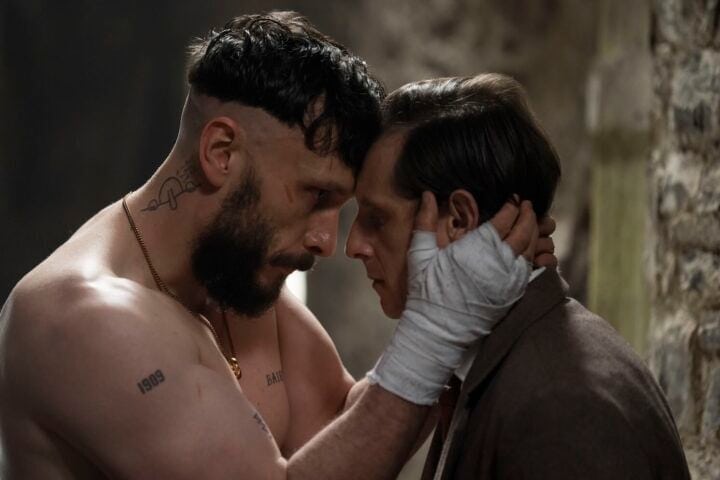
David Mamet may not be the visual stylist that Jean-Pierre Melville was, but in most other respects, his Redbelt is faithfully cast in the tradition of the great French auteur's Le Samouraï. As in Melville's brooding gangster classic, Mamet's film focuses on a lonely, figurative samurai devoted to a governing code, in this case a jiu-jitsu instructor named Mike Terry (Chiwetel Ejiofor) who runs a Los Angeles martial arts academy where he trains both lay people and cops. Already low on cash, much to his clothing designer wife's (Alice Braga) chagrin, Mike becomes ensnared in grave personal and financial circumstances after an accidental shooting at the academy and a bar fight involving a movie star (Tim Allen). The gears of fate soon begin turning, and Mamet takes thoughtful time laying out the forces that will, in due course, thrust Mike into the professional mixed-martial arts fighting arena which he shuns because, as the teachings of his red-belted master counsel, "A competition is not a fight."
As shot by Robert Elswit, Redbelt is clean and compact, its cinematography and editing exhibiting a clipped vigorousness that thankfully isn't complemented by the writer-director's usual, rat-a-tat-tat staccato verbal sparring, which makes only very occasional appearances. Brutal briskness characterizes the sporadic hand-to-hand combat sequences, though the story's prime concern is violence against not the body but the soul, as Mike's struggle isn't really against any particular opponent but a life and world in which wealth, status, and comfort are valued more than honesty, honor, and loyalty. It's a moral conflict expertly conveyed by Ejiofor, who, whether delivering stern lessons to his police officer student and friend Joe (Max Martini) or dealing with a host of shady businessmen (including Mamet regulars Rickey Jay and Joe Mantegna), smartly expresses his character's staunch conviction with hints of sorrow born from the recognition that devotion to his "code of the warrior" and its rituals inevitably means pain for himself and those he cares about.
This being a Mamet work, a central con naturally figures into the proceedings, and despite the capable orchestration of that subterfuge, the knowledge that a climactic revelation lies in wait diffuses at least a measure of suspense. Yet unlike so many of the director's previous cinematic puzzle games, Redbelt cares far less about tricking its audience than about plumbing its protagonist's psyche in a way both viscerally exciting and intensely analytical, a nifty trick that's aided by a host of uniformly sturdy but tonally divergent supporting actors (dainty Emily Mortimer, chilly Rebecca Pidgeon, hammy Rodrigo Santoro, goofy Tim Allen) who don't, at first glance, seem well-suited to coexist with each other. Yet that, ultimately, is the real trick Mamet pulls off: finding a way to make his latest's disparate elements—its formulaic sports industry critique, its narrative twists, its mismatched performances, and its sometimes overt, sometimes understated articulations of theme—perfectly coalesce into a precise, invigorating portrait of the difficulty and nobility of remaining true to oneself.
Redbelt @ the Tribeca Film Festival
Tribeca Film Festival: My Winnipeg

What is home, and if we want to leave but can't, why not? So asks Guy Maddin in a "docu-fantasia" about his native and lifelong city, My Winnipeg, his third consecutive feature with a protagonist named Guy Maddin (Darcy Fehr), here glimpsed throughout as one of several dozing, twitching night-train passengers headed out of the snowy, bone-freezing capital of Manitoba. But the dominant Maddin is the narrating filmmaker, more palpably present than usual in the sound of his voice, bemoaning a lost golden age of his hometown—"the heart of the heart of the continent"—and as usual excavating his memories, family history, and sense of self through the visual tropes of '20s and '30s cinema, and the straight-faced absurdities of the tall tale. Unlike some of his recent movies, My Winnipeg isn't "silent," or even confined exclusively to the distant past, but it gives its subject a fixed, eternal identity. "IF ONLY…" a recurring title card reads; to Maddin, his Winnipeg, built on disappointments and losses, is the birthplace of regret. By turns madcap and painfully nostalgic, it's at heart a mournful fugue to origins, aging, and something like forgiveness, familial and civic.
Maddin—that is, the questing narrator, who might bear roughly the same relationship to the director as the film's fanciful setting does to the real city—remembers living over the hair salon operated by his mother and aunt, a "gynocracy" whose air vent sends the odors of talc, shampoo, and purses into his room, all "the smells of female vanity and desperation." And so he begins exploring his identity as a Winnipegger via the "domestic experiment" of moving his octogenarian mother (Ann Savage, the wicked dame in Edgar G. Ulmer's 1945 Detour) back into his childhood home, along with young actors hired to play her children for the reenactment of their youthful crises. (How long-dead Dad is present is best discovered yourself.)
Difficult mothers appear in Maddin's films as reliably as infuriating or absent fathers in the work of Wes and P.T. Anderson, and Savage, though her acting shows rust, gives a noirish bite to her harpy's purple tirades. Deer fur and blood on the fender of her daughter's car isn't sufficient evidence to explain a late-night return from a date; Mother Maddin knows it's just a metaphor made visible for "real action" in the back seat. "Was it the boy on the track team or the man with the tire iron?" she hisses. This house-lab episode is suitably brief, as Mom's role on a long-running local TV soap illustrates the futility of attempting to excise trauma at the hearth: On every daily episode, a would-be suicide (Fehr again) is talked off a ledge by his mother (Savage). The old woman's face, seen looming in the skies by sleepy Guy from the train window, and seeming psychic powers do not suggest a dragon that can be tamed or slain.
Though the two rivers at whose confluence the city stands are linked by a dissolve to maternal vaginal folds ("the Forks, the lap, the fur"), it's in the urban landscape itself, its history, and its punishing winters that the film locates older, less familiar wounds. In his Winnipeg, Maddin sees the world's leading city of sleepwalkers, who are permitted to gain entry to any of their past residences with a biographical set of keys they commonly carry. Its daunting snows turn a maze of unnamed, unpaved back alleys into an alternate system of streets by cab-riding citizens. Other historical episodes ooze Freudian sublimation and repression: city fathers hold séances at the provincial government HQ, culminating in a zombified ballet; bare-legged girls at a convent school play a key role in post-WWI labor riots; the amusement park is leveled by stampeding bison, panicked over a male-male coupling in the herd; the 1930s mayor judges a male beauty contest in the Hudson's Bay department store restaurant amid tables of cooing matrons. And similar levels of subterranean mystery are plumbed from Guy's boyhood. The municipal swimming pool for boys, in a basement beneath the girls', is the site of a nude group frolic, title-carded "The Dance of the Hairless Boners." Working as a towel jockey at the local hockey venue, Guy meets a Soviet ice idol in the showers and takes his jersey home to rapturously don it. (Maddin continues to display the queerest sensibility of any contemporary hetero auteur.)
Skeptics may continue to see the zanier surfaces of My Winnipeg as a sort of whimsy with an attitude, given its juxtapositions of rear projection and gauzy black and white with unhinged sight gags, nudity, and Canadian pop songs like "Moody Manitoba Morning." But it has the feel of a personal accommodation, possibly one the real-life Guy Maddin has already made, with ambivalence and the way the march of time can seem married to the ascendancy of mediocrity. (But given that this Winnipeg's largest bridge is a bargain purchase relocated from the Nile, and its prime tobogganing hill a landfill that will occasionally impale children on disgorged junk, second-ratedness appears to be an established seam of the social fabric.) A city that's razed its temple of hockey, in which Maddin posits a team of ancient ex-athletes skating as demolition plaster falls around them, and mammoth retail palace in favor of a ticky-tacky arena and a mall has still failed to destroy the collective memory of its residents. Whatever pull Winnipeg still exerts over its moviemaking son is more likely in the fossil-like snow prints his feet leave on the front walk for months, or the recollection of the simple domestic cocoon of his clan's white block house.
My Winnipeg @ the Tribeca Film Festival
Tribeca Film Festival: Baghdad High

Baghdad High combines the video diaries of four Iraqi teen boys during their 2006-07 senior year in the violence-fraught capital. The boys are religiously diverse "sons of Mesopotamia" who look to pass their national exams while U.S. helicopters patrol overhead, power outages persist, checkpoints must be negotiated every morning, and nighttime walks to a neighbor's house are a mortal risk. Putting the trials of MTV reality-show prima donnas in perspective, the middle-class quartet will be relatable to this BBC/HBO production's audience in their easy embrace of Western kid stuff (dopey cell-phone videos, Britney and 2Pac as bedroom accompaniment for Koran study, "fuck!" as an interjection in Arabic sentences) and dealings with generational tensions (the frustration and anxiety of anguished parents grappling with financial and political hardship and the option of abandoning Baghdad, as a quarter of the school's students do by midyear).
In assembling their protégés' footage and augmenting it with interviews with their families, directors Ivan O'Mahoney and Laura Winter balance portraying an everyday sense of the adolescents' wartime anxiety with the more commonplace juvenile relief; a friendly insult in this time and place is "If Chemical Ali really wanted to destroy the north, he'd fill a rocket with (your) socks." Reflecting their elders' varying reactions to Saddam's conviction and execution, from exultation to concern, the boys' nerves fray at the imminent verdict of their exam grades; unsure if their tenuous nation is on the edge of civil war, to pass on to university offers an uncertain but plausible hope for a future of stability and peace. Words on the country's combative political factions or the American agenda are scarce in Baghdad High; its students' wary eyes, shaky confidence, and will to endure another day in the war zone that is home are the spine of its argument.
Baghdad High @ the Tribeca Film Festival
Tribeca Film Festival: Elite Squad

Hawking a simplified view of cause and effect, José Padilha's Elite Squad would make a fitting double bill with Nick Broomfield's Battle for Haditha. Broomfield's narrative fiction, a dubious recreation of the November 2005 massacre of 24 Iraqi civilians by a group of Marines, "humanizes" the Muslim woman by having her take her clothes off, while the American soldier is reduced to a Cro Magnon type: Social despair is described aloud but hardly ever seen ("We've got no water, no electricity. Our kids can't even go to school. This is Haditha!" says the terrorist who triggers the film's violent whirligig), while the mentality of the Marine is assessed through shrill bullet-points (Broomfield naïvely implies that the tragedy at Haditha might have been avoided had doctors been made available to troops prior to the end of their tour of duties). Like Broomfield, Padilha similarly shuns nuance, but his one-note Elite Squad is more pitiful—an instruction manual of sorts that doesn't illuminate police corruption and violence so much as it revels in it. Incessantly narrated by Nascimento (Wagner Moura), a BOPE (Batalhão de Operações Policiais Especiais) captain who is looking for a worthy successor, the film maintains a clinical remove from its material, beginning as a dull buildup to a violent skirmish between thugs and police outside a favela rave before settling into a Full Metal Jacket-style examination of police troops being sculpted into killing machines, prior to the Pope's 1997 visit to Rio de Janeiro. Nascimento is essentially a fly on the wall, and as the story cuts between the violent hubbub in the favelas to police rookie Matias (Andre Ramiro) making his way through school, where he rubs shoulders with lighter-skinned intellectuals, the reality of how people are divided along racial and economic lines is condescendingly laid out to audiences. "I wonder how many kids we have to lose for a playboy to roll a joint," Nascimento coldly remarks after some brutal depiction of police brutality, while that violence is both uninterestingly assailed and rationalized in Matias's classroom. By the time Foucault is alluded to for the umpteenth time, audiences may resent the film for doing all the thinking for them—maybe even long for the flashes of human interest that the similarly flamboyant City of God and its kissing cousin City of Men provided.
Elite Squad @ the Tribeca Film Festival
Tribeca Film Festival: Confessionsofa Ex-Doofus-ItchyFooted Mutha

Melvin Van Peebles has handmade a bildungsroman that isn't merely energetic enough to be called "spry" work for a 75-year-old independent filmmaking legend; Confessionsofa Ex-Doofus-ItchyFooted Mutha is downright effervescent. Celebrated for Sweet Sweetback's Baadasssss Song and Story of a Three-Day Pass, the veteran autodidact has shot a bouncy shadow play with an HD cam, utilizing animation, stock footage, irises, wipes, multi-exposures, split screens, and every other effect in the basic digital book. A knowing, picaresque folktale shot with few attempts to literally represent period (the streets of New York are contemporarily as is, and one character wears a "BAADASSSSS" t-shirt), Mutha has Van Peebles narrating and playing a loose version of himself from age 10 to adulthood, garish in sweater vests, shiny belt buckles, and fiery red pants, an old man re-inhabiting and mythologizing his young life like a nearly-one-man production of The Man Who Shot Liberty Valance. (There is a large cast in small roles, from son Mario to '60s satirist Paul Krassner, but they're essentially accessories.)
Van Peebles's Candide figure is a Chicago boy who can no longer salve his "itchy feet" with library travel books and sets out hitchhiking for the Gulf of Mexico and, after fleeing a gangland execution of an obliging trucker, ends up swimming down the Hudson to New York, finding eventual but oft postponed true love with Harlem choirgirl Rita—whose wholesome domesticity, complete with burnt cookies, revives his wanderlust. In the Merchant Marine, his ladykilling flourishes: "I opened every bar and every pair of legs from here to Kyoto." His antics in saving a stash of cash by following a shipmate's industrious servicing old ladies in every port is typical of Van Peebles's wry, earthy yarn-spinning. Scored with his own gospel/blues/jazz/funk instrumentals and songs based on a Broadway-mounted play of his own from the early '80s, it's Van Peebles's equivalent of the quaint, crazed autobiographical fables of Guy Maddin, a tall tale featuring a long-buried cashbox, fateful encounters with a bloody African dictator and a jungle gorilla in heat, and the explosive defeat of pirates on the high seas. Even if it doesn't quite sustain its spell for the full 99 minutes, it's an infectious autumnal work brimming with wit and love of life.
Confessionsofa Ex-Doofus-ItchyFooted Mutha @ the Tribeca Film Festival
My So-Called Montage
Because I'm never done telling people that My So-Called Life is one of the greatest television shows of all time, because someone should publish The Tao of Angela Chase, and because Rich Juzwiak is the king of the viral montage, I'd like to call attention to his incredible clip reel of who he calls the anti-Juno's private thoughts (only one of her essential universal truths is missing: "When you're not sure you trust a person anymore, say a person you really trusted, say your father, you start wishing they'd do something, like, really wrong, just so you could be right about them"). If none of those reasons are enough for you, then watch it because of the plaid. It's all about the plaid. Check it out below and then head on over to fourfour, where I hope we'll soon find clip reels for the rest of the characters (hint, hint, Rich):
And that, folks, is why My So-Called Life was cancelled.
Wiiging Out
There are many reasons to be thankful that the writers' strike is over, and many reasons to hope an actors' strike doesn't materialize, not least of which is Kristen Wiig on Saturday Night Live. There won't be another new episode until May (what's up with that?), so here's a little Wiig to tide you over. The first clip is of a new character from last night's episode who's kind of a rip-off of Wiig's Penelope but is astounding nonetheless, and the second is, well, a surprise!
Race Doesn't Matter
This year, the original King Kong celebrates its 75th anniversary, and thanks to Turner Classic Movies (the most watched channel here at Slant), I finally saw it last night. I spent half of the duration of the film amused (literally laughing out loud at Robert Armstrong's over-the-top performance and ridiculous dialogue, Kong's pearly-white grin, the T. rex's wrestling finesse, and the agile, water-friendly, man-eating Brontosaurus) and, having never read a single piece of criticism about the film, I spent the other half horrified at its blatant racism. To be fair, the film's special effects are an astounding achievement for 1933, but Old Hollywood's racial sensitivity—not so much.
I arrive only slightly less belatedly to the controversy surrounding the latest cover of Vogue magazine, on which NBA star LeBron James and supermodel Gisele Bündchen, photographed by Annie Leibovitz, pose as King Kong and Fay Wray. In case there's any skepticism about whether it was intentional or not, here's a side-by-side comparison that's been circulating the Internets:

If there's any sort of timely political commentary here, it's clearly lost on Gisele.
In other racially sensitive news, Absolut Vodka is pulling a Mexican ad that depicts a map of North America circa 1847 in which Mexico's border swallows up nearly half of the United States. Naturally, complaints and threats of a boycott from sensitive U.S. citizens ensued. Because, you know, we took their land fair and square and Mexicans should just shut the fuck up about it. They're hurting our feelings. According to Reuters, one wounded blogger with nothing better to do and plenty of gas money to burn wrote: "I have poured the remainder of my Absolut bottles down the sink." Somewhere, a hobo weeps.

Single Review: Madonna & Justin's "4 Minutes"

"4 Minutes" is so fucking meta (and its creators so egomaniacal) that I wouldn't be surprised to find out that Madonna and Justin Timberlake actually sat down with the specific intention of writing a song that could literally save the world and, instead, wound up writing a song about the hassle of writing a song that could literally save the world. Put simply, the song's lyrics—which at first seemed confusing and muddled to those of us who expected it to be about, you know, saving the world from climate change, or the AIDS pandemic in Africa, or George W. Bush—attempt to illustrate what it's like to write and/or perform a pop song that could actually succeed at doing one of those things, or making the bourgeoisie and the rebel come together in every nation. Or maybe it's not even that deep. Madonna wants to get into the groove. Justin is willing and able. Madonna wants it fast. No, she wants it slow. Wait, both! Justin can handle that, but Madonna needs to make up her damn mind first. "Tick, tock, tick, tock," she nags. "Don't be a prima donna," Justin says. This is what it must be like to work for the notoriously impatient superstar. Thank God for that colossal, ridiculously infectious horn riff. Without it, "4 Minutes" would be nothing but a busy assemblage of dubious clichés, mediocre vocals, and Timbaland's heard-it-all-before marching band beats and irksome "ick-y ick-y" banter. And then there's the video, helmed by the team who brought us Justice's "D.A.N.C.E." Madonna, freshly tightened by her surgeon and looking better than Justin's ex, does her usual pelvis-thrusting flexi-combat dance moves (when in doubt—or in lack of a choreographer—strike a yoga pose, right?), but hey, she makes pushing a car look sexy. And what little concept there is—encroaching, flesh-devouring black glass represents the battle against time, or something like that—actually helps solidify "4 Minutes" as the quintessential statement on the crushing pressures of being a Kabbalist pop star at 49.
Goldfrapp Finds "Happiness"
The guy in the new Goldfrapp video must have just upgraded Mariah's network to 802.11n. This warms our cold, gray hearts…and makes our feet hurt really bad:
Consolers of the Critical

The statement in the press release regarding the new Raconteurs album, Consolers of the Lonely, was telling in its word choice—the album's quick recording-to-release turnaround was designed so no one party would have the "upper hand"—but the quote wasn't attributed directly to Jack White. I assumed it came from him because it's consistent with his twitchiness and his authenticity fetish, but I suppose it's irrelevant exactly who made the statement; what's significant about it is the hardline defensiveness it reflects.
While I can't say that it's an attitude that's entirely on point with regard to the broad critical community (the underlying competition among the most high profile music blogs to stay several months ahead of an arbitrarily defined curve, which I would speculate is the source of defensiveness here, really came to a head during the pre-release hype for Clap Your Hands Say Yeah's first album and has only been scrutinized further thanks to Black Kids and Vampire Weekend), I also can't say that it's entirely unfounded. There is a definite impulse, as Ann Powers wrote in the Los Angeles Times last week, to be first, and a corresponding empowerment that accompanies it: Whether or not any one writer wants to admit to it, I like the idea that one of my reviews may have an impact on even one of the few people who read them.
At least for me, though, the more salient point that Powers makes is that good criticism is about furthering a conversation, about why a particular piece of work is enduring, how historical and cultural changes influence our perceptions of artistic value, or how something fits into a broader context (and the phrase "the context mafia" is dead-on). Criticism, when done well, isn't just a matter of approving or disapproving of something, or of building "hype" for the explicit purpose of riding out the even-more-fun backlash a few months later. What the situation with the Raconteurs does, then, is expose exactly where the machinery breaks down: Writers feel increasing pressure from the PR side to have a statement (preferably a good one) ahead of release date, with the hopes that enough good "buzz" might somehow translate into better sales. Artists like the Raconteurs and Trent Reznor, however, feel that there's something inherently dishonest with that process, in that it isn't about contextualizing their work but is, instead, about music writers comparing dick size. Neither party, in this case, is wrong.
That said, I do think it's worth noting—which Powers doesn't—that there are far more instances of artists who have been the subject of significant "hype" within the critics' community whose albums (both those that seemed commercially viable, like Anniemal or Arular, in addition to hard-sells like I Am a Bird Now) that have moved literally tens of units on their release dates. Anyone looking at music writers, either the print or online varieties, and their hype or their backlash as some kind of arbiter of broad-based influence is misguided.
Personally, it's a tough balance. I like to think it would be easier were I not also juggling a full-time "real" job and grad school, but I can't say for certain that it would be. I try to stick to street-date deadlines, but I'd be lying if I said I wouldn't rather spend an extra two weeks on most everything that I review to see if I have something more substantive to say about an album like, to pick one at random, the Punch Brothers' Punch. To a similar end, I'd also be in favor of doing away with star ratings altogether; I'm already on record about how I feel about Ebert and his thumb and the set of expectations that go along with them. And I think the Raconteurs' position reflects not only a reasonably well-justified defensiveness, but that same judgmental-thumbs perspective of what a good deal of current "criticism" offers: a consumer guide that doesn't have a whole lot to do with the content or the context of what's supposed to be art. If they're rejecting that, I can't say that I blame them.
Foster Child (Brillante Mendoza)

An issue film that doesn't play like one, Foster Child hangs compellingly from the shoulders of its characters, and though the influence of the Dardennes is felt, director Brillante Mendoza doesn't aim for claustrophobic effect. Like Jeffrey Jeturian's The Bet Collector, part of this year's Global Lens series, the filmmaker's docu-realist gaze absorbs a Philippine community's way of life without prejudice or judgment, roving narrow streets and capturing seemingly unrehearsed episodes of joy and panic with equal fixation. Much of the movie consists of Thelma (Cherry Pie Picache) simply getting around town and doing the only thing she knows how: being a mother. Under her foster care is a strangely silent little boy named John-John (Kier Segundo), whom she tends to just as she would her own blood, feeding him, clothing him, and in one particularly expressive scene, bathing him until she makes the mistake of going to get a towel, thus allowing him to piss on the street and run off to get dirty again. The boy's seemingly uncontrollable need to urinate is a running gag as amusing as it is touching, and as in a scene where Thelma's son helps the boy aim his dingaling into a toilet bowl, the film attests to the role of motherhood in society and the way in which behavior is ingrained at an early age. The film's goodwill is only squandered once, when Mendoza condescends to Thelma's know-how when she walks into a pimped-out shower inside a luxe hotel room, all in the interest of expressing the differences between the haves and have-nots and point out the absurdity of a shower with too many knobs accomplishing just as much—if not less—than a bucket filled with water, but the focus he places on the bounty of family ritual is not easily forgotten, not unlike the final shot in the film, which literally and figuratively looks up to Thelma and the role she fulfills in her society. (The 2008 New Directors/New Films program begins today and runs to April 8.)
Single Review: Kylie Minogue's "All I See"

Kylie Minogue has churned out three singles from her album X since its international release last year, but it's another song, "All I See," that will be the record's official first single in the U.S. It's one of only three tracks that don't seem to fit the otherwise consistent Euro-disco mash-up of the singer's 10th studio album (the belated Ray of Light rip-off "No More Rain" and the Fergie/Gwen-meets-the-Pussycat-Dolls-meets-"SexyBack" monstrosity that is "Nu-Di-Ty" are the other offenders), but that's exactly why it's a perfect fit for this country. In his review of X, Slant critic Dave Hughes compared "All I See" to Janet Jackson's 1997 house hit "Together Again," and while the breathy vocals are totally Janet, the rest of the song is a virtual carbon copy of Ne-Yo's "Because of You," right down to the measured 4/4 beat and harpsichord:
If radio programmers could find room on their playlists for Natasha Bedingfield's market-pandering "Love Like This," then surely they can find space for "All I See." Although a remix featuring MIMS will be serviced to radio stations soon, there's still no video in sight, so if the song fails, Kylie's American fans can blame her record label, which hasn't figured out how to market the superstar in the U.S. since "Can't Get You Out of My Head."
Barack Obama: A Story of Race and Politics

Below is a snippet from Dreams from My Father, in which Barack Obama describes watching Marcel Camus' Black Orpheus, the first foreign-language film his mother, Ann Dunham, had ever seen.
"We took a cab to the revival theater where the movie was playing. The film, a groundbreaker of sorts due to its mostly black, Brazilian cast, had been made in the fifties. The story line was simple: the myth of the ill-fated lovers Orpheus and Eurydice set in the favelas of Rio during Carnival. In Technicolor splendor, set against scenic green hills, the black and brown Brazilians sang and danced and strummed guitars like carefree birds in colorful plumage. About halfway through the movie, I decided that I'd seen enough, and turned to my mother to see if she might be ready to go. But her face, lit by the blue glow of the screen, was set in a wistful gaze. At that moment, I felt as if I were being given a window into her heart, the unreflective heart of her youth. I suddenly realized that the depiction of childlike blacks I was now seeing on the screen, the reverse image of Conrad's dark savages, was what my mother had carried with her to Hawaii all those years before, a reflection of the simple fantasies that had been forbidden to a white middle-class girl from Kansas, the promise of another life: warm, sensual, exotic, different."
When I flip through Dreams from My Father, I marvel at the way Obama discusses race, an integral part of his being, and I find camaraderie in his passion, his rage, his frustrations, his curiosity, his understanding, and most of all his conviction. I read Obama and I ponder the way critics like Armond White discuss racial identity and critics like Amy Taubin discuss sexuality, sometimes with deliberate calculation and desire to provoke but always as a natural expression of their distinctive being and as a fearless extension of their life experience, and I am reminded of the hate mail that filters into my inbox, almost regularly since the jejune days of this site, in which I am called a faggot, a spic, a wetback, sometimes worse, at which point I wonder and sometimes laugh at the pain that has nearly provoked me at times over the years to cover my mouth and hang up the skates.
People asking critics to keep their sexual, racial, and gender politics out of their reviews is as insulting to me as asking America to pretend Hillary Clinton doesn't have a vagina or Barack Obama's face ain't white. "If Obama was a white man, he would not be in this position," said Geraldine Ferraro earlier this month about Obama. "And if he was a woman (of any color) he would not be in this position. He happens to be very lucky to be who he is. And the country is caught up in the concept." Obama supporters cried foul, calling Ferraro a racist, as if they hadn't seen the poll numbers that reveal Obama's support among blacks, as if they never read his books or heard his speeches; if they had, they might understand that Obama's race is exactly what makes him so special.
However knee-jerk and unpolished, Ferraro's words acknowledge a mystique surrounding Obama that, in some ways, is not unlike the support Brokeback Mountain received a few years ago, when the film was perceived by gay rights activists posing as critics as a first-of-its-kind: the first mainstream gay-themed film to make money, and one to ostensibly turn the heat down on the nation's homophobic temper. It didn't seem to matter that Brokeback was about as aesthetically radical as a Bob Ross painting, only that it was a coup for gay representation on the big screen, and when it lost to Crash for Best Picture, the enraged chalked it up to homophobia, never considering that Crash, infinitely worse than Ang Lee's prestige picture, simply appealed more strongly to a different, more insular, more topical sort of political bias. Of course, where the Obama-Brokeback analogy diverges is that while Obama does seem to inspire a certain degree of blind, therefore disingenuous, devotion from his base, I can't say it's unfair.
As evidenced by Dreams from My Father, talking about race comes naturally and forcefully to Obama, a point the media, Obama himself, or his campaign hasn't really been upfront about, no doubt because the Obama campaign, like Scarborough, understands that the perceived antagonism of Sharpton, who some think gave the most important speech at the 2004 Democratic National Convention, is not something they want to come close to evoking. In Dreams from My Father, I get a sense of a tougher, more vigilant and conflicted Obama, one who thought about and lashed out against the cruelty of racism in its many manifestations (like the people who would traipse into his Harlem neighborhood so their dogs could shit on his sidewalk, like the white lady in the elevator of his grandparents' Hawaii apartment building who thought he was stalking her), one who has struggled to understand, sometimes defy the stereotypes of black experience, an Obama I have rarely seen on television. Until this week.
This is the Obama who once wrote: "Look at yourself before you pass judgment. Don't make someone else clean up your mess. It's not about you. They were such simple points, homilies I had heard a thousand times before, in all their variations, from TV sitcoms and philosophy books, from my grandparents and from my mother. I had stopped listening at a certain point, I now realized, so wrapped up had I been in my own perceived injuries, so eager was I to escape the imagined traps that white authority had set for me. To that white world, I had been willing to cede the values of my childhood, as if those values were somehow irreversibly soiled by the endless falsehoods that white spoke about black."
Obama's political courage should be studied, and though his speech was generally well-received, he has been declining in polls (against both Clinton and McCain) since the Wright scandal, and one wonders if he'll fully recover, having dared to go where few, if any, politicians ever go, having suggested that race should be kept on the table, having shown that his smoldering desire to cultivate conversation about how people are split along racial and ideological lines is not only essential to healing our nation but reaching out and brokering peaceful relations with the non-white leaders of nations abroad. It appears that he will be the Democratic candidate for president, and though I worry for the mental health of anyone who would opt for McCain over Obama, if Obama were to lose in November, he always has a career as a film critic.
I Best Not Catch This Clip on YouTube
Because I'm not sure what I despise more, Sally Shapiro's attempt at "mystique" via pathological shyness, the frequency with which clips are removed from YouTube for "copyright infringement" (as if those videos do anything but help promote said artist, album, TV show, movie, porno flick, etc.) while racist, sexist, ageist, homophobic, and other hateful comments (not to mention clips) remain unregulated, or the frequency with which Mariah Carey attempts to recapture past successes by doing the same thing ad nauseam, I'd like to point Slant readers to a recent mash-up of Mariah's soon-to-be-#1 "Touch My Body" and Pebbles Flintstone's unintelligible babytalk by our friend Rich Juzwiak, whose YouTube account was permanently suspended for posting a live clip of Sally Shapiro's DJ gig at Mercury Lounge, which we almost attended but thankfully had the last-minute wisdom not to, on his blog fourfour: