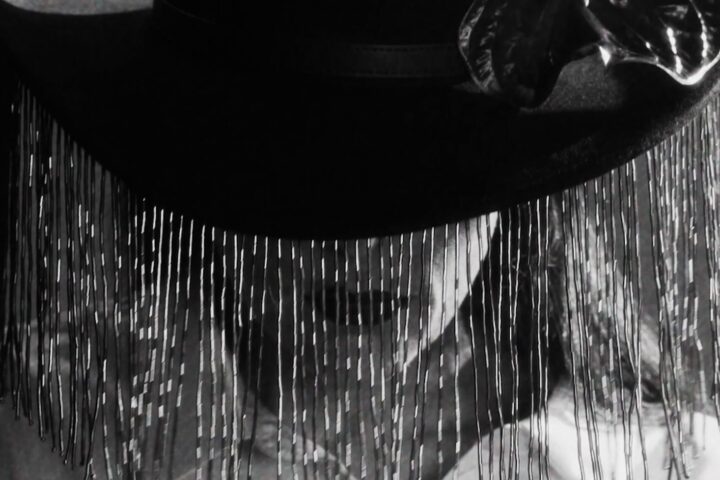
The Fall of the House of Usher (Jean Epstein, 1928)
By: Ed Gonzalez On: 08/02/2006 00:24:15 In: Blog-a-Thon Comments: 1

First, a distinction—or, rather, an abstraction—by Jean Epstein: that The Fall of the House of Usher is based on the themes of Edgar Allen Poe's famous short story of the same name. The gothic-printed message of the title card forecasts the film's ether-ness (its avant-garde inquest of the real through an incantation of otherworldly atmosphere), which crests over us like the veil of the cinema's original corpse bride. Through kaleidoscopic composition—of prismatic swamp water, soggy terrain, and branches that caress the sky like fingers—Epstein affects Rorschach-like chiaroscuro, every image a dense, sludgy viscera, a looking glass held up to the audience and characters, daring us to pass through.

The staircase outside Usher's house is the final check point between here and there, winding down and around to the ground and shot by Epstein so that the landscape of the film is sliced into three very distinct spatial planes: foreground, middleground, and background. This profound consideration and demarcation of cinematic space gives this masterwork of the silent era a striking 3D-like complexity, and its power is such that the long shot of a dog running away from the house of Usher induces a cataclysmic sense of fear and strangulation, as if the animal weren't running down a road but falling into a bottomless abyss.

The world inside the house is no less frightening, a phantasmagoria of transmigrating vibes where Usher's wife Madeleine (Marguerite Gance)—one in a long line of obscure objects of desire—travels in slow-motion torpor, caught by the camera at odd or oblique angles, like the shot of the woman glimpsed through the strings of a harp. The film's images pluck the heart, which is apt given that the aristo Usher (Jean Debucourt) paints his ostensibly sick wife as if he were performing a transfusion. To the faithful-hearted Usher, Madeleine is a keepsake, a genie to lock inside his canvas-bottle and whose wedding dress, like make-a-wish plumes of smoke, haunts his imagination and memory.

The film's tour-de-force is a hulking funeral procession of overlapping visual textures and animal-like camera movement, a startling vision of metaphysical passage and metamorphosis. With the castle's dripping candles in ominous tow, the men proceed through land and water toward the netherworld of Usher's catacombs, with Madeleine's veil weighing them down like an arm digging into the ground; all the while, an owl keeps ominous watch and two toads get their groove on. Madeleine will not go gently into this sinister night, nor will Usher let her, insisting that her coffin remain unnailed, which, in effect, precipitates a supernatural spill between worlds.

What was theoretical in Epstein's The Three-Sided Mirror is here loosened and made even more lucid and ethereal, and from its first image of a visitor with busy fingers wading through a tangle of trees and branches to the final orgy of poetic destruction, the director intensely considers the push-pull relationship between life and art, the precarious soul-suck between the two and the chaos their battle risks. When Debucourt's Usher looks at his painting, he is both staring at the visage of his elusive wife's representation and the audience itself. Epstein treats celluloid not unlike Usher's canvas—a delicate, fragile thing to draw on (slow or fast, sometimes twice, thrice, four times over)—and to look at the screen of this film is to witness a portal into a complex, heretofore unknown dimension of cinematic representation.


First, a distinction—or, rather, an abstraction—by Jean Epstein: that The Fall of the House of Usher is based on the themes of Edgar Allen Poe's famous short story of the same name. The gothic-printed message of the title card forecasts the film's ether-ness (its avant-garde inquest of the real through an incantation of otherworldly atmosphere), which crests over us like the veil of the cinema's original corpse bride. Through kaleidoscopic composition—of prismatic swamp water, soggy terrain, and branches that caress the sky like fingers—Epstein affects Rorschach-like chiaroscuro, every image a dense, sludgy viscera, a looking glass held up to the audience and characters, daring us to pass through.

The staircase outside Usher's house is the final check point between here and there, winding down and around to the ground and shot by Epstein so that the landscape of the film is sliced into three very distinct spatial planes: foreground, middleground, and background. This profound consideration and demarcation of cinematic space gives this masterwork of the silent era a striking 3D-like complexity, and its power is such that the long shot of a dog running away from the house of Usher induces a cataclysmic sense of fear and strangulation, as if the animal weren't running down a road but falling into a bottomless abyss.

The world inside the house is no less frightening, a phantasmagoria of transmigrating vibes where Usher's wife Madeleine (Marguerite Gance)—one in a long line of obscure objects of desire—travels in slow-motion torpor, caught by the camera at odd or oblique angles, like the shot of the woman glimpsed through the strings of a harp. The film's images pluck the heart, which is apt given that the aristo Usher (Jean Debucourt) paints his ostensibly sick wife as if he were performing a transfusion. To the faithful-hearted Usher, Madeleine is a keepsake, a genie to lock inside his canvas-bottle and whose wedding dress, like make-a-wish plumes of smoke, haunts his imagination and memory.

The film's tour-de-force is a hulking funeral procession of overlapping visual textures and animal-like camera movement, a startling vision of metaphysical passage and metamorphosis. With the castle's dripping candles in ominous tow, the men proceed through land and water toward the netherworld of Usher's catacombs, with Madeleine's veil weighing them down like an arm digging into the ground; all the while, an owl keeps ominous watch and two toads get their groove on. Madeleine will not go gently into this sinister night, nor will Usher let her, insisting that her coffin remain unnailed, which, in effect, precipitates a supernatural spill between worlds.

What was theoretical in Epstein's The Three-Sided Mirror is here loosened and made even more lucid and ethereal, and from its first image of a visitor with busy fingers wading through a tangle of trees and branches to the final orgy of poetic destruction, the director intensely considers the push-pull relationship between life and art, the precarious soul-suck between the two and the chaos their battle risks. When Debucourt's Usher looks at his painting, he is both staring at the visage of his elusive wife's representation and the audience itself. Epstein treats celluloid not unlike Usher's canvas—a delicate, fragile thing to draw on (slow or fast, sometimes twice, thrice, four times over)—and to look at the screen of this film is to witness a portal into a complex, heretofore unknown dimension of cinematic representation.

The World is a Vampire: Abel Ferrara's The Addiction
By: Ed Gonzalez On: 05/27/2006 00:49:21 In: Blog-a-Thon Comments: 134

I've been an Abel Ferrara junkie ever since a friend showed me Ms. 45 at NYU, so the idea of contributing to the Ferrara Blog-a-Thon felt like a duty to one of our greatest unsung directors, but as I told Girish and Aaron Hillis before a press screening of Quinceañera at this year's New Directors/New Films series, "I don't do cliques." Ferrara might approve—fans of his films are familiar with his thou-shalt-not-conform ethos—but then I got an annoying email from Quinceañera co-director Wash Westmoreland that worked to change my mind. Westmoreland objected to my review of his film on the grounds that I was insulting him and his directing partner when I wrote that they were inserting themselves into their movie by way of the story's lascivious white gay couple. I told Westmoreland: "Lili Taylor is Abel Ferrara's proxy in The Addiction, doesn't mean I think Ferrara has tits or likes to suck blood."
Having used one of Ferrara's films as mace, something had clicked: the Ferrara film as a weapon of choice. Together, the man's films suggest a set of steak knives—sharp and serrated, they leave behind wounds that are not easily healed or forgotten. I've tried them all with the exception of Mary and Nine Lives of a Wet Pussy, and while it isn't my favorite one to handle (the heady and dissonant Snake Eyes, the elegiac The Funeral, and the bonkers Ms. 45 are tops), The Addiction provides the cleanest cut. It is somewhat of an anomaly for the Bronx-born director, sheathed as it is in a black-and-white, expressionistic cloak, but it's thrown at you with the same moral, guttersnipe effrontery as Bad Lieutenant and Fear City. Ferrara has always been cool like dat and The Addiction is a very diggable piece of horror sautéed in a beatnik sauce of Lower East Side philosophizing at once spunky and chill.
The story of Ferrara's histoire-du-cinéma: a vampire (first name Casanova, played by Annabella Sciorra) bites Kathleen Conklin (Lili Taylor), a student from the University of New York (a stand-in for the very real, monopolizing NYU, around which the film was shot). Its form: slide-show compositions that together affect slice-and-dice movement. The gist (or, rather, thesis—given the film's grad-school setting and presentation): the nature of the organism, the seduction of history, war, and myth (of vampires and man), and sex (necking at least)—gay and straight, and lots of it—bleeding together into one. Again, its form: images that suggest a self-devouring world cracking back-and-forth in tectonic-plate fashion—or an organ on the brink of rejecting itself.
The year was 1995 and Rudy Giuliani, as part of the "Disneyfication" of New York City, was beginning to clean up Ferrara's city streets with an iron grip but none of the compassion of Chistopher Walken's Robin Hood-like character from King of New York. Here, Walken stars as a withered version of his drug lord Frank White, a vampire king with all the knowledge in the world but not much power. His infection is political and personal awareness and Kathleen takes to it with fear, then resistance, and finally rapture. (Taylor's "turning" scenes are triumphs of physical performance—in a just world she would have won an Oscar for this film.) She is a foot soldier, helping to build an army with other HBO Stars of Tomorrow (among them Edie Falco) to preserve the integrity of a Big Apple that had more personality when it was a little more rotten.
This stealth, beguiling creature of a film—so alternately jejune, funny, and scary (all part of a clear-eyed evolution)—is teeming on the inside with rapidly-growing ideas about cultural and personal malaise. Through the film, which is filled with stunning images of a city in ominous transition and Taylor foregrounded against holocausts of yesterday, Ferrara extends a great line from one of Smashing Pumpkins' most popular songs, released that very same year. In it, Billy Corgan sings: "The world is a vampire, sent to drain." The title of the song, "Bullet With Butterfly Wings," like Ferrara's movie, combines poetry and violence. A political song, a political movie—perhaps the most fabulously serpentine political work of Ferrara's career, a quivering nexus of AIDS allegory, identity crisis, historical unease, and socio-economic panic. It's a small world after all, but Ferrara's is becoming the smallest of all. Keep it alive, by any means possible.

I've been an Abel Ferrara junkie ever since a friend showed me Ms. 45 at NYU, so the idea of contributing to the Ferrara Blog-a-Thon felt like a duty to one of our greatest unsung directors, but as I told Girish and Aaron Hillis before a press screening of Quinceañera at this year's New Directors/New Films series, "I don't do cliques." Ferrara might approve—fans of his films are familiar with his thou-shalt-not-conform ethos—but then I got an annoying email from Quinceañera co-director Wash Westmoreland that worked to change my mind. Westmoreland objected to my review of his film on the grounds that I was insulting him and his directing partner when I wrote that they were inserting themselves into their movie by way of the story's lascivious white gay couple. I told Westmoreland: "Lili Taylor is Abel Ferrara's proxy in The Addiction, doesn't mean I think Ferrara has tits or likes to suck blood."
Having used one of Ferrara's films as mace, something had clicked: the Ferrara film as a weapon of choice. Together, the man's films suggest a set of steak knives—sharp and serrated, they leave behind wounds that are not easily healed or forgotten. I've tried them all with the exception of Mary and Nine Lives of a Wet Pussy, and while it isn't my favorite one to handle (the heady and dissonant Snake Eyes, the elegiac The Funeral, and the bonkers Ms. 45 are tops), The Addiction provides the cleanest cut. It is somewhat of an anomaly for the Bronx-born director, sheathed as it is in a black-and-white, expressionistic cloak, but it's thrown at you with the same moral, guttersnipe effrontery as Bad Lieutenant and Fear City. Ferrara has always been cool like dat and The Addiction is a very diggable piece of horror sautéed in a beatnik sauce of Lower East Side philosophizing at once spunky and chill.
The story of Ferrara's histoire-du-cinéma: a vampire (first name Casanova, played by Annabella Sciorra) bites Kathleen Conklin (Lili Taylor), a student from the University of New York (a stand-in for the very real, monopolizing NYU, around which the film was shot). Its form: slide-show compositions that together affect slice-and-dice movement. The gist (or, rather, thesis—given the film's grad-school setting and presentation): the nature of the organism, the seduction of history, war, and myth (of vampires and man), and sex (necking at least)—gay and straight, and lots of it—bleeding together into one. Again, its form: images that suggest a self-devouring world cracking back-and-forth in tectonic-plate fashion—or an organ on the brink of rejecting itself.
The year was 1995 and Rudy Giuliani, as part of the "Disneyfication" of New York City, was beginning to clean up Ferrara's city streets with an iron grip but none of the compassion of Chistopher Walken's Robin Hood-like character from King of New York. Here, Walken stars as a withered version of his drug lord Frank White, a vampire king with all the knowledge in the world but not much power. His infection is political and personal awareness and Kathleen takes to it with fear, then resistance, and finally rapture. (Taylor's "turning" scenes are triumphs of physical performance—in a just world she would have won an Oscar for this film.) She is a foot soldier, helping to build an army with other HBO Stars of Tomorrow (among them Edie Falco) to preserve the integrity of a Big Apple that had more personality when it was a little more rotten.
This stealth, beguiling creature of a film—so alternately jejune, funny, and scary (all part of a clear-eyed evolution)—is teeming on the inside with rapidly-growing ideas about cultural and personal malaise. Through the film, which is filled with stunning images of a city in ominous transition and Taylor foregrounded against holocausts of yesterday, Ferrara extends a great line from one of Smashing Pumpkins' most popular songs, released that very same year. In it, Billy Corgan sings: "The world is a vampire, sent to drain." The title of the song, "Bullet With Butterfly Wings," like Ferrara's movie, combines poetry and violence. A political song, a political movie—perhaps the most fabulously serpentine political work of Ferrara's career, a quivering nexus of AIDS allegory, identity crisis, historical unease, and socio-economic panic. It's a small world after all, but Ferrara's is becoming the smallest of all. Keep it alive, by any means possible.
Categories
Archive
Links
- Cinematical
- Cinephiliac
- Elusive Lucidity
- Film Experience
- Film Freak Central
- fourfour
- Girish
- GreenCine Daily
- Hell on Frisco Bay
- The House Next Door
- IFC Blog
- Some Came Running
- Like Anna Karina's Sweater
- Movie Love
- The Nick Schager Film Project
- Nick's Flick Picks
- The Projection Booth
- The Reeler
- Reverse Blog
- Scanners
- Sergio Leone and the Infield Fly Rule
- Shooting Down Pictures
- SpoutBlog
- The Stranger Song
- Termite Art
- Shut Up and Deal
- When Canses Were Classeled
Website