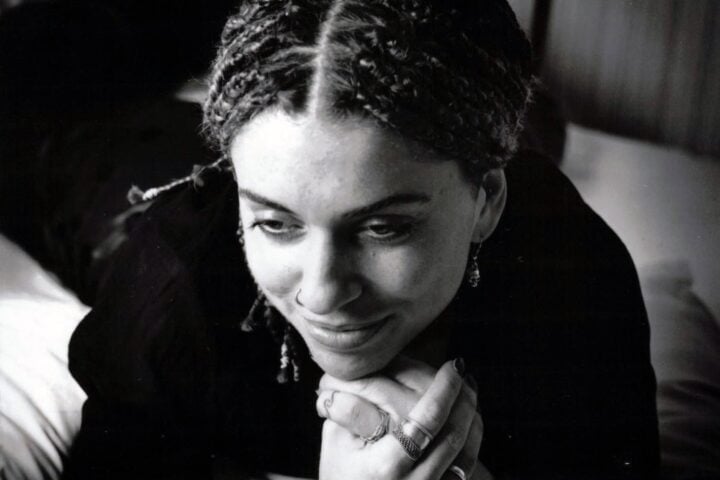
In 1997, Ani DiFranco graced the cover of Spin magazine for the very first time, a feat that was viewed as extraordinary by some. None of the folk singer’s studio albums had even been certified gold, yet the editors at the magazine knew something big was about to happen. That very year, Living in Clip, a live double-disc, topped critics’ lists and became DiFranco’s biggest seller, exposing her unique brand of folk-punk to an entire generation of mainstream rock fans. DiFranco was poised for her big breakthrough. Though she had made a career out of turning her nose up at the major labels that continually courted her, she finally seemed comfortable enough in her own skin to make the swan dive into mainstream popularity—on her own terms.
DiFranco’s extensive catalog displays a woman on a mission whose musical development went hand-in-hand with personal discovery. Each album, from the pure folk of Not So Soft to the more musically padded Out of Range and the emotionally complex yet cohesive Not a Pretty Girl, mapped out a distinct pattern of growth. DiFranco was an artist coming to grips with a society (and fanbase) that would not allow a woman to be political while wearing lipstick and a dress.
In 1996, she released Dilate, a dark and haunting mix of folk, punk, and dub influences. Many critics consider the album her best studio effort, with the singer pounding on the walls of every existing boundary in popular music. For the first time, she released a music video, a medium she had always viewed as too commercial. Co-directed by DiFranco herself, the clip was set to a trip-hop remix of the song “Joyful Girl” and featured the artist wearing an evening gown and heaps of makeup.
Seeing DiFranco perform live is essential to fully understanding the breadth of her talent. Her spastic energy, humor, and command of the stage is unrivaled, which is probably why 1997’s Living in Clip was such a huge success. But by 1998, her live audiences were changing. For the first time there were almost as many men as women, and swarms of trend-conscious teens began descending on DiFranco’s shows, due in large part to the media exposure and her new mainstream appeal. Where she had once played college campuses and small clubs, she was now selling out arenas.
There was speculation that DiFranco’s next studio album could be her mainstream breakthrough. And no one seemed more aware of this than the singer herself, writing songs about self-examination under public scrutiny that would eventually become Little Plastic Castle. It was a fishbowl concept album, with DiFranco contemplating the leap into the shark-infested waters of rock stardom on tracks like “Swan Dive”: “They can call me crazy if I fail/All the chance I need is one in a million/And they can call me brilliant if I succeed.” Released in March of 1998, Little Plastic Castle debuted at an impressive #22 on Billboard’s Top 200 chart.
Less than a year later, DiFranco returned with Up Up Up Up Up Up, a relatively understated answer to the public response of Little Plastic Castle. Whether intentional or not, it seemed DiFranco was taking a step back to more organic, folk-rooted music. For the most part, the album was super-political and generally steered clear of any references to the folk singer’s taste of super-stardom.
DiFranco’s musical progression has always made sense and each album seems to be a stepping stone to the next. And while her latest direction might not be as emotionally gripping as her previous work, she seems to have come full circle on Revelling/Reckoning. Many of the songs find DiFranco singing alone with an acoustic guitar. The appropriately titled “Garden of Simple” begins with “Some crazy fucker carved a sculpture out of butter,” a reminder of her previous lyrical prowess.
On “Sick of Me,” DiFranco grapples with growing older and mellower: “I took to the stage/With my outrage/In the bad old days…But the songs/They come out more slowly/Now that I’m the bad guy.” “School Night” finds a woman choosing between the two loves in her life, her husband and her career: “What kind of scale/Compares the weight of two beauties…I stand committed to a love that came before you.” Elsewhere, she wrestles with the time that has flown by: “She’s 19 going on 30/Or maybe she’s really 30 now.” There’s a comforting brilliance in knowing that she at least acknowledges the fact that she has changed—personally and musically.
DiFranco’s career can basically be divided into two parts: before and after Little Plastic Castle. It might seem harsh to say DiFranco has stumbled since that album, but there has been a definitive arc in her popularity. Revelling/Reckoning debuted at #50, selling 37,000 copies, significantly less than her last three releases.
The chances of DiFranco ever appearing on the cover of Spin again are essentially slim-to-none and with no music videos, MTV has little interest. Yet DiFranco is consciously limiting her exposure by not making music videos; therefore, like her gradual rise, she is once again in control. DiFranco is simply evolving and redefining the music industry along the way. Developing new artists with her own Righteous Babe Records and inspiring musicians like Prince, who are looking for alternative ways to make music in an increasingly corporate industry, seems to be what’s important to DiFranco. As she sings on “Garden of Simple”: “They never really owned you/You just carried them around/And then one day you put ‘em down/And found your hands were free.”
Since 2001, we've brought you uncompromising, candid takes on the world of film, music, television, video games, theater, and more. Independently owned and operated publications like Slant have been hit hard in recent years, but we’re committed to keeping our content free and accessible—meaning no paywalls or fees.
If you like what we do, please consider subscribing to our Patreon or making a donation.