Fukada Kōji thrives on structural quirks—on ellipses, bifurcations, and unconventional pacing that drives his audience to savor and question details that most filmmakers would take as a given. The Japanese director’s films often present themselves as genre fare, conditioning you to wait for the dropping of a narrative sledgehammer—for a punchline or a catharsis—only to reveal themselves to be concerned with that very anticipation, with a sense of being on hold, that mirrors the uncertainty of his characters.
So far, in films such as Harmonium, A Girl Missing, and, now, The Real Thing, Fukada’s governing subject has been bourgeoisie complacency—a theme that filmmakers often broach simplistically, with canned observations in mind. But Fukada is truly interested in how middle- and upper-class Japanese citizens live with their comforts, dramatizing the isolating as well as the unifying properties of their routines. Fukada’s characters tend to be thematic markers, but he sees them from multiple angles, and this unusual juxtaposition of elements allows for a kind of distanced, intellectualized empathy that can be both wearying and moving.
Adapted from a 10-episode TV series that’s been re-edited into a standalone feature, The Real Thing is certainly wearying and moving, often simultaneously. Fukada has once again set himself a structural challenge, stretching a familiar scenario for a rom-com thriller—in which a bored yuppie meets a volatile woman—out to nearly four hours. Usually such a plot, executed to perfection in Jonathan Demme’s Something Wild, traffics in wish-fulfillment, implicitly telling unadventurous men that they can attract sexy women, and women that they can find a man who is, deep down, the romantic they yearn for. Fukada and Mitani Shintaro’s screenplay fulfills these expectations, but the film’s running time upsets the patness of such tropes.
Instead of meeting cute and setting forth on an erotic adventure, The Real Thing’s potential lovers collide into one another over and over in prolonged scenes that are both comical and exasperating, leaving one to wonder when the plot proper will be hatched, when in essence the plot is comprised of these negotiations. The lovers here are characters in a romance who can never quite get off the launching pad, and this sense of repetition comes to suggest the actual difficulty of bonding with someone who’s socially different, lacing cinematic wish-fulfillment with a sense of the actual work that goes with building and sustaining relationships.
Tsuji (Win Morisaki) is a 30-year-old executive at a toy and fireworks store who gets by on his non-threatening handsomeness and an uncommitted “one day at a time” ethos that’s more selfish and manipulative than it initially appears to be. And Morisaki and Fukada dramatize this mindset—essentially an entitled feeling many of us have that something better is perpetually around the corner—so precisely as to risk rendering Tsuji insufferable. That sort of pitilessness is common of Fukada, who detonates the myths we harbor about ourselves, especially concerning our own specialness, even as we adhere by societal expectation.
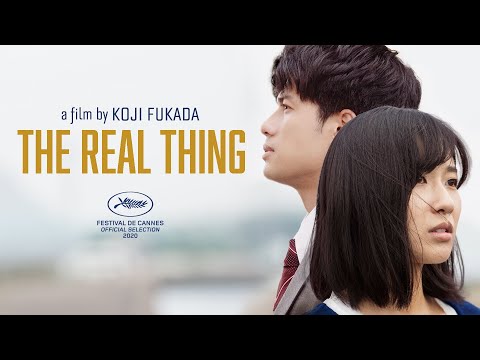
Along these lines, Tsuji works what appears to be a routine office job, which is dramatized in terms of him filling out spreadsheets or counting toys for inventory. The counterpointing of toys with office tedium is funny, and alludes to Tsuji’s arrested development. He holds two lovers, both co-workers, at arm’s length: Ms. Hosokawa (Ishibashi Kei), who’s about his age and is quite vulnerable beneath her affection of steely severity, and the younger Minako (Fukunaga Akari), who openly embodies the sort of immaturity that Tsuji possesses yet steadfastly obscures. The Real Thing includes many episodes of these characters doing the same actions: Tsuji and Hosokawa go to bed together at his place, comfortable yet bored, and Minako often ineptly asks Tsuji out on dates that he manages to never quite either accept or decline.
Interrupting this stasis, at least in theory, is Ukiyo (Tsuchimura Kaho), a woman who Tsuji meets at a convenience store. He tells her the toy gun she’s buying has a busted package, as pristine packaging is a preoccupation of Tsuji’s, a hint that he’s more earnest and idealistic than he often appears to be. Soon, Tsuji saves Ukiyo from a near-death calamity, pushing her stalled car off a railroad as a train hurtles toward them. One wonders why Ukiyo simply didn’t get out of the car, and these sorts of incongruities mount as Tsuji continually bails Ukiyo out of idiotic, easily avoided predicaments. In this sort of film, the woman eventually acquiesces to the man, respecting and rewarding his devotion with at least sex. Here, that trope is put off for hours on end, as Fukada obsessively stylizes the work of keeping an unstable person stable.
Emulating Tsuji himself, The Real Thing holds the viewer at arm’s length, and you have to be willing to come to it. For a while, it seems as if we’re watching cliché stick figures drive each other nuts ad infinitum. But as the film proceeds, it becomes increasingly evident that we’re watching well-observed characters who are trapped in, well, cliché roles that they feel they have to assume. The Real Thing, due to its piercing subtlety, may be destined to be misunderstood. Notions of power and especially weakness are mentioned often in the dialogue, as the narrative expands to include multiple strata of Japanese society—from the worker-bee heroes to the yakuza to the high echelon of corporate culture. People from all these walks of life are revealed to be highly insecure and neurotic, and Ukiyo, with her simultaneous resemblance to a femme fatale and a damsel in distress, has a way of bringing these submerged emotions to the fore. By resembling a character out of a fantasy, she implicitly promises her acquaintances the fantastic, which suggests transcendence and escape.
As the characters in The Real Thing suffer, they come to possess more gravity. The film’s running time allows Fukada to sustain the illusion that these people are growing up before our eyes, and he understands that the attainment of maturity often depends on pain. Tsuji may be irrationally drawn to Ukiyo, but his willingness to subject himself to these humiliations humbles him, just as Hosokawa’s heartbreak over Tsuji allows her to shed her pretense of invulnerability and subsequently free herself. Remarkably, even Ukiyo, the most maddeningly superficial character in the film for over three hours, experiences such a humbling.
Like some of Fukada’s previous work, The Real Thing is poignantly bifurcated, as Tsuji and Ukiyo switch roles. She eventually endures the torment of losing control, as Fukada understands the constant chaos of her early misadventures to be a form of manipulation every bit as insidious as Tsuji’s laidback routine. Meanwhile, Tsuji becomes both a mysterious object of pursuit, as well as, like Hosokawa at first, a spurned lover. And as the characters grow more recognizably life-like, the repetitions of earlier passages—staged in Fukada’s typically lucid and deceptively casual manner—become retrospectively moving. The Real Thing reveals Fukada to be playing a patient, very resonant long game, underscoring the struggle to wrest oneself out of social vices. The film is a grand melodrama disguised as a rom-com.
Since 2001, we've brought you uncompromising, candid takes on the world of film, music, television, video games, theater, and more. Independently owned and operated publications like Slant have been hit hard in recent years, but we’re committed to keeping our content free and accessible—meaning no paywalls or fees.
If you like what we do, please consider subscribing to our Patreon or making a donation.