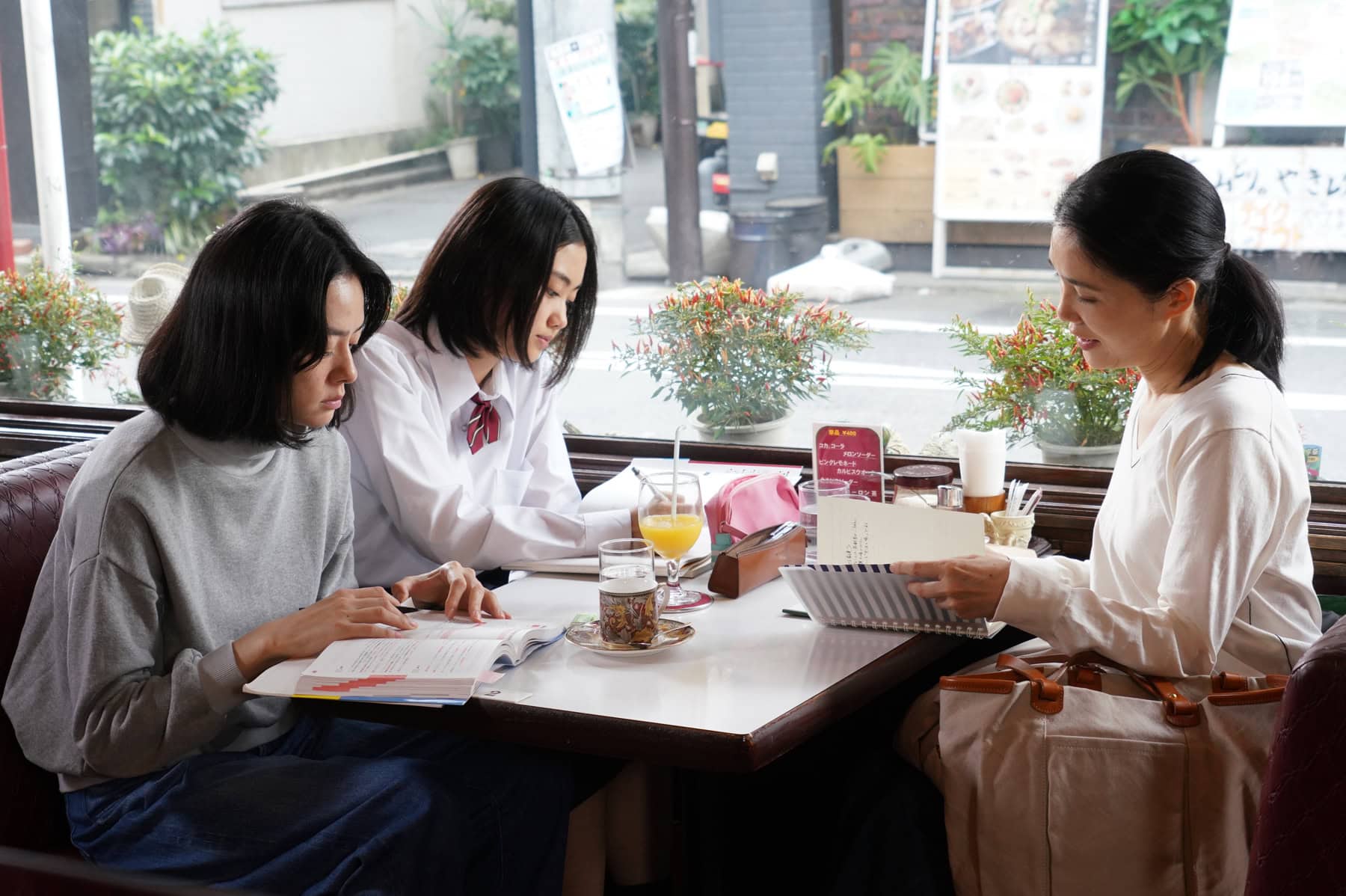
Throughout his 2016 film Harmonium, Kōji Fukada favored ambiguous, emotionally charged tableaux over narrative mechanics, and he continues that emphasis in A Girl Missing to ambitious, evocative, and troubling effect. Fukada’s latest is defined quite a bit by what we don’t see, and by odd empathetic preoccupations. Most notably, A Girl Missing is a story driven by kidnapping that’s almost entirely disinterested in the motivations of the kidnapper and the pain of the victim and her family. Instead, the film is attached, to a consciously insular degree, to a nurse, Ichiko (Mariko Tsutsui), whose life is ruined peripherally by the kidnapping due to one peculiarly bad choice on her part.
A Girl Missing’s images are so clear, detailed, and seemingly neutral that one’s encouraged to pore over them for meaning—a search that causes tension that Fukada gradually turns into a low-thrumming suspense. Ichiko’s spare apartment connotes the emptiness of her life, namely one astute and chilling detail: several small plastic shopping bags of what appears to be trash, which Ichiko uses as a pillow after falling asleep surveying a neighbor from outside her window. When Ichiko gets her hair cut—an action that’s revealed to have considerable significance—Fukada fashions an image in which we see Ichiko’s tired face in the foreground and the hair dresser, Kazumichi Yoneda (Sosuke Ikematsu), via a mirror in the background, suggesting that he’s haunting her, which isn’t far from the truth. Such moments and images affirm Fukada to be a master of an implicative, pregnant kind of social portraiture.
Ichiko’s life isn’t the only emptiness of A Girl Missing, as the film itself feels hollowed out. The audience never sees anyone enjoy anything, and the narrative’s central family, one that Ichiko helps to care for, doesn’t quite come into focus. The kidnapping victim, a girl named Saki (Miyu Ogawa), disappears and reappears with little fanfare. Saki’s older sister, Motoko (Mikako Ichikawa), never appears to be especially concerned for the girl, which might be less a result of thoughtlessness than the deep ennui that grips everyone in Fukada’s film. (And Motoko’s attraction to Ichiko, which is significant to each woman’s fate, seems to come out of nowhere.) The fact that a dying elderly artist, Tōko Oishi (Hisako Ōkata), is the most vital character in A Girl Missing is probably an intentionally achieved irony on Fukada’s part, though the filmmaker doesn’t have the sense of humor to spin a joke out of such a detail.
Ichiko drifts through two timelines—a bit of subtle chronological trickery that ultimately doesn’t matter. In the first narrative strand, Ichiko is a nurse at the aforementioned household, engaged to a doctor (Mitsuru Fukikoshi) with a cute little boy from a prior marriage. In the second, Ichiko’s a disgraced woman, who hid her connection to Saki’s kidnapper, who turns out to be her teenaged nephew, Tatsuo (Ren Sudo), whom she briefly introduced to Saki. This melodramatic hook, a promising motor for a thriller, is utilized by Fukada only as an agent of Ichiko’s undoing. There isn’t much emotional or formal variety in A Girl Missing, as its plot has been reduced to shards of incident, and those impressive images become glacially self-conscious. Occasionally, a scene will shake up the film’s depressive monotony with its sheer oddness, such as two parallel exchanges of sexual longing that are set at a zoo, and pivot on a reference to a rhinoceros’s erection. Fukada adores stray textures that stick in the proverbial throat and free-associatively affirm his characters’ rootlessness.
A Girl Missing feels so drab, and so nearly pointless, because the timelines don’t contrast. Ichiko’s “full” life with the job and her work and personal families is as riven with disconnection as her second life as a wandering voyeur. This concept is almost certainly intentional but to what end? The film feels like an experiment in pruning that has gone somewhat awry. Fukada has leeched his plot of too much humanity. As austere as Harmonium could be, the characters were in their way dynamic and made sense. With A Girl Missing, Fukada may believe that he’s transcended the melodramatic strictures of a regular crime film or of the kind of woman’s martyr vehicle in which Joan Crawford used to specialize. Instead, he’s fashioned an occasionally haunting art object with miserable stick figures.
Since 2001, we've brought you uncompromising, candid takes on the world of film, music, television, video games, theater, and more. Independently owned and operated publications like Slant have been hit hard in recent years, but we’re committed to keeping our content free and accessible—meaning no paywalls or fees.
If you like what we do, please consider subscribing to our Patreon or making a donation.