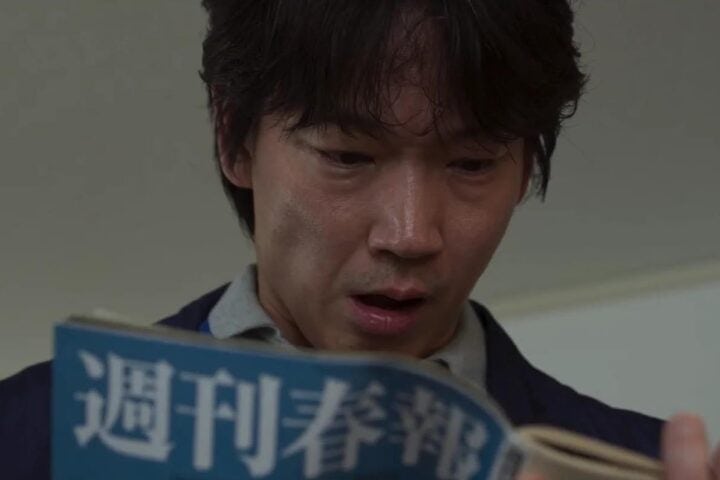
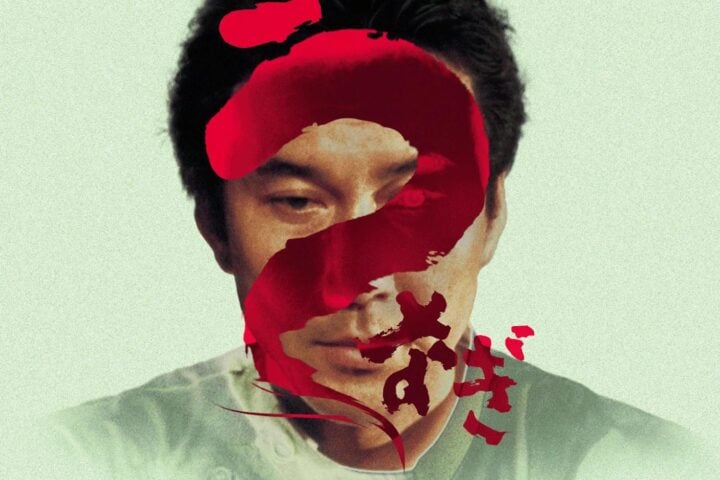
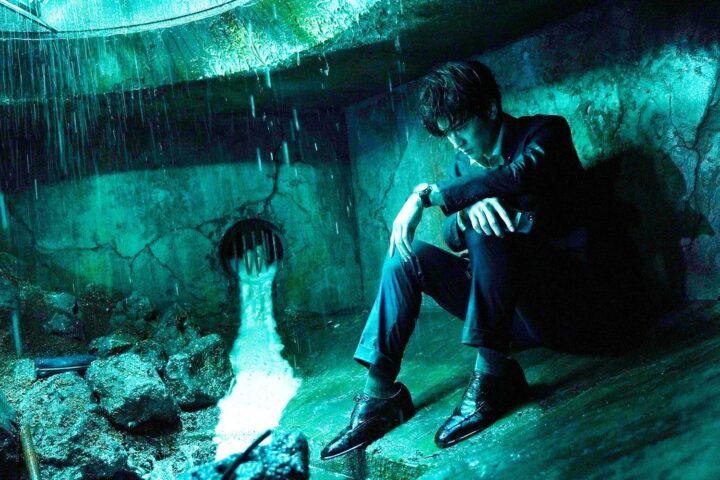
The opening stretch of Fukada Kōji’s Love Life is rich in textures that put the characters’ present-day lives into nuanced context. When we first meet Taeko (Kimura Fumino), she’s playing a game of Othello—a modern version of Reversi—against Keita (Shimada Tetsuta), her young son from a prior marriage. They live with her current husband, Jiro (Nagayama Kento), in an apartment furnished by his parents and currently decorated to celebrate Keita’s win in an Othello tournament. When Taeko steps out to the balcony, she calls out to some of her friends, who are rehearsing a routine to hold up congratulatory signage. Then she drops by the soup kitchen where she works, and on her day off, after being called in to defuse a situation.
The significance behind some of those details and how it slowly comes into focus is one of Fukada’s signatures. Several scenes pass before we become privy to Keita’s exact parentage, or to the fact that his party is doing double duty as a surprise birthday celebration for Jiro’s father, Makoto (Taguchi Tomorowo). Conflict, too, takes time to seep into the film, as when the standoffish father eventually voices his disapproval of Taeko for already having a child. Like Fukada’s 2016 film Harmonium, this gradual unspooling of context primes us for a particularly dramatic rug pull, which here takes the form of Keita’s sudden death during the party.
The reverberations of this tragedy lead to some fascinating and thorny entanglements throughout Love Life, primarily through the arrival of Keita’s absent birth father, a deaf and homeless Korean immigrant named Park (Sunada Atom). Taeko’s job with social services puts her in further contact with Park, and she throws herself into helping him as a means of coping with her grief over her son’s death. And though Park’s initial reaction to the death is a violent outburst, he quickly comes to seem like the only person who truly understands Taeko’s grief.
Perhaps naturally, Jiro is threatened by Park’s presence, and soon he, too, is drawn into the orbit of one of his exes, Yamazaki (Yamazaki Hirona). The film wordlessly conveys Jiro’s reservations about Park in a great scene that begins with Taeko and Park conversing in front of Jiro through sign language that’s initially subtitled for the audience. The camera then pushes in to center Jiro in the frame, and the subtitles disappear as though they’re now out of frame.
It would be one thing if Jiro mistook a basic communication for a deeper romantic connection, but the film seems to share the same perspective. Love Life struggles to convey what Taeko and Park ever saw in one another beyond that sort of basic connection, as though it speaks for itself. We learn precious little about the life they lived before Park abandoned her, and only late in the film do we see them laugh together. Jiro’s characterization is no less spotty, but his aloofness at least fits his role within the story as the inattentive partner with whom Taeko grows dissatisfied.
There are moments in Love Life that wouldn’t feel out of place in a rom-com if they weren’t so weighted by tragedy, like dancing at a wedding right before rain begins to fall or running to catch a boat before it departs. But because we’re tasked with inferring so much about the characters, especially their pasts, so much of the film’s romance is unconvincing.
Fukada is clearly adept at conveying the simmering tensions and resentments that exist and grow between individuals, which makes it a shame that Jiro’s parents exit the plot so early. They bring what’s far and away the most psychologically fraught dimension to the narrative, with their prior misgivings about Keita hanging over their every interaction with Taeko following the boy’s death. By instead choosing to follow the romantic threads in the lives of its characters, Love Life is left feeling like a pale imitation of Fukada’s more grandiose melodramas.
Since 2001, we've brought you uncompromising, candid takes on the world of film, music, television, video games, theater, and more. Independently owned and operated publications like Slant have been hit hard in recent years, but we’re committed to keeping our content free and accessible—meaning no paywalls or fees.
If you like what we do, please consider subscribing to our Patreon or making a donation.