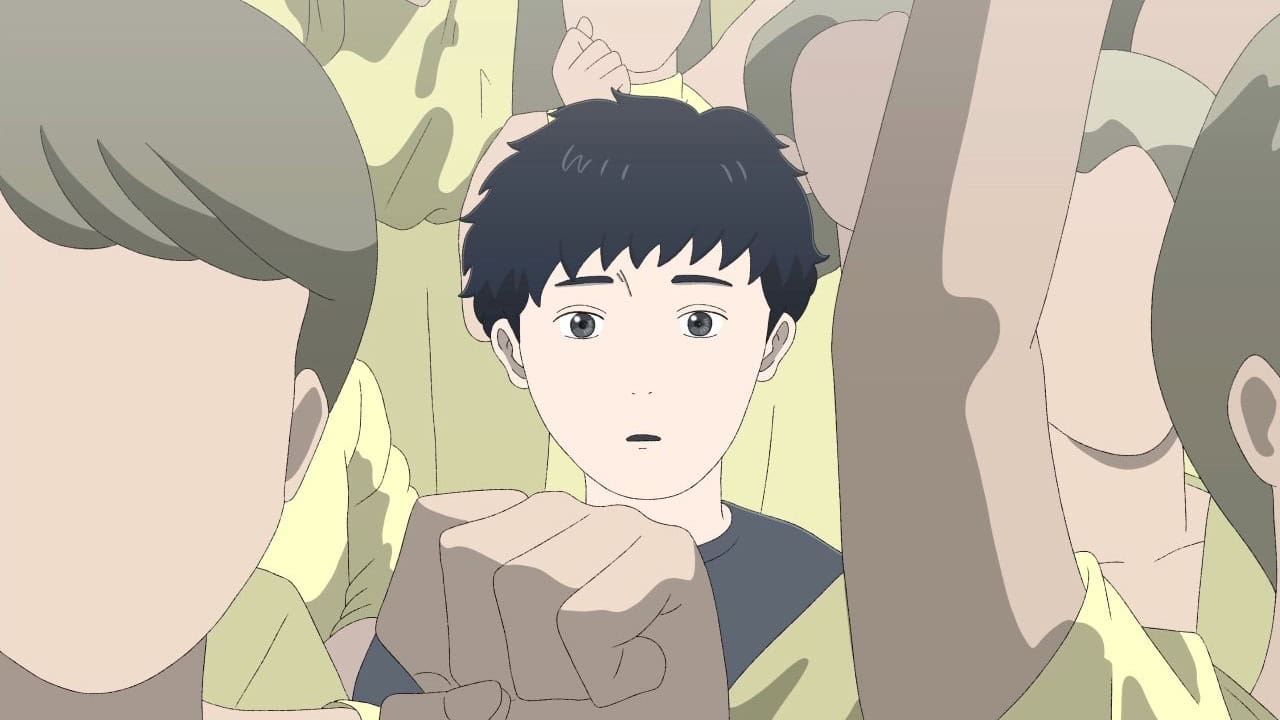
“Jinsei is a swan. You can go anywhere. You can do whatever you like,” muses the guilt-ridden Hiroshi (Shohei Uno) to his wayward, blue-haired stepson (voiced by rapper Ace Cool) in writer-director Suzuki Ryuya’s century-spanning animated feature Jinsei. Hiroshi’s words of wisdom are as good a summation as any of this scrappy film, which blurs the borders of irony and sincerity beyond distinction. This brooding, disaffected character study, which Suzuki also drew, scored, and edited, and whose title translates to “life” in Japanese, is a singularly odd, messy, and haunting portrait of detachment.
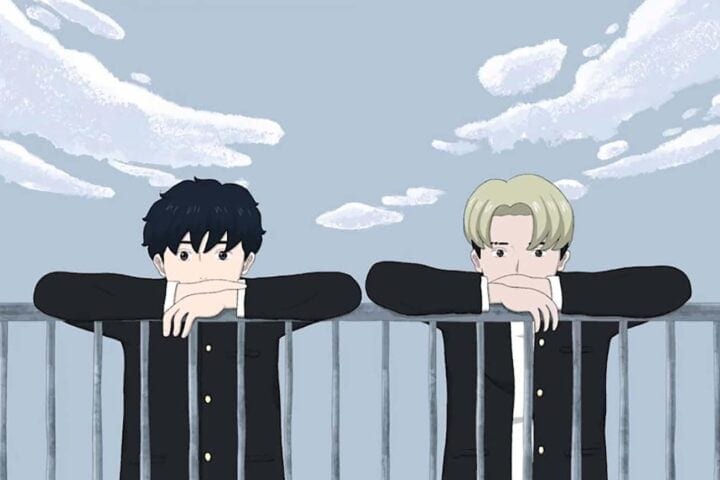
Employing a squiggly, semi-manga digital art style redolent of Flash animation, Jinsei starts in the mid-1990s with an Up-like montage showing the protagonist’s family, birth, early childhood, and the traumatic loss of his biological parents in an accident—all framed in match cuts from the perspective of the family car. The film then proceeds through a chronological series of chapters named after different monikers—insults, nicknames, stage names, and more—that the main character goes by in different periods of his life. His true name is never spoken.
Rendered selectively mute by his trauma, our protagonist is brought up by the earnest but impotent Hiroshi and cruelly bullied by schoolmates, until a schoolyard fight leads to a tender, homoerotic friendship with fair-haired transfer student, Kin (Tanaka Taketo). Kin introduces his new friend to his obsession: the world of pop-idol boy bands. It’s one of the first and only experiences to make him speak out loud, when he lets out an awestruck “cool.”
As the 2010s arrive and his father’s wealthy estranged family and Hiroshi fight over custody of him, our hero and Kin chase dreams of idoldom, with the film exploring the two boys’ bond and the hidden costs of fame as they toil their way up the youth showbiz ladder. Everyone agrees, including the sinister record mogul (Tsuda Kanji) who recruits the boys into a band, that the protagonist has something special, an intangible aura of greatness, as he performs floppy dance moves with fewer animation frames than the average South Park character.
But Jinsei, like life, is often defined by violent swerves and unpredictable outcomes. As the timeline of events approaches the real-world present, Suzuki audaciously burns down the film’s dramatic scaffolding, reconfiguring the story into a series of increasingly disjointed, genre-defying, and surreal vignettes. And as traumas and triumphs seem to fall into his lap—and he variously assumes the roles of hermit, celebrity, husband, and demigod—our impassive lead continues to lash out in acts of jarring violence that derail his life. All the while, the film resets the board in a new time and place. The older the protagonist gets, the faster time passes and the more confusing, colorful, and angular the world seems to become, en route to a quietly apocalyptic, watercolor-tinged finale reminiscent of A.I.: Artificial Intelligence.
While the alienating collapse of conventional plot structure and increasingly haphazard later episodes may be at least partly the result of an amateur filmmaker rushing toward a self-imposed deadline, it’s also reflective of Jinsei’s central theme. From the simple grayscale textures to the flat, symmetrical compositions (Suzuki favors rigid, single-subject profile shots), the film constructs a certain ironic distance from its earnest, evocatively scored theatrics. Its glassy-eyed protagonist likewise remains ambiguously torn between emotion and detachment, tumbling seemingly without even noticing into depths of degradation and heights of greatness in an absurd and senseless world, a man in fragments forever haunted by his stolen childhood.
The storytelling is similarly fragmentary. Key plot details, such as the backstory of the main character’s father, are implied through bits of dialogue and blink-and-you’ll-miss-it montage shots. Suzuki’s existential vision may tend toward the solipsistic, with its emphasis on the protagonist’s extreme suffering, specialness, and nihilistic apathy, but that unfiltered angst splattered on the screen combines with a subtle eye for psychological detail. Deeply felt and personal in its bittersweet ruminations on loneliness, pain, and destiny, Jinsei is an idiosyncratic and impressive debut by a fiercely independent artist eager to take on the world.
Since 2001, we've brought you uncompromising, candid takes on the world of film, music, television, video games, theater, and more. Independently owned and operated publications like Slant have been hit hard in recent years, but we’re committed to keeping our content free and accessible—meaning no paywalls or fees.
If you like what we do, please consider subscribing to our Patreon or making a donation.