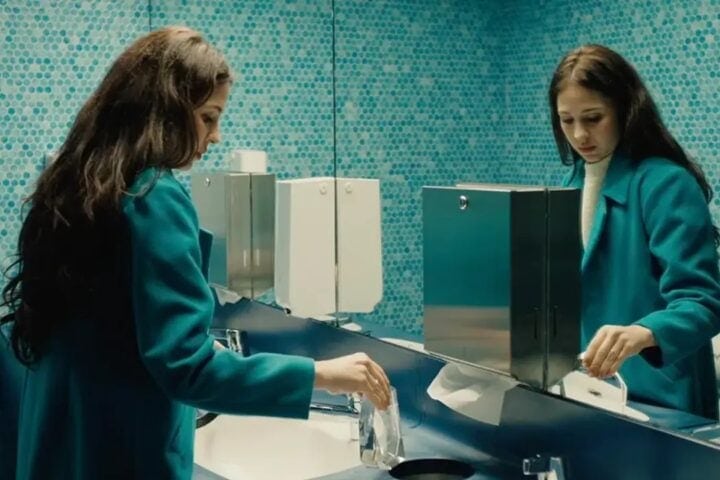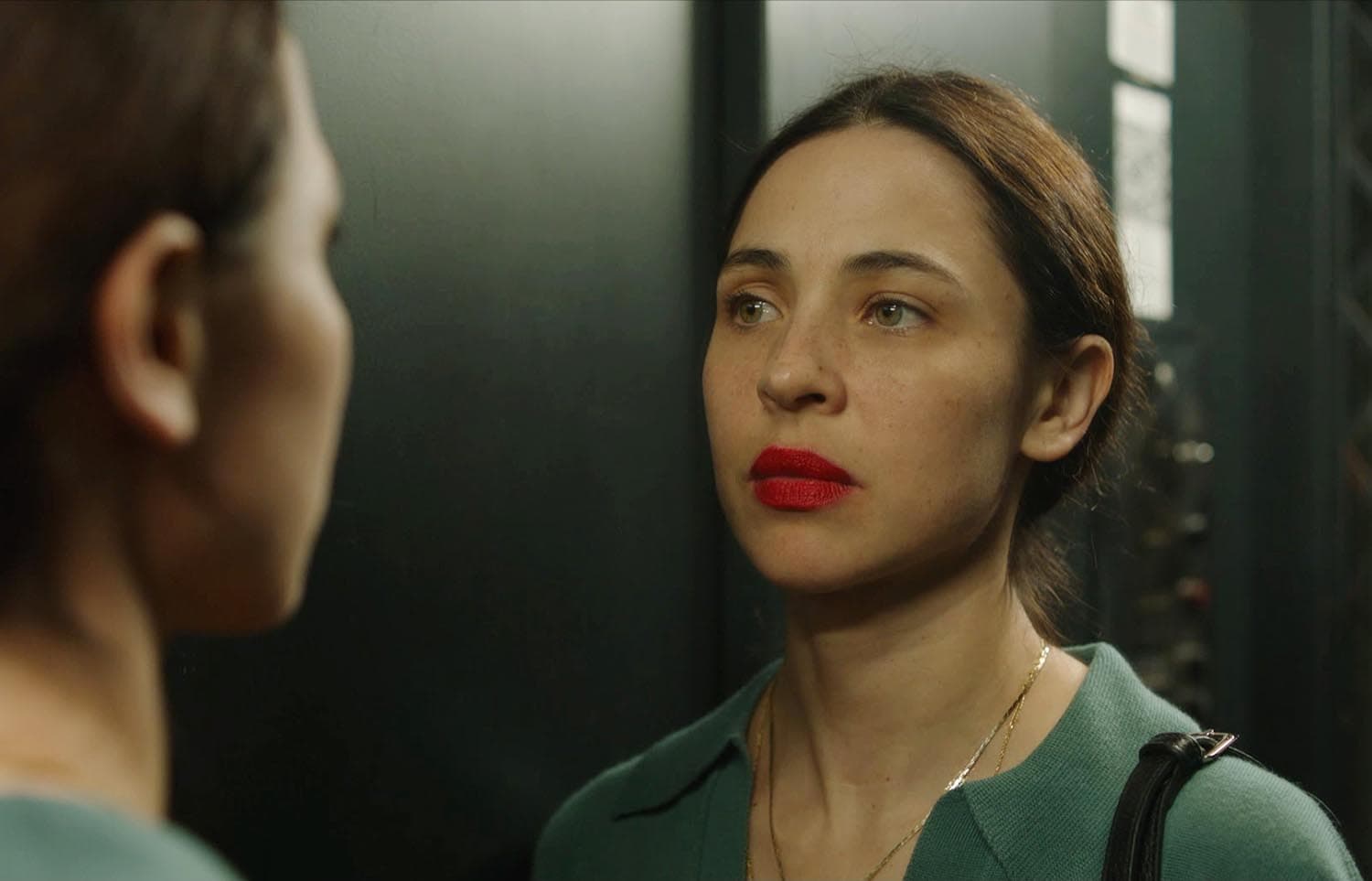
In the nearly wordless prologue of Milagros Mumenthaler’s The Currents, the camera captures Argentinian stylist Lina (Isabel Aimé González-Sola) from a distance as she leaps from a bridge in Geneva into the freezing water below. In the next shot, Lina unassumingly walks back into her hotel lobby while drying herself off under a space blanket. It’s as if the incident’s most troubling development was the bag of waterlogged clothing that she carries.
The sequence offers an early indication that Mumenthaler’s interest lies in psychological ambiguity rather than easy answers to her protagonist’s behavior. The Currents is a beguiling character study of a successful wife, mother, and businesswoman who struggles to escape an ambient sense of disillusionment, which occasionally solidifies into outright disassociation. Family, friends, and colleagues note something is ever so slightly off in Lina’s behavior and disposition, though no one can pinpoint just what her ailment might be.
Mumenthaler, with the aid of a formidable Gonazález-Sola, masterfully builds the film around portraying Lina’s subjective experience. Their combined efforts in the film ultimately provide something more interesting than diagnosing the character’s condition. The Currents replicates for the viewer the very feeling of being in the miasma that envelops Lina herself.
I spoke with Mumenthaler just before Film at Lincoln Center’s opening night showing of The Currents. Our conversation covered what images sparked the process of writing the film, how her script explored Lina’s subjectivity, and why unlocking physicality was so crucial to understanding the character’s psychology.
Lina is 34 in the film. Is there something specific about this time in life that lends itself to an existential crisis?
I didn’t pick an exact age [for the character], but it was more about looking at an accomplished woman in several respects and his question of what happens when you reach success when you’re young. She’s a mother, she has a husband, she’s in a stable relationship, she’s had professional success, and so the question becomes: What more? What comes next? It’s about living in a society where success is almost kind of demanded at an earlier age.
Your films often start with images that compel you to write. What were those for The Currents?
The first image, the seed of the film, was of a woman walking by the river in Geneva and plunging herself into the freezing [waters]. Here you already have three important elements: character, action, and water. These brought up a lot of things to think about, and [inspired me] to start looking for answers and bring in different interests of one’s own into the story.
After this, several sequences of images presented themselves, and that becomes a question of how to introduce them, transform them, and see how they fit into the narrative. These very elemental images are always the ones that make it into the edit. They have a certain power to them; they demand more. Perhaps, if you think of [showing] a tailor, you might see the feet first, and then you’ll see the body, and then you’ll see the face of the person. It becomes about finding a way of how these elements are to be presented in the narrative.
You mentioned finding answers, but the film is so much about dwelling in ambiguity. Were there questions you were trying to solve?
This first sequence brings a lot of questions to the fore, but these questions don’t necessarily have to be concrete. Sure, you can say, “Does she have a daughter?” Yes. “Does she live in Geneva?” No. The question isn’t about answering these questions. With the script itself, I worked from Lena’s subjectivity. She’s not going to Buenos Aires and immediately going to a psychiatrist or neurologist and saying, “What is it that concretely is wrong?” It becomes a matter of accompanying her on this journey that she takes in different directions, only being able to perceive as she goes along to accompany her through this journey. And really, how concrete of a diagnosis can you have for someone in this state? Sure, a lot of people aren’t happy in life or have childhood traumas, but not everybody jumps into a river.
Everything from the camera position to the sound design of the film is so masterfully calibrated to plunge the viewer into Lina’s subjectivity. How were you determining the best way to convey what’s going on inside her head in each scene?
From the beginning, when you think about her on this walk, you already have a kind of suspended time. As you walk with her, you’re brought into this subjective state of mind. That allows a certain freedom to think [about] different scenes or certain atmospheres—the colors, for example. From the writing perspective, that meant different images would come to me, and it was always a matter of writing from how she’s perceiving the world right then.
There’s also the fact that this script was written over a long period of time, so that allowed me to be able to incorporate different things that I’d encounter in the streets. For instance, take that corsetry shop: Although it was a recreation, I drew inspiration from a real corsetry shop in Buenos Aires—one run by a woman who always dressed entirely in monochrome. It’s as if certain inspirations just strike you out of the blue. You find yourself thinking a bit about Lina and that sense of nostalgia that she harbors for trades that, perhaps, are on the verge of vanishing. So, the thought arises: “Well, this is a story I want to tell.” I took that memory of that woman and her corsetry shop and wove it into the narrative.
It’s as though you perceive the city—its sounds, its atmosphere—in a particular way, and then suddenly you realize where your gaze has settled, and how a specific sound can lead your mind in one direction or another. A key example being this scene that happens at the lighthouse at the Palacio Barolo building in Buenos Aires. In the script itself, it’s a very small portion about Lina imagining different lives from this perspective [looking out over the city], but the scene itself transforms. It comes back to imagining the world from her state of mind.

How do you go about directing a performance like that? It sounds like there was a lot on the page if you were writing from her perception.
We worked a lot on the physical dimension, so I did sessions with a theater instructor that were very immersive. Through certain breathing exercises, you start to get a sense of one’s inner self. In this case, it was the sense of an inner storm, so it became a matter of transmitting the senses. For example, at Lina’s mother’s house, you get this cold feeling. That also allowed me to bring in certain elements like plastic or a certain coldness to the tiles, and to tell Isabel to modulate her voice. It’s smaller in this space to feel this coldness of her surroundings. It becomes a matter of questioning: “Well, how does one’s voice come out in this state of crisis? How does one move?”
You’ve expressed an uncertainty that we can ever know ourselves, and the film echoes that. How much of Lina did you and Isabel feel you needed to nail down and explain, and was there anything you felt you could leave as a mystery?
I wrote a lot about her childhood, what her grandparents were like, what her family was, what happened to her dad, why her mom was the way she was. It almost came from memory. You could know what happens in her head, when, why, and with who.
Isabel understood this, and she also didn’t ask for concrete answers, especially about why she would plunge into the river. Sure, there are elements that could bring this to the fore, but this situation is something that we understood [the audience] didn’t need to arrive at a definite answer about. On top of that, a lot of reading was shared from a French sociologist [David Le Breton] who wrote Disappearing from Oneself, and also from fiction that had to do with mother-daughter relationships. It wasn’t about finding concrete answers, and this is something that we were in agreement about, allowing us to think openly about the character.
Isabel also did something in the casting: She didn’t over-interpret. I appreciate this from actors, when they leave a little opening so that the two of us can follow it through.
I know you and Isabel have spent long periods of time away from Argentina. Was that experience of feeling a part of both worlds, and maybe not necessarily home in either, something that you brought to the character or film?
Not an influence on the film per se, but more on the casting. There’s also this latent element in the film that explores the question of belonging. Maybe if you have one foot in one world and in the other, that’s certainly on top of one’s mind because you’re not neither here nor there.
I loved the moments when Lina is enmeshed in technology, be it a VR headset or scrolling through her Instagram comments. How did these enter the film?
The Instagram thing really comes about because she’s somebody who has a job that’s very involved with social media, but it also speaks to a certain kind of superficiality that she navigates. You also have this distancing thing where you’re observing your life, and it becomes difficult to make sense of. The virtual reality thing has to do with cognitive therapy, but a kind of therapy that might solve immediate problems and not deeper-rooted issues. The fact that she picks this kind of therapy speaks a lot to the person Lina is, and that she might not be prepared to deal with these deeper issues about herself.
Are these moments a counterpoint to whenever she encounters art, be it a drum recital or a sculpture, and has these seemingly profound realizations?
The museum scene, like the lighthouse scene, is a projection, and it speaks to a certain nostalgia that comes to Lina about something she used to do. There’s a sense that things have fallen apart, and she had a different sensibility and an interest in art before that.
Translation assistance from Nicolas Pedrero-Setzer
Since 2001, we've brought you uncompromising, candid takes on the world of film, music, television, video games, theater, and more. Independently owned and operated publications like Slant have been hit hard in recent years, but we’re committed to keeping our content free and accessible—meaning no paywalls or fees.
If you like what we do, please consider subscribing to our Patreon or making a donation.