Ridley Scott’s Alien has cast a long shadow. Certain images in the film conjure an unshakeable terror of violation, which is afforded a brutal catharsis when one creature, suggesting a cross between a tapeworm, a snake, and a phallus, rips its way out of a man’s ribcage in one of the most brutal “births” in cinema history. Many movie monsters since have been compared to the various creatures of Alien, just as virtually every slasher movie owes some form of allegiance to Psycho. Egor Abramenko’s Sputnik is already at least the second film to riff on Alien this year alone, after William Eubank’s Underwater, and it adds one promising gimmick to the body-horror formula: The alien here is a symbiote rather than a parasite, entering and exiting its host over and over again. The violation is ongoing.
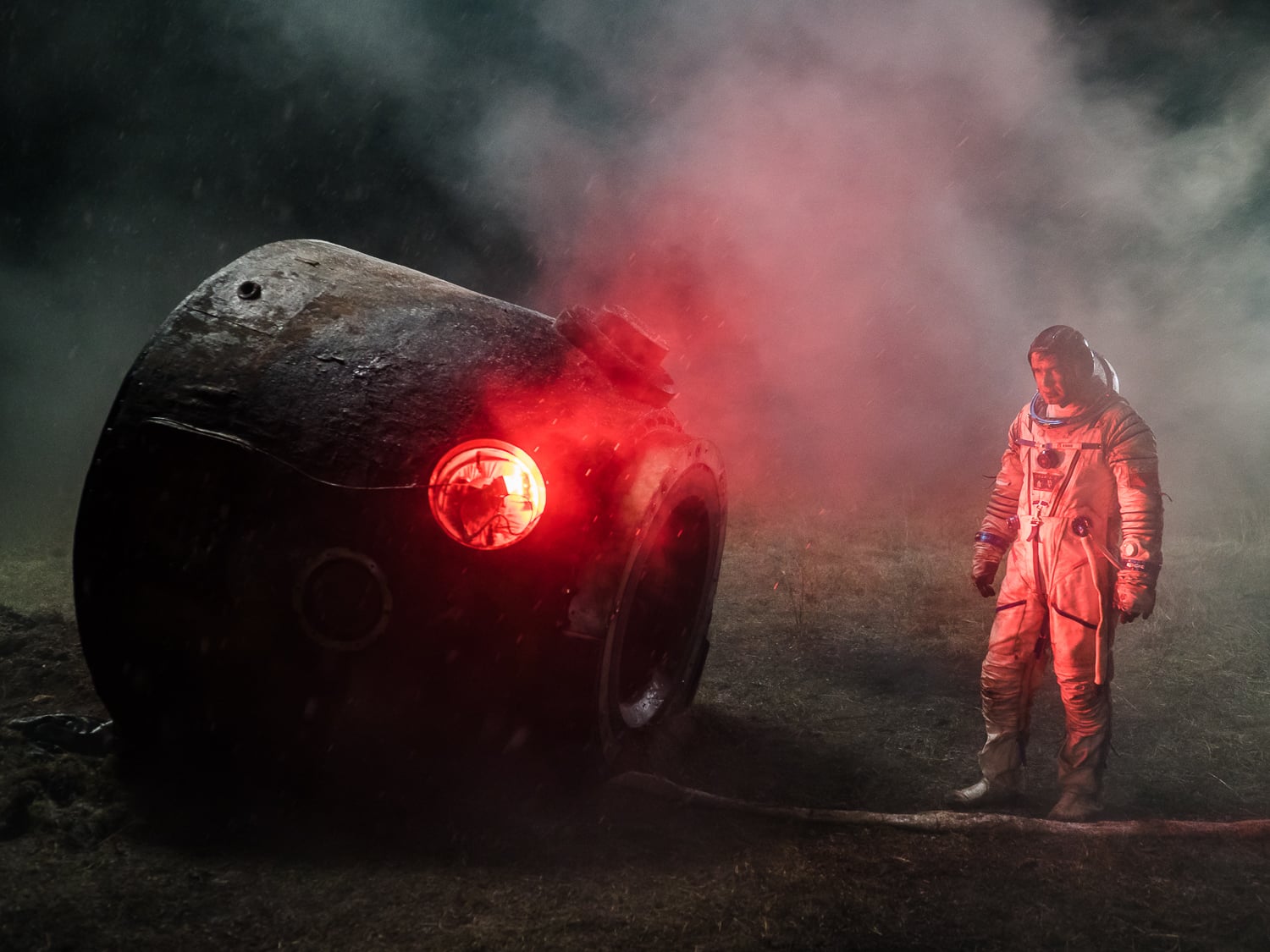
Sputnik is set in the Soviet Union in 1983, and Abramenko subtly allows us to feel the pall of the Cold War as it’s entering its death rattle. It’s cast in lonely, shadowy hues, and the soft, warm, and grainy cinematography un-showily suggests that the film has been beamed in from the analog era, in the tradition of Andrew Patterson’s The Vast of Night, also from this year. The Soviets are concerned with heroes to keep morale up, and cosmonaut Konstantin Veshnyakov (Pyotr Fyodorov) will do nicely. He’s returned from a space mission that’s vaguely defined by the filmmakers, which is an evocative touch that suggests that when heroes are needed by a society the specifics of their aspirational accomplishments hardly matter. Something happened in space though: A shadow drifted over Konstantin’s vessel, and his fellow cosmonaut is now in a coma. Konstantin has amnesia and is being held in a bunker presided over by Semiradov (Fedor Bondarchuk), who’s pressing scientists to solve the mystery of the time he lost in space. Semiradov recruits a doctor who’s in hot water for unorthodox measures, Tatyana Klimova (Oksana Akinshina), in an effort to crack Konstantin.
Sputnik’s first act is eerie, strange, and unusually character-centric for a monster movie. The film initially suggests many episodes of The Outer Limits, in which the audience was chilled by the implications of what happened to characters who ventured into outer space. And Abramenko doesn’t tease the audience as long as one might expect: Soon, Semiradov reveals more details of the situation to Tatyana, inviting her to watch Konstantin in his holding cell in the middle of the night, when he convulses in his sleep while a creature gradually crawls out of his mouth. This sequence is unnerving, showing the creature’s emergence partially from the point of view of laboratory cameras, lending the event a patina of casualness and “reality.” The creature itself is, in design, beholden less to Alien than to the mutations of that film’s prequel, Prometheus, as it’s pale and amphibian in nature, suggesting a miniature manta ray or hammerhead shark, with little legs and a gelatinous tail that is, of course, so very phallic.
Like the various otherworldly beings of Prometheus, Sputnik’s monster is disappointing, timidly designed for the sake of a supposed, greatly overrated notion of believability. It doesn’t seem especially plausible that a tapeworm creature would evolve, seemingly overnight, into the metallic praying mantis colossus of Alien, and this irrationality, coupled with the primordial design itself, is terrifying. By contrast, Sputnik’s wan creature ushers forth a series of anticlimaxes that ripple through the film. After the alien’s symbiotic relationship with Konstantin is explained via amusing pseudo-science, Sputnik changes formulas, becoming a story of a special man who must be saved from evil military industrialists. At times, Abramenko even seems to be visually quoting Ang Lee’s Hulk.
But a story of a special man must be fixated, as Hulk was, with the psychology of said man. Konstantin’s anguish at being invaded, and the weird elation he might feel at discovering that he can control his interloper, are glossed over by Abramenko. Sputnik’s third act is a rush of formulaic action meant, perhaps, to compensate for the interminably repetitive and impersonal second act, which is mostly concerned with reinforcing a set of foregone conclusions. Incredibly, the central notion of the film—of an alien that symbolically rapes its host over and over—is relegated to an inciting incident. Sputnik is an egregious missed opportunity that bites off more formulas than it can chew.
Since 2001, we've brought you uncompromising, candid takes on the world of film, music, television, video games, theater, and more. Independently owned and operated publications like Slant have been hit hard in recent years, but we’re committed to keeping our content free and accessible—meaning no paywalls or fees.
If you like what we do, please consider subscribing to our Patreon or making a donation.