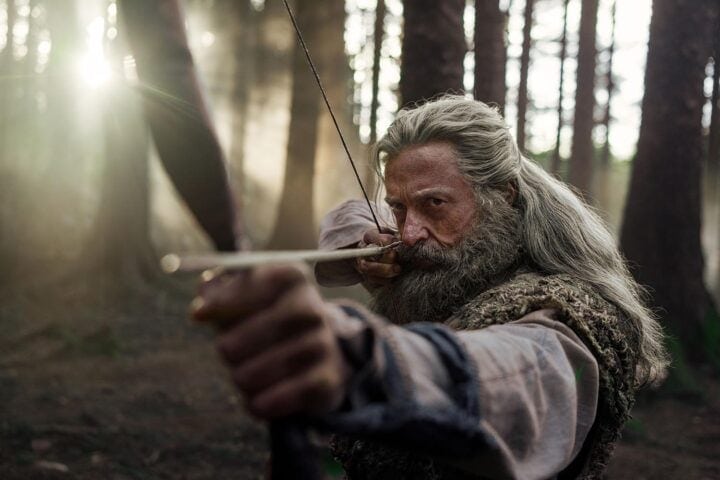
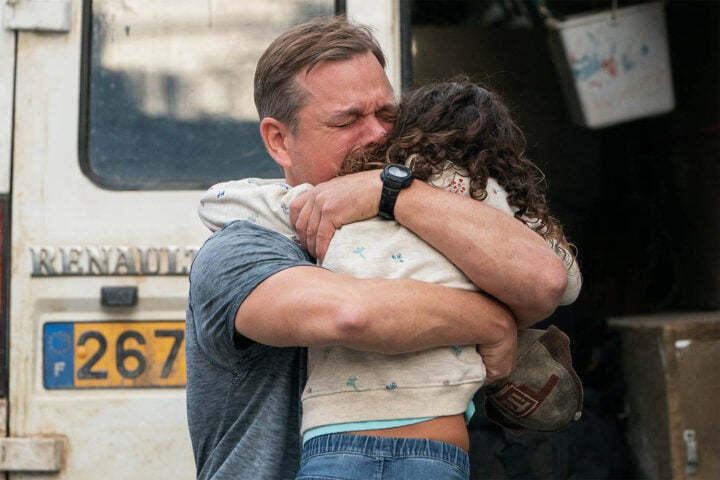
The shadows of Kore-eda Hirokazu’s After Life and Albert Brooks’s Defending Your Life loom large over Edson Oda’s feature-length directorial debut, Nine Days, whose story also unfolds in a mysterious limbo realm. It’s there that Will (Winston Duke) spends eternity watching the lives of people on Earth via stacks of TV monitors, while also auditioning a group of unborn souls to replace a perished individual on Earth, and in turn experience the miracle of life. But unlike Kore-eda and Brooks, Oda never really puts a unique spin on the familiar story of otherworldly figures peering in on the lives of the living.
Nine Days’s most notable idea is its understanding of life as a kind of performance, with people on Earth seen as the protagonists of movies being watched and scrutinized by Will. But it’s also one that’s essentially a riff on Defending Your Life’s central conceit, and it may leave viewers plagued with an almost constant déjà vu all the way through to the moment that it explicitly states the point that’s implicitly conveyed by Will’s candidates during the audition process: that life, in all its joys and hardships, shouldn’t be taken for granted.
Duke, who makes a more lasting impression than the film’s ideas, plays Will with a coiled restraint and a professional coolness toward the candidates whom he interviews no matter how hard they try to engage him on a personal level. But Will shows subtle yet increasing flashes of emotion as his aloof demeanor starts to crack, due to both his trying investigation into the death of one of his charges on Earth and the constant prying by one candidate, Emma (Zazie Beetz), into his mysterious past. This culminates in Will’s climactic reading of a Walt Whitman passage to Emma that he had committed to memory: Rendered by Duke with amusingly apt theatricality, Will explosively gives himself over to the joy-inducing pleasures that he had talked to the candidates about but was heretofore reluctant to embrace.
To an extent, it makes sense that the clinical tone of Nine Days mirrors its main character’s personality. But given how Nine Days endlessly discusses the wonders of being alive, you may find yourself wishing that this by and large inert film featured more sparks of life like the raucous Whitman reading. Oda refreshingly depicts the candidates experiencing the sort of minor spectacles of life that they—to a stultifying extent—watch on TV and analyze, and there are jolts of energy courtesy of snappily edited montages occurring at sporadic intervals, which efficiently contrast, via inspired match cuts, the candidates’ different personalities, and how they fare during the audition process. But such moments are few and far between.
To his credit, Oda thankfully never feels the need to bog down the story by explaining every aspect of its limbo realm, and the film boasts one truly unforgettable scene. In it, Will grants a final wish to a rejected candidate, Mike (David Rysdahl), to enjoy a simple walk on the beach. Will constructs a fake yet detailed shoreline for Mike, and as Will simulates a gentle tide by pushing an oar through the water, Nine Days movingly captures the beauty of the ostensibly quotidian through Mike’s experience and the candidate’s subsequent state of bliss. In fact, if it weren’t for the loving attention to detail present in this sequence, you’d think that Oda, like his characters, got his ideas about life predominantly by watching it on a screen.
Since 2001, we've brought you uncompromising, candid takes on the world of film, music, television, video games, theater, and more. Independently owned and operated publications like Slant have been hit hard in recent years, but we’re committed to keeping our content free and accessible—meaning no paywalls or fees.
If you like what we do, please consider subscribing to our Patreon or making a donation.