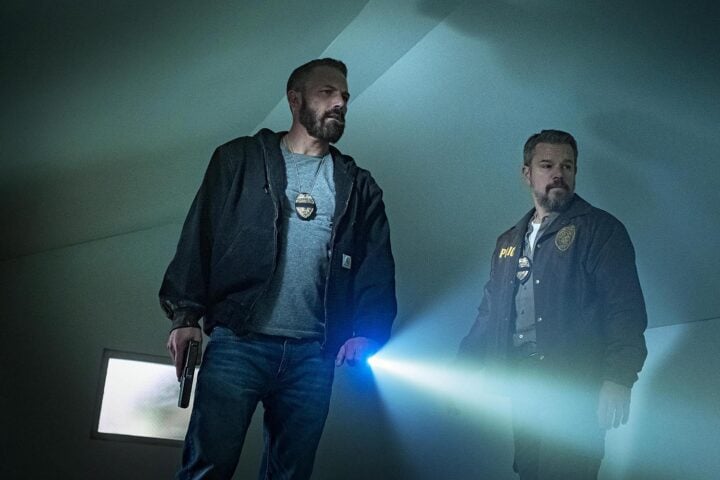
Early in director Tom McCarthy’s Stillwater, an immigrant worker observes that “Americans don’t like to change.” He’s referring to the many evacuated residents of the Oklahoma town he’s cleaning up in the aftermath of a tornado who will inevitably return home to rebuild their lives rather than move and adjust to a safer place. But he could just as easily be talking about Bill Baker (Matt Damon), the out-of-work oil worker sitting behind him in a truck heading to the disaster site. Day in and day out, the straight-shooting, god-fearing Bill wears the same style of hat, sunglasses, and shirt, as well as a thick goatee and stoic expression that obscures any genuine emotion he may be feeling.
Bill’s distaste for change is brought into sharper focus when he visits his incarcerated daughter, Allison (Abigail Breslin), in Marseille, France, picking up a Subway sandwich before checking into his room at a Best Western. He’s an American through and through—a living, breathing avatar for the heartland—something which, along with his history of bad parenting and former struggles with addiction, resulted in his strained relationship with his daughter, who’s now five years into a nine-year sentence for allegedly killing her girlfriend.
It’s a setup that clearly echoes the Amanda Knox case, with the young, white American Allison defiantly proclaiming her innocence while facing a thrashing in the European press. This plotline, and Allison’s traumatic experience, however, is too often left on the backburner, functioning primarily as a catalyst for Bill’s potential redemption, especially once he learns of a new lead in the case from his daughter and sets off around Marseille to snoop around in an unfamiliar country and culture. But despite all the screen time taken up by Bill’s amateur sleuthing, this aspect of the film offers little in terms of suspense or intrigue.
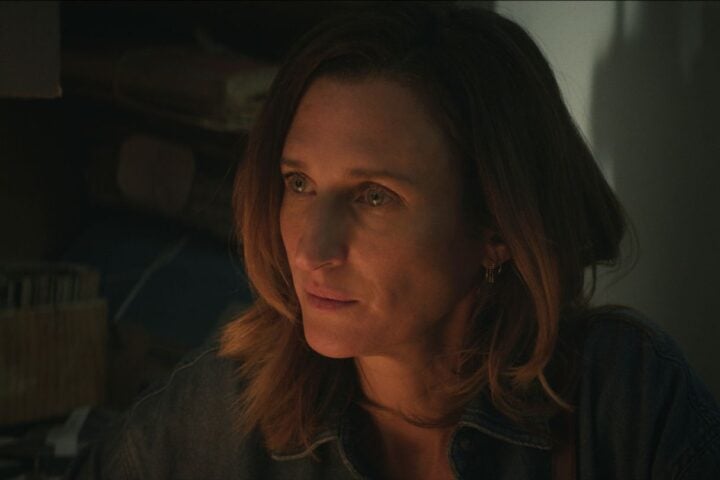
In fact, the filmmakers all but lose interest in Allison’s case once Bill becomes involved with a single mother, the very modern and liberal Virginie (Camille Cottin), and grows close to her young daughter, Maya (Lilou Siauvaud), both of whom give the man a chance at a fresh start. The deliberateness of the screenplay, as well as the often amusing and understated ways that Damon and Cottin play off one another, manages to make this rather unlikely couple feel surprisingly believable. And for a while, their relationship, which at first involves her translating for him in his investigation while he plays the role of handyman and babysitter for her, yields some interesting cross-cultural clashes, from a discussion on gun ownership to the treatment of immigrants, that are at least less reductive than the depiction of Bill himself.
But Stillwater’s final act, which hinges on a number of patently absurd contrivances that all but abandon whatever naturalism had been developed in the film’s earlier stretches, brings with it an air of determinism, steering the narrative toward a finale that’s more pitying of its protagonists than compassionate toward them. The drastic plot twists here derail a film that was already over-stuffed with narrative incident and ideas, thanks to its constant bothsidesing, settling for a hollow message about finding peace in a state of powerlessness.
McCarthy clearly aims for Stillwater to complicate the notion of the typical Trump voter. Although Bill gets out of admitting to being one by saying that he didn’t vote because of his criminal record, he’s clearly a somewhat sympathetic stand-in for that type of dispossessed, angry American. Stillwater may have avoided the sin of proposing a broad corrective to the pains that ail the blue-collar men and women of America, but to end such a convoluted film with the pat observation that life is brutal feels like the ultimate cosmic shrug.
Since 2001, we've brought you uncompromising, candid takes on the world of film, music, television, video games, theater, and more. Independently owned and operated publications like Slant have been hit hard in recent years, but we’re committed to keeping our content free and accessible—meaning no paywalls or fees.
If you like what we do, please consider subscribing to our Patreon or making a donation.