Before its world premiere at 2025’s Edinburgh International Film Festival, Blue Film achieved a rarity for a small indie from a first-time director, as its reputation already preceded it. The film became a hot potato among festival programmers, including those with queer-focused missions. A string of rejections showed just how few organizations were willing to risk backlash by giving a platform to Elliot Tuttle’s film about the nature of perversion.
It’s a fitting journey for a film whose title refers to the blue grease pencil used to mark film cels that merited censorship. But while Blue Film takes a transgressive approach to taboo sexuality, it doesn’t set out to be titillating or exploitative. If anything, the dangerous status it carries ahead of its release belies the intimacy and earnestness of this two-hander chamber drama.
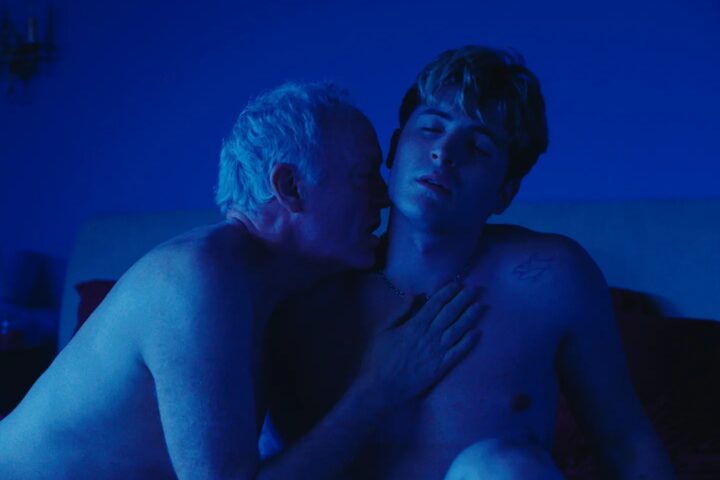
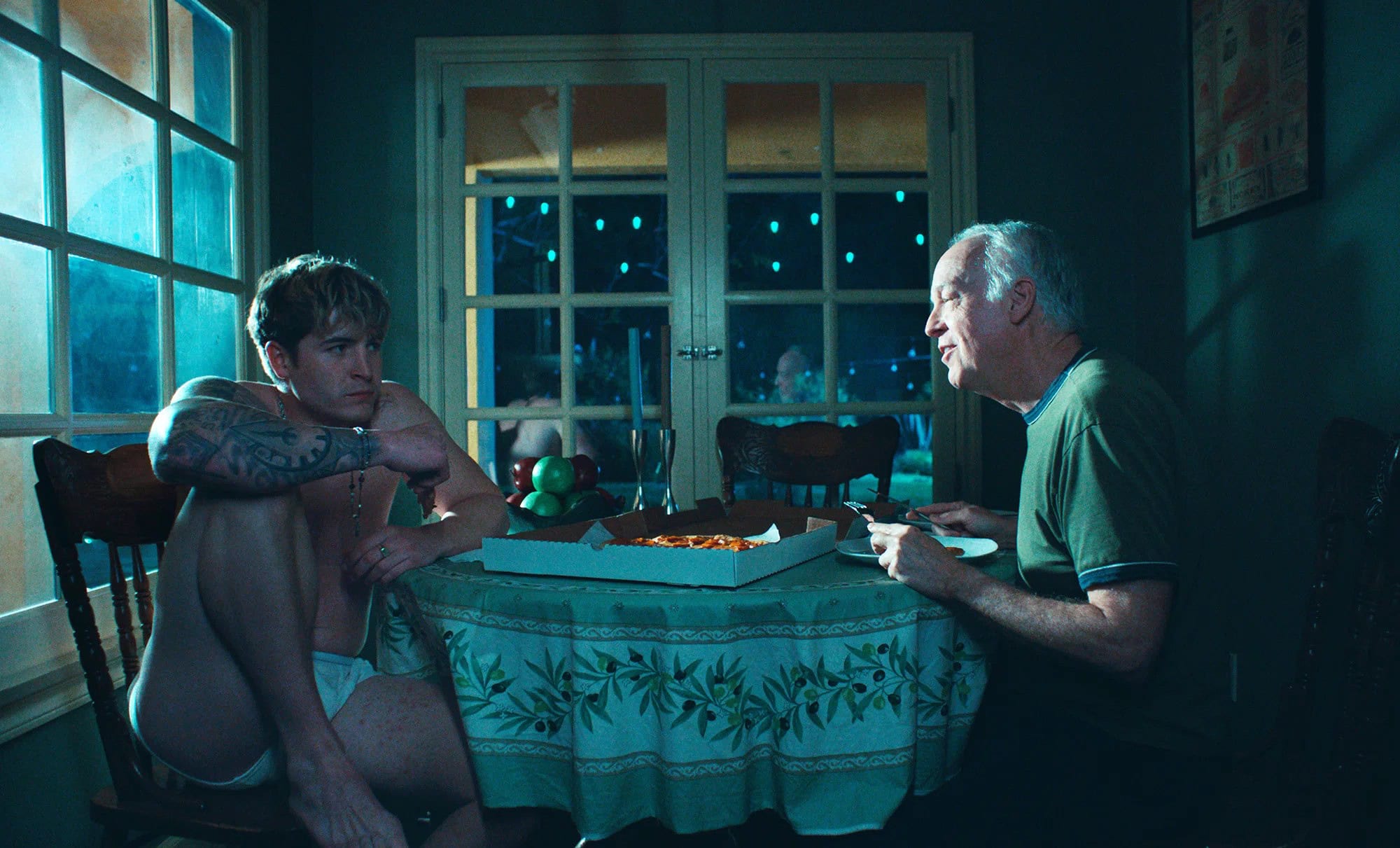
The film chronicles one fateful night between Kieron Moore’s Aaron, a camboy, and Reed Birney’s Hank, a pedophile, as they investigate the contours of their former relationship as student and teacher. Their discussion and deliberation illuminate the way that shame has warped their respective experiences of sexuality. Tuttle’s nuanced, humane filmmaking places us alongside the characters as they undertake an intellectual, soulful, and sensual journey that runs toward sensitive subjects that most other filmmakers sprint away from.
I spoke with Tuttle ahead of Blue Film’s limited theatrical opening. Our conversation covered why he avoided more graphic depictions of sexuality, how he directed his actors through the script’s rich subtext, and what reactions on the festival circuit have taught him about the film.
You’ve said that this film was born out of your frustration with discourse around sex scenes and eroticism. What kinds of conversations do you want it to spark?
I feel like a lot of sex in contemporary film is pretty conceptual. I really wanted to make something where sex felt like it had a real imprint on our lives, and it was laced with like danger or a life-changing feeling, because that’s how I think a lot of us experience sex. It does inform the way that we live our lives, even on a minute level. I would hope that audiences, more so than [the film] sparking a discussion, leave having felt seen or moved in some way. It’s been so interesting to me how people react to the film differently when I have attended screenings and then talk to people outside or something. I feel like no one has the same response to the film.
What have the extremes on either side been?
Some people are very moved, which is really humbling. Some people will come up to me and be like, “I couldn’t sympathize with any of them.” It feels like a litmus test…of what, I’m not sure!
Have any reactions surprised you, or shown you something about the film that you didn’t see or think about whenever you were in the process of making it?
Yeah, someone came up to me and said that it felt like a coming-out story. Obviously, one of the characters is a gay man, but this person was like, “Aaron thinks he’s this horrible person, and he feels so bad about his homosexuality. And then, he comes face to face with someone who’s truly worse than him, and he’s able to understand himself in perspective.” In that way, it felt like a coming-out story to this person, which wasn’t explicitly an intention that I had in making the film. But it was interesting. That interpretation felt like it rang true to me in some way.
How did the film evolve from your initial inklings of thinking about representation and adolescent sexuality into this multi-layered dismantling of shame and taboo?
It started as a conceptual piece of writing, but that’s not really a way to make a film. Maybe it is for some filmmakers! But there was a process of rewriting to narrativize it. When I’ve written something, that’s what happens. It starts with a couple of big ideas, and then [those] get synthesized through characters and plot over a series of rewrites. I never think of the story first, necessarily. It always starts with a feeling, and then I’ll figure out how to translate that feeling.
How did putting these characters and the dialogue in the hands of your actors change your understanding of what you’d written?
When anyone reads your words, it immediately makes them more human. That sounds trite, but it’s true! When you have two other people reading the script, their job is to empathize completely with their characters and understand everything about where the characters are coming from. They will bring in stuff that you hadn’t felt before. It was a really cool experience, having Reed and Kieron sitting down for the first table read in my old apartment, just the three of us. It being so intimate and hearing them read all the words was really illuminating. [I’d be] like, “Oh, I’m cutting that line. I’m rewriting this. What makes sense in their mouths?”
You’ve mentioned Catherine Breillat as a source of inspiration for the film, and Blue Film reminded me of something she said in my interview with her about Last Summer. Breillat said that we need to be aware of all forms of puritanism in society because those are at the root of perversity. Does that track with your own understanding after making Blue Film?
One hundred percent! She’s very eloquent and one of the best to ever do it. That ethos she expressed was very much in my mind while creating this film. I love that she never uses the word “destigmatization.” She’s able to express this true phenomenon without using that word. The purpose isn’t destigmatization; it’s meant to be a whole and truthful exploration of [a feeling] more so than anything political or moral.
Despite the heaviness of the theme and subject matter, I was struck by how often there are these moments of humor and levity in Blue Film. Those strike me as particularly risky, so how did you find the times when you could reach into that tonal register?
Honestly, I feel like a lot of that came from Reed and Kieron. It felt natural when it happened because they were the ones saying all these words and living in the rhythm of the scene. There were a couple improvised lines, but when it came out of any of that, it felt very natural and intuitive. You just hear them say something, and you know if it fits in the rhythm of the scene or not. The levity is something that I only realized when I watched the film with an audience, and it feels nice. I knew that some moments were lighter than others, but hearing an audience react to it in real time, you feel all the things that you don’t know you’re building in the editing room.
Making a two-person chamber drama makes a lot of talking natural, but some of the most potent moments of Blue Film come in these moments between the lines. How much were you discussing this subtext?
I’m never giving directions like “this is the broader meaning.” It’s only helpful for them to work with points like “I want you to get this reaction out of him.” It’s only helpful to work with the actor on that minute level, and it’s for me to understand why I’m giving that direction and what I want the unspoken to be. We didn’t explicitly talk about it. I would direct them to be quiet for a moment. I’d tell Kieron not to talk and try to make Reed uncomfortable to fill in the space.
Perhaps this is born of the dangerous reputation Blue Film built on the festival circuit, but I was struck that the depictions of sexuality themselves weren’t particularly explicit. What was your calculus around how much of these acts to show without placing it in a purely conceptual realm?
One, I wanted people to be able to see the film. I wanted it to play in a theater where people could go see it. That’s a consideration. Two, I’m working with these two actors who are already being so vulnerable in performing these roles. I didn’t feel like nudity was warranted. I would never be opposed to it. In a lot of my influences, people are naked for half the movie! It’s not a prudish thing. It’s more that I’m working with these two guys who are being so vulnerable already in doing this. Do I want to make it that much harder for them for not that good of a reason? I could never truly justify asking either of them to go nude, so I didn’t.
So much of the film revolves around both characters questioning why they’re the way they are. It’s an unanswerable question in many ways, but in making Blue Film, did you feel closer to, if not explaining, at least understanding?
Where I ended with the film is where the film itself ends. You’re right, it’s very difficult to explain. You can talk about it as much as you want, and you will never get to the heart of it. But [discussing] does inform how you move forward, which is what happens to these characters at the end. But did I get closer to an explanation? No, but it wasn’t necessarily what I was trying to do. It was an exploration of this thing, and it only paints a picture of where we go from here. So, I didn’t get closer to [understanding], but it doesn’t really matter at the end of the day.
Since 2001, we've brought you uncompromising, candid takes on the world of film, music, television, video games, theater, and more. Independently owned and operated publications like Slant have been hit hard in recent years, but we’re committed to keeping our content free and accessible—meaning no paywalls or fees.
If you like what we do, please consider subscribing to our Patreon or making a donation.