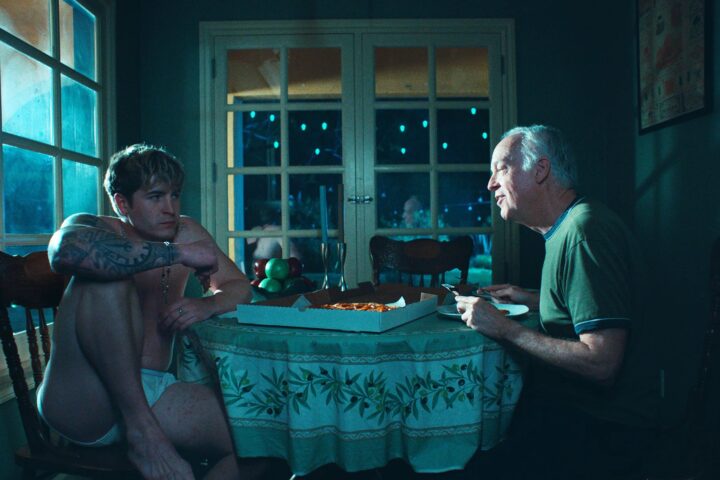
“I’m a trustworthy guy. I promise. I swear on my life,” intones a man in a balaclava (Reed Birney), pointing a camcorder at the sex worker (Kieron Moore) he’s lured to a suburban Los Angeles home. The target of these reassurances—young and muscular, undressed to his underwear and perched stiffly on the sofa—briefly protests and threatens his masked client. But with just a little more pushing and wheedling from the masked man, the sex worker meekly consents to disclose intimate personal information on video.
That’s a representatively squirm-inducing scene from Elliott Tuttle’s debut feature, Blue Film, a scrappy and profoundly unsettling chamber drama that uses taboo questions about performance, trauma, and (un)ethical desire as scalpels, rooting around in its emotionally blighted characters’ and audiences’ psychological defenses without anaesthetic, so to speak.
Moore’s Aaron Eagle is a tatted camboy and escort, ordinarily a sadistic dom who verbally and physically abuses his clients, as well as takes financial advantage of them. His is an emotionally isolating and legally murky lifestyle. However, his latest client is different: Upon getting Aaron in the house and on camera, he begins asking questions about the younger man’s background and childhood, addressing him with a familiarity that quickly puts Aaron on edge.
Aaron’s client isn’t a stranger, it turns out, but Hank Grant, his middle school English teacher from the Maine town he escaped in his teens. Hank, known to Aaron once as “Mr. Grant,” was fired and ostracized by their community for sexually assaulting a male student. Hank proclaims that he’s always been secretly in love with Aaron, and having remotely followed his former student’s career as a sex worker, now wants to confront the younger man whose loneliness and suffering pain him to see—and perhaps have sex with him as well.
Consumed with self-hatred beneath his façade of belligerent masculinity, Aaron is repulsed yet intrigued by the gesture—and enticed by a five-figure payday—and doesn’t see himself as having any moral high ground on which to walk out on a pedophile paying for his services. Moreover, Hank’s appeals to his former student’s childhood self essentially make Aaron come to terms with all the ways in which he’s grown into a jaded and angry adult.

As the pair engage in personal disclosures and disquieting sexual roleplay (at one point they even pretend to be children), Aaron seems to wonder whether and how much he should pity Hank. Tuttle, to his immense credit, never guides us into a safe or obvious stance on the matter, the uncertainty making it all the more disturbing. Moist-eyed, gentle, and radiating emotional burden even when he’s in subtle control of the scene, Birney imbues Hank with a wounded vulnerability that belies the horror of the words often slipping out of his mouth.
In some moments, Hank seems cognizant of the moral abhorrence of his desires, which he insists are unchangeable, and to demonstrate his commitment to redirecting them from harming children, as in his claimed accountability meetings with a priest. In others, he seems to romanticize these desires in attempts to exonerate himself, as when he likens himself to the socially accepted pederasts of ancient Rome. Hank expounds, at Aaron’s prompting, on the “love” he feels for the prepubescent boys on which he fixates. Sometimes Hank’s compassion seems earnest or even naïve, yet in the film’s most chilling throwaway remark, he fawningly describes the then-12-year-old victim of his assault as “innocent, like a dog.”
Moore, for his part, portrays Aaron as someone trying to hide from his past and his deep, lingering pain—the source of which is only broadly described—in direct contrast to Hank’s resigned self-acceptance. Aaron insists that his brutal, transactional sexuality represents his own freedom, yet his encounter with Hank brings him closer to his more submissive, compassionate repressed self in a queasily cathartic role reversal. Aaron’s discomfort in his own skull-tattooed skin occasionally grinds against mannered dialogue that gives the film a bit of a community theater feel (“I wonder a lot if there is purity in perversion,” says Hank at one point), while the story arrives at a final note that feels a little too tidy after all that’s preceded it.
Ryan Jackson-Healey’s cinematography is mostly plain coverage of the single rental house location (conveniently also a rental in the story), rightly retaining focus on the two committed performers. Its periodic attempts at Lynchian expressionism—as in breakouts of blue nocturnal lighting and glowing crimson bedsheets—are neither heightened nor understated enough to mesh with the film’s otherwise prosaic and pared-down visual register. Inserted home movies of (presumably) Aaron’s younger self, contrasted with his adult self’s relationship to cameras and Hank’s obsession with observing him through the lens, are far more haunting and provocative.
On the whole, Blue Film’s raw, skin-crawling interrogations of aberrant sexuality and trauma ring fearless and true. The unsteady waltz of its two characters figuratively and literally stripping each other down, never easily predictable yet methodically controlled by Tuttle and his actors, is hard to watch but impossible to look away from. Rough edges and all, the film may be a new classic for American indie cinema of the fringe and perverse.
Since 2001, we've brought you uncompromising, candid takes on the world of film, music, television, video games, theater, and more. Independently owned and operated publications like Slant have been hit hard in recent years, but we’re committed to keeping our content free and accessible—meaning no paywalls or fees.
If you like what we do, please consider subscribing to our Patreon or making a donation.