Xander Robin’s The Python Hunt makes it abundantly clear from the get-go that the people are the problem. In an early montage, the documentary details how 900 imported pythons were accidentally released into the middle of the Florida Everglades in the early 1990s. This “ecological disaster,” as one interviewee describes it, led to somewhere between 50,000 to 500,000 non-native predators roaming the wetlands today. (That questionable range is something that the film attributes to inconsistent human judgment.) They’re purportedly wiping out the small game population, though the film’s subjects disagree on the extent to which that’s true, and whether or not the python invasion is even as bad as people say it is.
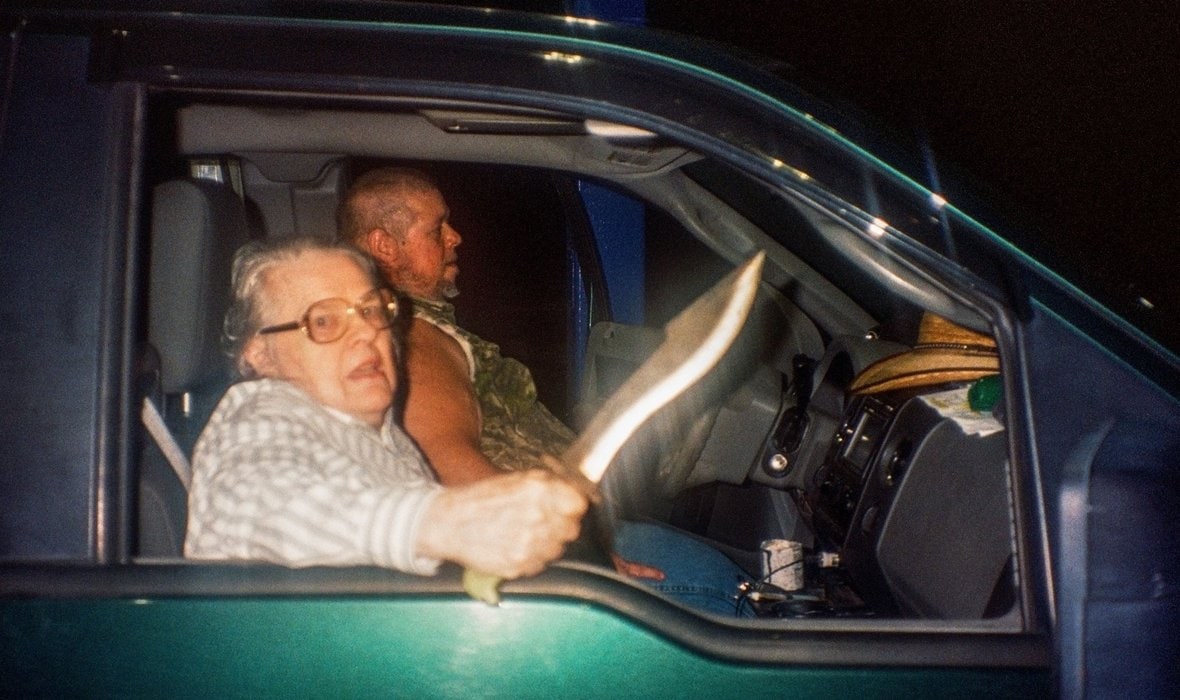
The Python Hunt follows a ragtag group of eccentric obsessives, locals and out-of-towners alike, who participate in the Python Challenge, an effort to protect the endangered Everglades ecosystem. There’s journalist, professional outdoorsman, and “8th generation Florida cracker” Toby Benoit, who’s linked up with the recently widowed Anne Stratton on the promise that he’ll capture a snake so she can “scramble its brains.” We also follow Richard Perenyi, a San Francisco science teacher who enjoys micro-dosing ecstasy while he goes out hunting. Then there are Joe Wasilewski and Amy Siewe (a.k.a. the Python Huntress), two locals who, unlike Toby, Anne, and Richard, are more practiced and successful in their retrievals.
Some of the film’s most riveting sequences show people in thrall to their targets. In one scene, a group of hunters think they see a python in the bushes. It turns out to be a cottonmouth, a common mix-up. One guy can’t put the snake down, fixated on it, despite his companions’ encouragement to move along. The narrator calls this particular hypnosis “snake eyes,” and it isn’t the last time in The Python Hunt that we’ll see someone under a snake’s spell.
Just as the hunters are entranced by reptiles, Robin and cinematographers David Bolen and Matt Clegg are bewitched by the drug and alcohol use of several subjects and the way they’ve let this excursion define their lives. But the film’s spotlighting of its subjects’ idiosyncrasies can be as entertaining as it is overemphatic; these are colorful enough characters without the need for an unflattering close-up or the synth stylings of Nick León’s atmospheric score.
Still, the at times overbearing aesthetic touch isn’t enough to diminish the film’s saliency. “Humans are good at destroying things,” says someone at one point. Elsewhere, Toby points out that the monsters are always people in Scooby-Do. It’s notable, too, that the only people we see here making fools of themselves, engaging in the competition, satisfying their boredom and existential dissatisfaction with a snake hunt, are white. Once that particular realization hits, it also becomes clear that The Python Hunt is about whiteness running amok. The film resolves itself on a note of failure, with only 209 pythons collected by the subjects. It’s also a rather damning one, as the humans here are killers who aren’t very good at it.
Since 2001, we've brought you uncompromising, candid takes on the world of film, music, television, video games, theater, and more. Independently owned and operated publications like Slant have been hit hard in recent years, but we’re committed to keeping our content free and accessible—meaning no paywalls or fees.
If you like what we do, please consider subscribing to our Patreon or making a donation.