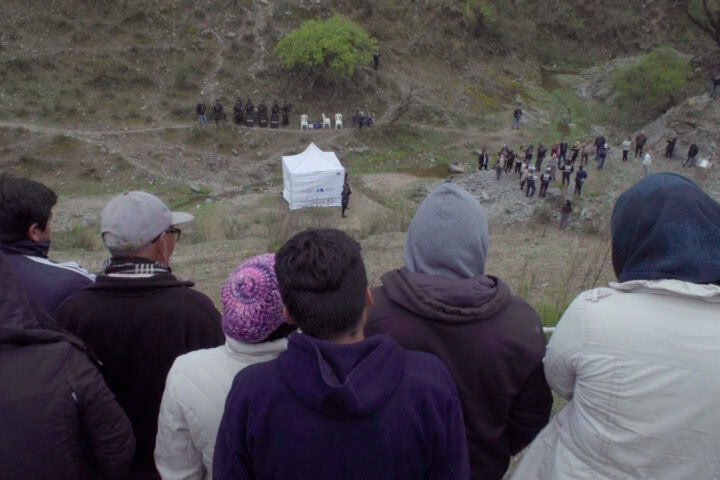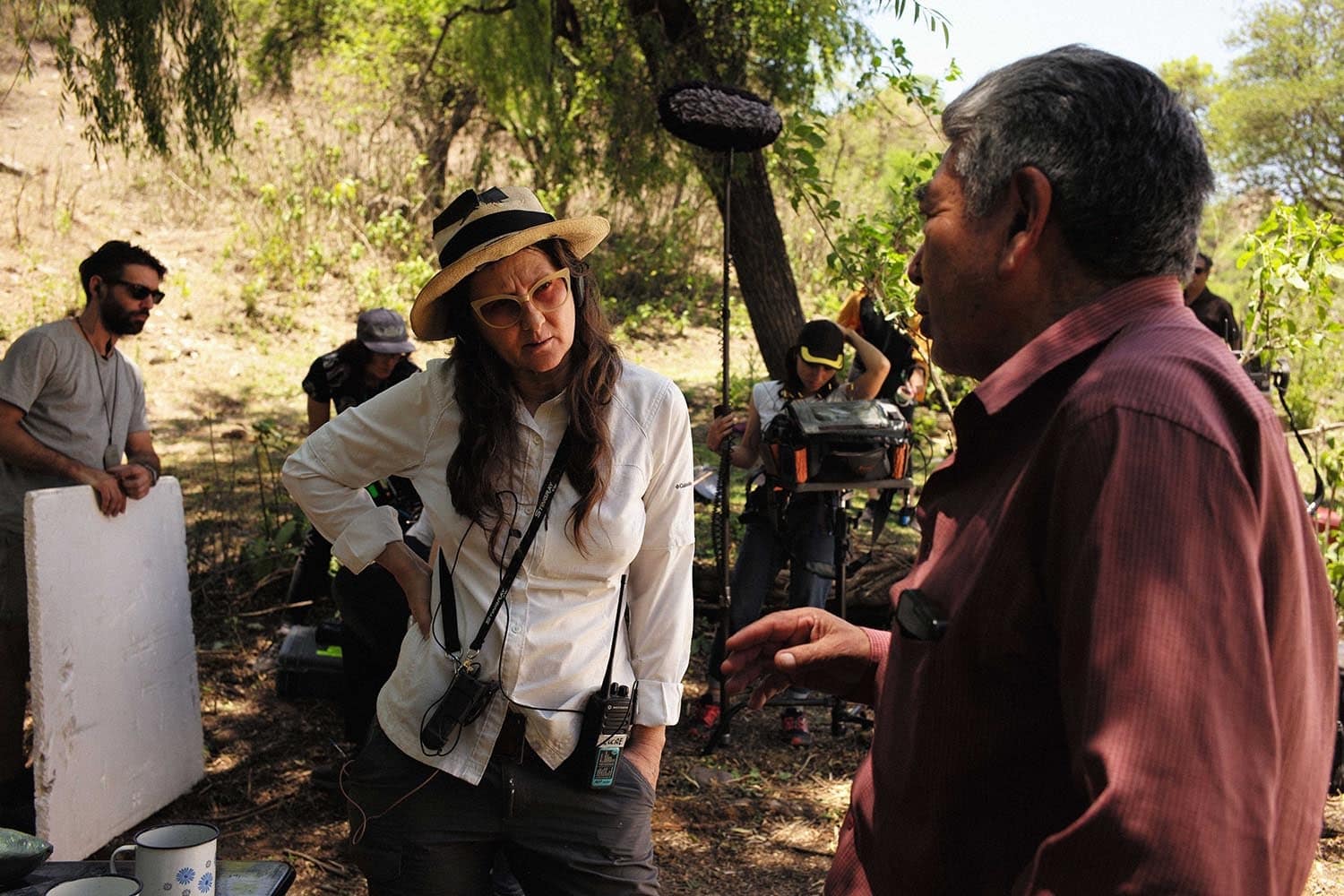
Anticipation was already building for Lucrecia Martel’s first documentary when she toured her previous feature, 2017’s Zama, and teased details of a project referred to as Chocobar in interviews. She grew fascinated with the YouTube footage of land rights activist Javier Chocobar’s 2009 murder at the hands of a local property owner looking to evict the Indigenous Chuschagasta population. This initial point of intrigue led Martel into the community to learn more about their historic connection to a piece of territory in northwestern Argentina.
Over a decade and a half from the project’s genesis, Our Land presents itself as a synthesis of the New Argentine Cinema pioneer’s learnings and reflections on her time spent among the Chuschagasta people. The arc of the story grows to encompass the 2018 trial of Chocobar’s killer, Dario Luís Amin, which many thought would never occur due to the state’s deference to landowners’ claims to self-defense within their own domain. But the documentary resists the narrow framing of a binary verdict as the ultimate arbiter of justice.
As Martel weaves together the past and present of an ongoing struggle, her film pays tribute to the resilience of a community bound by a shared love of their land. Through preservation of the Chuschagasta’s photographic archives and documentation of their oral history, Our Land helps ensure the persistence of a people in the wake of relentless mutations of colonialist attitudes. Martel, for her part, never inserts herself into the narrative as a white savior. Her presence might be invisible in the events she documents, but her rumination on the connection between image-making and identity formation ensures that her distinctive perspective is always felt.
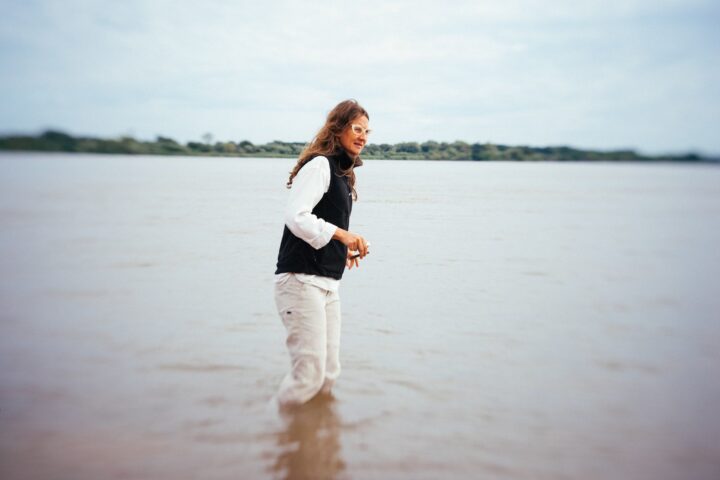
I spoke with Martel in New York ahead of Our Land’s theatrical opening. We discussed how she approached sound and image across her first nonfiction work, why there was controversy around subtitling the documentary in Argentina, and what role film has in opening up conversations around Indigenous land rights.
You’ve described an incident in your own life where you turned to a form of Indigenous medicine akin to shock therapy, which taught you that souls can be separated from the body at the site of a traumatic incident. Is that experience, whether literally or spiritually, something that informed Our Land?
I think it definitely informed the making of The Headless Woman. In the north of Argentina, the Indigenous culture and the Creole culture are very mixed. This is something that’s very adopted, this type of Indigenous healing. I don’t think that it was especially [informative] in this.
I’m not sure if Chocobar was ever a title for this film, but how did you end up calling it Our Land or Landmarks, as it’s sometimes been translated into English? Was there an evolution of what you understood the subject of the film to be?
No, we actually never had a title until Our Land or Landmarks. Obviously, Chocobar was a very important part of this. I think, internally, we referred to it as Chocobar. It was probably the name of the folder where we were keeping everything.
Who is the “our” of the title?
I think what we liked about the title is that it forces you to think about that. Who does the land belong to? Perhaps, in Spanish, the title also has the connotation of the land referencing the planet Earth, which in English doesn’t quite translate.
Is that part of why the film starts in outer space?
Yes, without a doubt. But, also, we were interested in all of these technologies that are watching us and are producing images of us, whether that is drones, satellites, in film, of video, photography…all the tools that we use to register the image.
When you were promoting Zama, you referred to what this documentary would become as “an essay on photography.” How did that angle emerge and sharpen over the production process?
That may have been a misunderstanding! I do know that we definitely think of it as a reflection on cinema, which it is. At the beginning, it wasn’t clear, but it’s definitely a layer that was embedded in the film, and we’re talking about all of the photography that we were able to collect from the community itself. There’s this question about their will to leave a register and archive.
You tend to think through the soundtrack well before shooting your fiction films. Did you have to approach this any differently, working within nonfiction? Is that what led to presenting the community’s archive with the narration behind it, adding a sense of space to these photographs that are otherwise two-dimensional?
In this film, the narrative process was the one that I’ve always used, but what was most important for me was to make sure that we were listening to the Indigenous community, the community members, and the ways that they express their stories, as well as the stories about that territory, in their own voices and in their own accents.
Did hearing how the community uses Spanish, a language imposed upon them, to express their history change the way you thought about the spoken word?
A bit, yes, but I think it’s less because they were Indigenous and more about the rural areas they inhabit. They have a very special way of speaking. They lost their original language, the Cacán, in the 17th century. So, in many ways, the construction of what they’ve done in their appropriation of that Spanish has more to do with the spaces they’re inhabiting.

In reading some Argentinian local press, I came across some articles that made it seem as if there was some controversy around whether or not to subtitle some of the Spanish they’re speaking. How did you approach that?
In our country, in Argentina, there are lots of different ways of speaking Spanish. Curiously, in the province of Buenos Aires itself, there’s a very low capacity for hearing other tonalities. But a big chunk of the film was understood, mostly. We decided to bet on the fact that people, as they watched the film, would get accustomed to the tonality and speech. That they would be able to understand it. And, at the end of the day, it wasn’t incomprehensible. We did some tests, and sure, there were a couple of things that somebody may not have understood. But it was comprehensible for the most part. If I had decided to do subtitles, I wouldn’t have just done subtitles for the Indigenous community. I would have subtitled the entire film. In Zama, the decision was actually the opposite. All of these languages that we decided we didn’t want to learn then, now we’re not going to show or give the audience the ability to hear them.
You’ve described “white dramaturgy” as an attitude you wanted to avoid in this film. What does that phrase mean to you?
It is a type of white reasoning that helps us put ourselves in that space. It’s a type of thinking that, at least in a country like Argentina, happens regardless of what color skin you have.
The trial didn’t happen for many years into the project. How did you incorporate it into the narrative without overpowering the portrait of the people?
It took me a long time to decide to bring the trial into the film. I wasn’t sure if it was going to make it in. We did a lot of editing for the footage of the trial, and we decided to choose elements that displayed some level of transparency into the difficulty of actually building an Indigenous identity, as well as the difficulty of trying to hide something that was blatantly immoral.
When thinking about Indigenous identity, it’s often built around a language or shared genetics. In the case of the Chuschagasta, that bedrock is their connection to the land, which is harder to prove since so many of those records have been destroyed. Was part of the purpose of the film trying to offer that proof, or was it just about trying to capture this intangible feeling of their connection?
There’s a lot of proof of continuity of the community having been there for a very long time. There’s historical proof of that. But the Argentinian state was really able to separate the idea of ownership and community. So that’s very difficult to explain, and what the Argentinian state wants now as proof is clear proof of language or of a cultural difference. These things that are no longer there [for the Chuschagasta]. What there is proof of is that these communities have been there, always building their lives and their activities in this space.
There’s such a striking moment in the film where a bird hits the drone and sends the camera crashing down. Obviously, that was an accident when it happened, but how did you come to turn this accident into something that has a very intentional and very powerful impact in the film?
We thought about it a lot. We thought about the decision of buying the drone or renting it out. We knew that we were going to be using it for a while, so we decided to buy it, and we started using it about a week later. It was taken down, so it was a very expensive take! When we saw it, we hoped we could embed it and use it outside of that. We lived in this bubble where we knew that we needed the film to include all of the information that we had gathered throughout our research. This take provided us a way to cut into that narrative, into this weird moment where you start having the storyteller go over this information. We needed to make sure that the specific last names were included in that narrative. Those are last names that the community is in conflict with and will continue to be in conflict with until the state is able to come to a resolution. The fall of the drone gave us a segue into that.
The film opened in Argentina last month. Did it spark the kinds of conversations or actions you hoped it would?
Not in the traditional media, but there was definitely a lot of debate that came about on social media. We did a small premiere, and when we were presenting the film, during and after the Q&A, there was a necessity for the people watching to be able to discuss it. We had to put people working in the reception and taking on all of the queries around the projection of the film in community centers and schools. For me, it was very gratifying because it felt like the first time that I’ve seen this kind of impact come out of a film.
It was [important] for me that the film was able to come close to a part of the population that had never been close to the film in any way. What I do think is interesting, in the media, we do now have the topic of the land and its ownership back at play, which is something that had disappeared with [Javier] Milei. There are a lot of Indigenous conventions and community meetings where leadership asked me directly for the film so that they could project it, and that means that the film has been very useful in opening up a broader conversation.
Is the dialogue enough? Mexico is trying to get Spain to apologize for colonialism, for example, which you’ve called a joke.
Yeah, I think it’s silly, but I think for a society to back an action related to the restitution of land in our country, we need to have a conversation first. What I think is that film can provide the tools to open up that conversation.
Translation by Cordelia Montes
Since 2001, we've brought you uncompromising, candid takes on the world of film, music, television, video games, theater, and more. Independently owned and operated publications like Slant have been hit hard in recent years, but we’re committed to keeping our content free and accessible—meaning no paywalls or fees.
If you like what we do, please consider subscribing to our Patreon or making a donation.