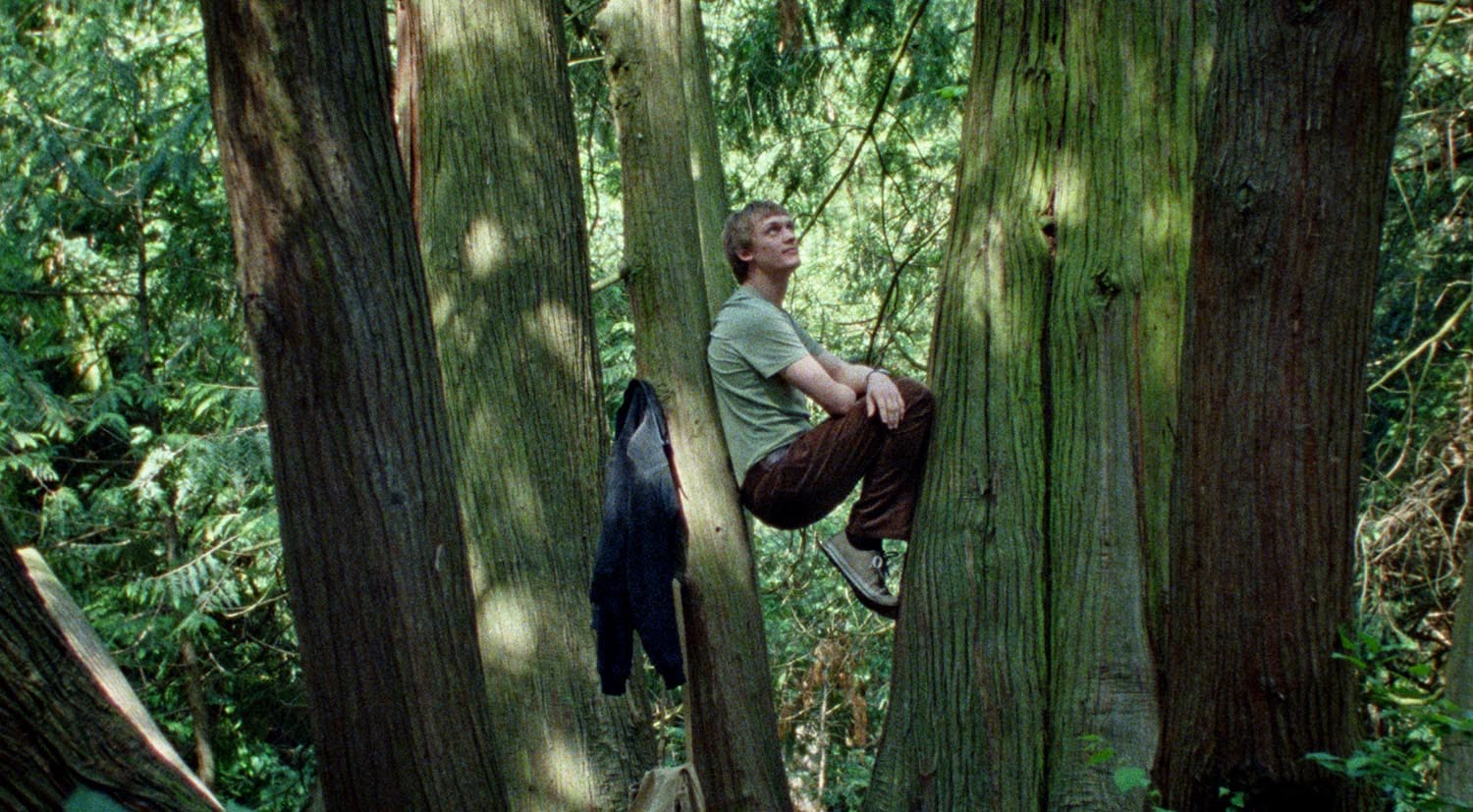
As quiet and low-tension as its title implies, writer-director Ildiko Enyedi’s mind-bending, meditative Silent Friend wears the skin of a trans-historical epic but contains the spirit of an eccentric eco-feminist philosophical essay. Rooted in the multi-century life and memories of a single ginkgo tree on the campus of the University of Marburg in Germany, this singularly oddball film appeals to science and the senses to argue that plants may possess something closer to consciousness than we’ve conventionally understood—and that understanding them better may expand human consciousness to more enlightened realms.
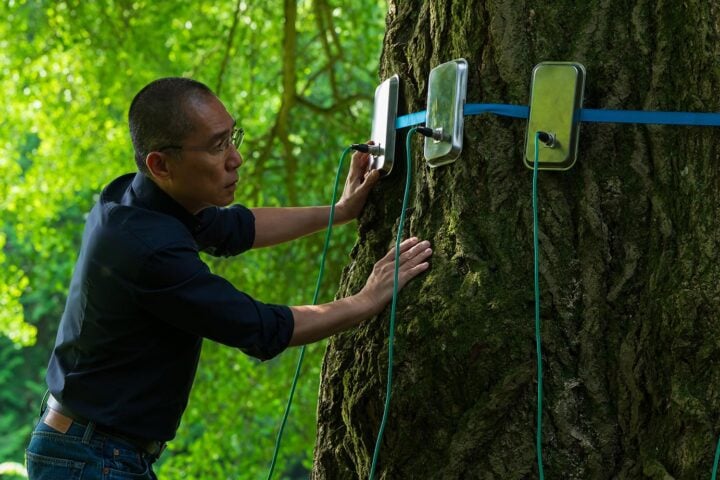
Likening the life of a tree to the life of an institution, the film cuts between three storylines as it follows staff and students at the university across three historical periods, filmed in three different mediums. In 2020, shot on crisp HD digital film, Dr. Tony Wong (Tony Leung Chiu-wai) is a visiting neuroscientist from Hong Kong whose research focuses on the way infant brains absorb and catalog information. The process, he explains in a lecture, involves complex activity across the brain that differs starkly from the more myopically focused, “exclusionary” neural pathways of the adult mind, except under the influence of certain strong psychogenics.
When stranded alone on campus due to the Covid lockdown and unable to progress his research, a bored and lonely Dr. Wong strikes up a Zoom correspondence with Alice Sauvage (Lea Seydoux, confined to phone and laptop monitors). She’s a botanist whose interest in the neural and reproductive processes of plant life inspires Wong to attempt a bold new series of experiments involving EEG readings of the titular ginkgo—much to the consternation of the campus janitor (Sylvester Groth), who eyes Wong with possibly-racist suspicion.
“Meanwhile,” at the dawn of the 20th century—shot in monochrome 16mm—a gifted young botanist named Grete (Luna Wedler) becomes the university’s first female student, in the face of open hostility from a stridently patriarchal community. Alienated from her peers (who all either patronize her, try to get in her pants, or both) she comes under the tutelage of an elderly photographer and begins to take an interest in the craft, capturing and studying semi-abstract close-ups of plants, fruits, and her own body in juxtaposition.
Finally, in the 1970s—shot in extra-grainy, groovy-colored 16mm—a naïve young student named Hannes (Enzo Brumm) is romanced by yet another female botanist, the liberated and confident coed Gundula (Marlene Burow). Hannes’s conservative working-class background puts him at odds with Gundula’s peer group of student radicals, who are less interested in discovery and understanding than free love, sit-ins, and miscellaneous aggressions against the status quo or anyone questioning their vaguely defined revolution. When Gundula goes on a research trip, Hannes finds himself increasingly drawn into her dorm room experiment tracing the electrochemical life of a pet geranium that seems to respond to specific human presences, a crude prototype of what Dr. Wong will attempt almost half a century later.
Silent Friend is stacked with acclaimed actors embodying the emotional and spiritual yearnings of the lonesome egghead. (Enyedi says that she wrote Leung’s part with him in mind, and Wedler was awarded for her embodiment of quiet persistence by the jury at last year’s Venice International Film Festival.) But for as much as the humans strive to communicate across barriers in their sparse and fragmented storylines, the real stars are the plants, who even receive their own credits in a list of names significantly longer than that of human actors.
Time-lapse footage and sonic recreations of germination and seed growth share the film with wide shots of flowers and trees dwarfing or even looking back at small human figures, their many-limbed alien bodies dominating the frame, their colors distinctly graded to the three very different visual registers. Through the film’s winding structure and scope, the audience is encouraged to see outside the “human time frame,” as Dr. Sauvage puts it in a fictional TED talk, with fragmentary, lackadaisically paced, and shuffled narratives loosely rhyming across the expanse of a rapidly changing century as natural cycles persist unabated.
To entertain the idea that plants “see” and remember us is, as Dr. Sauvage says, to suddenly feel naked with countless eyes on oneself. So Enyedi wants to make the viewer reconsider their anthropocentric view of the world, framed in the film as merely the next frontier for progress to conquer beyond sexist and xenophobic prejudices of old.
In Enyedi’s narrative the humans speak for the trees, for even with the help of colorful spectrograms and 3D electric current visualizations, the trees have no tongues. The majority of the film’s dialogue and imagery is dedicated to expounding on its many, many ideas, which include a survey of the similarities and differences in human and plant sexuality, and the ancient association of flowers and seeds with the human female body. There’s also an interrogation of knowledge creation systems, image-making technology, and the valuation of “objectivity” as a mask for the privileging of certain perspectives over others. On top of that, the film is a meditation on the beauty and necessity of cross-pollination to evolution and understanding, and the reflexive resistance of closed systems to anything new and foreign.
All of the film’s discursive branches stem from the same root, though it isn’t always clear how they tie together in the big picture. Likewise, the exact connection between the three minimally plotted narratives is opaque, and the film ends on something of a question mark, with only Dr. Wong’s storyline granted anything vaguely resembling a resolution.
Only qualified scientists and philosophers will be able to properly assess the strength of Enyedi’s claims about the consciousness of the plant world (though the film draws from actual research, and a platoon’s worth of PhDs are credited as consultants), but the romance of her plea for open minds and cross-boundary understanding can be admired or scoffed at according to one’s level of optimism about the world. That’s the strange catch of Silent Friend: Presenting an academic argument in elliptical poetic form, it posits a world where the guidance of science and nature can transcend politics and collapse binaries, which in 2026 represents either visionary optimism or hopeless naïveté. Despite loose ends, it’s one of the most dreamily affectionate (and affectionately critical) portrayals of the natural sciences ever committed to the screen.
Since 2001, we've brought you uncompromising, candid takes on the world of film, music, television, video games, theater, and more. Independently owned and operated publications like Slant have been hit hard in recent years, but we’re committed to keeping our content free and accessible—meaning no paywalls or fees.
If you like what we do, please consider subscribing to our Patreon or making a donation.