
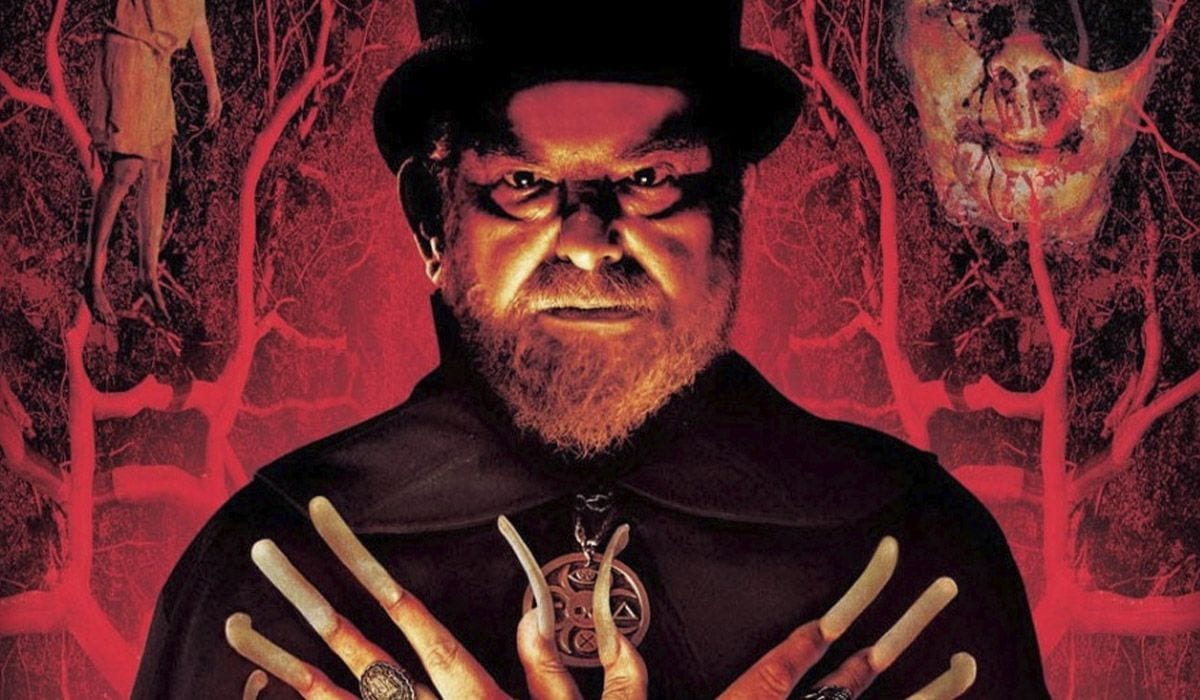
Writer, director, and actor José Mojica Marins singlehandedly inaugurated Brazilian horror cinema in 1964 when he released At Midnight I’ll Take Your Soul. This surprisingly gruesome gothic concoction introduced unsuspecting audiences to the indelible figure of Coffin Joe, a nefarious undertaker with a black top hat and cape, uncannily long fingernails, and a bloodthirsty life philosophy that’s part Friedrich Nietzsche, part Marquis de Sade. Over the next four decades, Coffin Joe would not only headline his own official trilogy but also turn up as a sometimes secondary character in numerous other films and TV shows, ultimately achieving the status of a national icon often called “the Brazilian Freddy Krueger.”
Arrow Video has assembled 10 of Mojica’s films in their staggeringly appointed new box set Inside the Mind of Coffin Joe. All of these titles have received striking new 4K restorations from original film elements, and Arrow has included many hours of bonus materials, including filmmaker commentaries, interviews with cast and crew, visual essays on the films’ principal themes, and lots of other goodies. This lavishly designed set also comes complete with a foldout poster featuring arresting artwork from Butcher Billy, 12 two-sided art cards, and a beautifully illustrated book with new writing about Mojica from a handful of genre experts.
At Midnight I’ll Take Your Soul combines the shadow-sculpted black-and-white cinematography of a 1930s Universal horror movie with bursts of unexpectedly gory mayhem along the lines of H.G. Lewis’s roughly coeval Blood Trilogy. Set in a small town somewhere outside São Paulo, the film chronicles Coffin Joe’s quest to achieve immortality by fathering a perfect offspring with a “superior” woman. The lengths to which he will go to achieve this end include shocking acts of torture, rape, mutilation, and murder.
Coffin Joe is a fascinating bundle of contradictions. On one hand, he represents a sort of Nietzschean “overman” in open rebellion against the stifling strictures of Brazilian society and the hidebound dogmas of the Catholic Church. On the other, he’s an overblown narcissist, misogynist, bully, and criminal who seems to embody the misconceptions of Nietzschean philosophy put horribly into practice by the Nazis, and so perhaps a reflection on Brazil’s harboring of Nazi war criminals and its own recent turn to a military dictatorship.
From a psychological perspective (and psychologists turn up often in Mojica’s films), Coffin Joe expresses both the ego’s emphasis on logic and reason and the id’s churning chaos of unchecked desires. Rather than making manifest the content of the unconscious, Mojica is interested in following reason down the rabbit hole into unreason. In “Ideology,” the third segment of the anthology film The Strange World of Coffin Joe, from 1968, he plays a psychologist suspiciously reminiscent of Coffin Joe who resorts to some graphically extreme measures to persuade a skeptical journalist and his wife that instinct always trumps reason.

Seen through a Nietzschean lens, Coffin Joe combines Apollo and Dionysos, the Greek gods of reason and ecstasy. The long-gestating third film in the trilogy, 2008’s Embodiment of Evil, closes with a beyond-the-grave voiceover from Coffin Joe in which he claims to reside in a third place “beyond good and evil” (an overt nod to Nietzsche) where dreams and nightmares dwell. Like all good surrealists, Mojica found inspiration in precisely this spot.
Mojica often claimed that the figure of Coffin Joe first came to him in a dream, so it’s no surprise that dreams or hallucinations feature prominently in many of his films. In fact, the second film in the trilogy, 1967’s This Night I’ll Possess Your Corpse, recreates Mojica’s initial dream when Coffin Joe is accosted by a figure clad all in black who drags him out of his bed, down the stairs, and out into the local graveyard. Mojica then amplifies this with a remarkable sequence, shot in garish gel-lit color, where Coffin Joe descends to hell.
Awakening of the Beast, from 1970 (though banned in Brazil for two decades), is a fascinatingly self-reflexive film. In a series of episodes that range from the legitimately disturbing to the surreally hilarious, a psychiatrist (Sérgio Hingst) outlines to a panel of his peers the disturbing effects of drugs on contemporary society. At one point, Mojica appears as himself on a TV show where he’s put on trial for the deleterious influence of his films.
In order to chart the results on their mindsets, the psychiatrist exposes a quartet of volunteers to a screening of This Night I’ll Possess Your Corpse before administering a dose of LSD. The film then switches abruptly to color as we’re treated to another hallucinatory color freak-out, before then springing a fascinating punchline: the injection was merely a placebo. In reality, it takes little stimulation to awaken all that’s bestial in human nature.
In Hallucinations of a Deranged Mind, from 1978, a psychiatrist (Jorge Peres) is being tormented by nightmares in which Coffin Joe steals his wife, believing her to be the perfect woman to give birth to his wunderkind. His colleagues recruit Mojica himself to convince him that it’s all in his head. Except, in a turn typical for the surrealist-inclined Mojica, it isn’t. Having cheekily claimed an equivalence between psychology and the supernatural, the film ends with Coffin Joe entering the “real” world to wreak vengeance on the couple.
The ethical flipside of Coffin Joe is represented by the comparatively impassive character Mojica plays in The End of Man, from 1970, and its 1972 sequel, When the Gods Fall Asleep. The first film is basically a modern-day riff on the life of Jesus: The man who will eventually call himself Finis Hominis (Latin for “end of man”) emerges naked from the sea, startles a (supposedly) wheelchair-bound old woman into walking, attracts throngs of followers, exposes hypocrisy high and low, and delivers his own peculiar variation on the Sermon on the Mount, all before returning to the mental hospital he escaped from in the first place.
The End of Man works as social satire, even if it’s never terribly funny. Perhaps the best sequence takes place amid a hippie commune. Mojica gets to let loose with some cool artwork and timely psychedelic imagery right out of The 14 Hour Technicolor Dream. But even the hippies get called to task for their willingness to set aside their beliefs in the crass pursuit of money. When it comes to the follow-up, it’s a case of diminishing returns: There’s more of the same, only it’s all choppier, slower paced, and less satisfying than the first.
Mojica’s films exhibit a resolutely lo-fi, handcrafted quality that brings to mind filmmakers like Ray Dennis Steckler and Andy Milligan. Like Steckler, but with an even more meta bent, Mojica occupies his own unique cinematic cosmos, especially in the numerous Coffin Joe films collected in this set. That’s hardly surprising for a man who grew up over a movie theater: As a result, Mojica’s are films drunk on and dazzled by film, delirious creations that resolutely push the envelope (sometimes even refusing to admit the very existence of an envelope) in terms of form and content. They are quite simply “such stuff as dreams are made on.”
Inside the Mind of Coffin Joe is now available from Arrow Video.
Since 2001, we've brought you uncompromising, candid takes on the world of film, music, television, video games, theater, and more. Independently owned and operated publications like Slant have been hit hard in recent years, but we’re committed to keeping our content free and accessible—meaning no paywalls or fees.
If you like what we do, please consider subscribing to our Patreon or making a donation.


