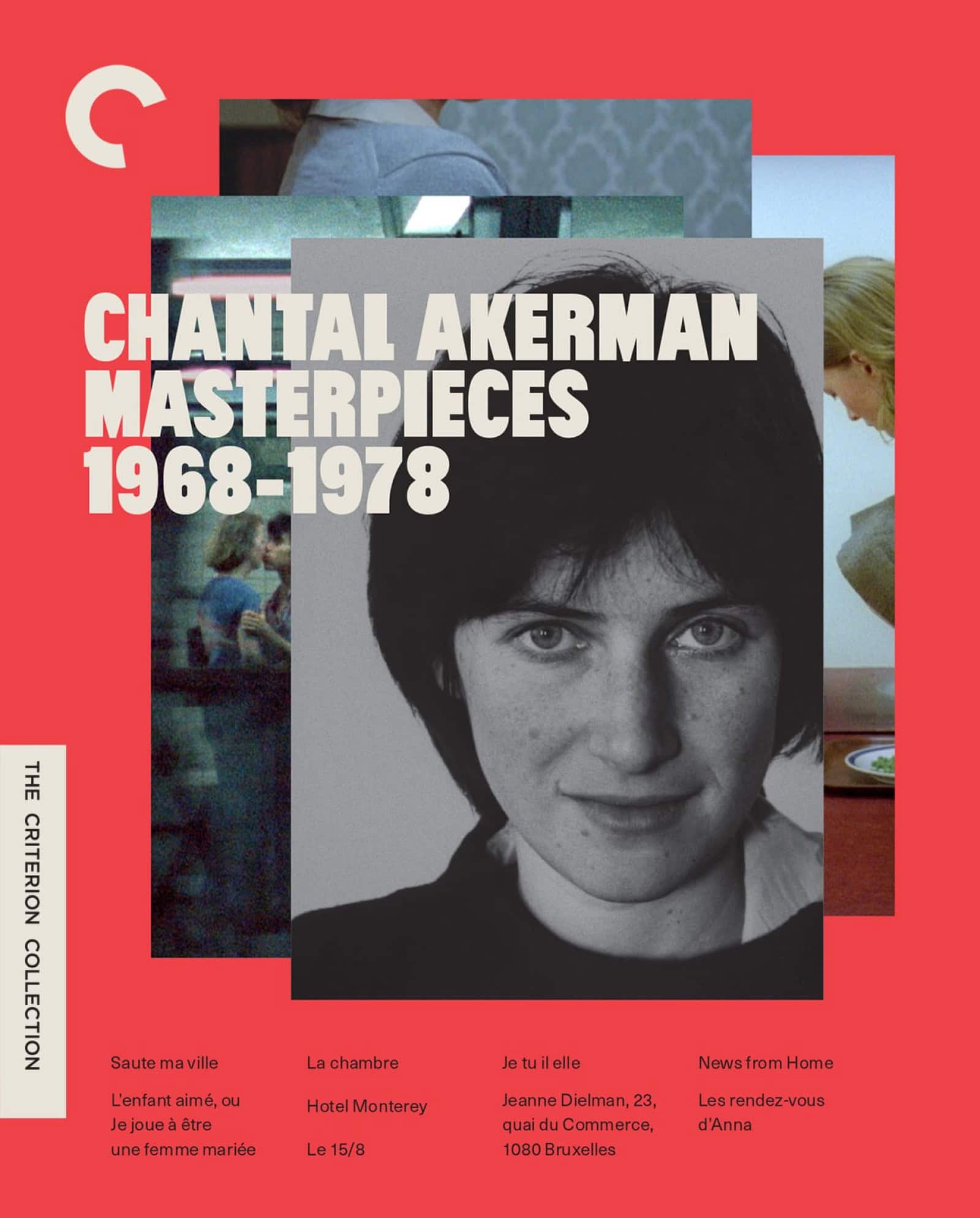
 On its face, Criterion’s Chantal Akerman Masterpieces, 1968–1978 is an essential set for offering key early works, some more obscure than others, from the career of one of the great film artists. But the pleasures here run deeper. Akerman used each of her initial films as a springboard to the next, and watching them in chronological order sees her consolidating and complicating her aesthetic and thematic preoccupations with each successive project.
Consider Akerman’s first film, 1968’s Saute ma ville. Akerman made this 13-minute short at the age of 18, and its debt to the antic energy and seriocomic political inclinations of the French New Wave makes it an outlier in a body of work fixated on structuralism and more meditative atmospheres. Yet in the film’s depiction of a young woman (Akerman herself) trashing her apartment emerges an outlandish expression of what will become a more somberly explored theme in upcoming shorts, that of women chafing against the constrictions of confining domesticity.
Akerman builds upon this theme with 1971’s rarely seen L’enfant aimé ou Je joue à être une femme mariée. If Saute ma ville borrowed liberally from the Jean-Luc Godard who made the anarchic Pierrot le fou, Akerman’s follow-up might be compared to Godard’s Une femme mariée in its materialist analysis of a woman’s self-conception and response to gendered norms. The young single mother (Claire Wauthion) at the short’s center frequently studies her body in the mirror while musing about her feelings on motherhood and aging in a voiceover monologue. Occasionally, she voices her anxieties aloud to a friend (Akerman), whose pointed silence underlines Akerman’s role as the filmmaker documenting the woman.
The juxtaposition of a woman’s domestic routine and interior thoughts recurs in 1973’s Le 15/8, which was co-directed with Samy Szlingerbaum and focuses on a Finnish expat (Chris Myllykoski) living in Paris struggling with feelings of displacement. As Akerman became more of a world traveler, such hang-ups became more pronounced in her studies of unsettled women.
The observant, tightly composed views of domestic spaces in these films reach a zenith in 1972’s La chambre, which consists of an unbroken shot panning back and forth around Akerman’s own bedroom and taking in the same objects—the only dynamic element in the frame being the filmmaker striking poses in her bed. Even by the minimalist standards of Akerman’s work to this point, La chambre pares down the essence of filmmaking to its bare minimum.
Even though La chambre slightly predates Le 15/8, it feels like the turning point that leads directly to Akerman’s more intricate work of the mid-1970s. Made around the same time as Le 15/8, the hour-long structuralist silent documentary Hotel Monterey takes that film’s notions of geographical displacement and applies them to Akerman’s time living in New York City, which she documents via fixed, long takes in the rental and communal spaces she navigated.
On its own merits, the film is a remarkable feat, each Hopper-esque composition and perfectly timed edit deepening a sense of ominous alienation that feels like the antithesis of celebratory, silent-era city symphonies. In the context of Akerman’s preceding shorts, though, Hotel Monterey is as much a radical challenge to her own established artistic language as those of conventional cinema. In place of claustrophobic studies of living spaces, Akerman focuses on transient spaces, like hotel corridors and subway cars, which are rendered unnatural and unnerving via her propensity for geometrically schematic compositions. So subliminally terrifying are Akerman and cinematographer Babette Mangolte’s images that this experimental silent would make an excellent companion for Stanley Kubrick’s The Shining.

All of these early shorts contain the component parts that culminate in her first two feature-length masterpieces, Je Tu Il Elle and the magnum opus Jeanne Dielman, 23 quai du Commerce, 1080 Bruxelles, both from 1975. The former recapitulates the displacement of Hotel Monterey back into the domestic sphere, with Akerman playing a depressed woman named Julie who, reeling from a breakup with her lover (Wauthion), lies around her flat in a stupor. The filmmaker’s static takes and abrupt, time-distorting edits perfectly reflect how days can slip by when one sinks into such a numb state, and somehow even a brief sojourn into the outside world that involves an impulsive bit of hitchhiking and transactional sex with a driver (Niels Arestrup) feels more despairing than Julie’s retreat from view.
Then there’s Jeanne Dielman. An anti-epic in which a single mother and sex worker (Delphine Seyrig) goes about her dreary daily routines, the film is a master class of what can be communicated through composition and editing. Throughout, Akerman cuts around what most would consider the most exciting parts of Jeanne’s day (pointedly eliding over her sexual liaisons the way she does activities like grocery shopping) in order to keep all focus on the regimented manner in which the woman approaches daily tasks like cooking and cleaning.
Gradually, though, these fixed actions become hypnotic, and to the point that when small aberrations occur, like the clumsy dropping of a fork, they hit with the sudden, thrilling charge of Raymond Burr looking up into the camera in Alfred Hitchcock’s Rear Window. And it’s especially interesting to return to the film in the wake of pandemic lockdowns, when it becomes suddenly much easier to empathize with Jeanne’s hyper-fixation on her precise internal schedule, and how one too many deviations from it spiral into the shocking finale.
After Jeanne Dielman, the final two films in the set, 1976’s News from Home and 1978’s Les Rendez-vous d’Anna, feel like falling actions. The former reworks Hotel Monterey’s dark urban malaise as wistful homesickness, with Akerman shooting in pallid daytime instead of starless night and adding the crucial element of reading letters from her mother. Though she includes none of her own responses, Akerman’s gentle recitation of her mother’s updates about her banal life and mildly passive-aggressive reminders to her daughter to write back convey a faint tinge of longing that adds a new emotional frequency to the filmmaker’s depictions of depression.
Similarly, 1978’s Les Rendez-vous d’Anna, which follows a thinly veiled avatar for Akerman (Aurore Clément) touring her films around western Europe, expands upon the alienation of the director’s works centered around artists living abroad. Nations like West Germany, France, and Belgium bleed into a homogenous mass of look-alike train stations, while hotels are differentiated only by the language on signs. Where other directors might have turned this into a commentary on the flattening aesthetics of globalized culture, Akerman makes these interchangeable backgrounds into a manifestation of Anna’s unmoored lack of belonging.
And yet, for once, the outside world will not be reduced to a simple backdrop; throughout the film, strangers, old acquaintances, and relatives intrude upon Anna’s benumbed reveries and share intimate details about their lives or invite her for a moment of connection, however tenuous and awkward. While the overall atmosphere is still gray, if not bleak (a riff on Je Tu Il Elle’s joyless sex scene is even more detached than the original), but rays of sunshine at last start to pierce the murk and point to a tonal pivot that would come in the ’80s.
For all of their formal rigor, Akerman’s early films aren’t mere exercises, and even in their shared sense of detachment and loneliness is a certain invitation to empathize. Three of the four pronouns in the title of Je Tu Il Elle are obvious: the first-person “I” representing Akerman the director and her on-screen avatar, the “he” representing the driver who picks up Julie, and the “she” representing Julie’s ex-lover. Crucially, though, there’s also the “you,” which by implication is the viewer. Akerman composes with the precision of a painter but ultimately leaves interpretation and feeling up to you to read into her deceptively icy work, and these projects slowly build up a panoply of emotional responses to the same basic moods.
Image/Sound
Apart from Jeanne Dielman, which appears here in the same transfer that was used on Criterion’s 2017 Blu-ray of the film, each of the works here previously released on the company’s barebones Eclipse Series 19: Chantal Akerman in the Seventies has been given a new transfer sourced from a 2K (or, in the case of Les Rendez-vous d’Anna, 4K) restoration. Films like News from Home and Hotel Monterey look darker than they did on Eclipse Series 19, but they boast significant upticks in sharpness, contrast, and, for the color films, saturation. Where the old DVD of Hotel Monterey looked like hazy security camera footage, the new Blu-ray has the rich, filmic qualities of 16mm photography in its naturally lit footage of New York City. Of particular note are L’enfant aimé ou Je joue à être une femme mariée and Le 15/8, which have been rescued from obscurity and shoddy bootlegs and whose black-and-white images are crisp and sharp. Each film also comes with lossless mono tracks, and all boast a sturdy fidelity.
Extras
Criterion’s box set comes with a number of terrific extras, first and foremost the footage from Chantal Akerman’s aborted 1973 documentary Hanging Out Yonkers, a commissioned look at a juvenile rehabilitation program that the filmmaker abandoned when she lost the audio that went with her footage. The images that remain, though, complicate the otherwise unified thematic arc of the complete films in the set, forgoing isolated portraits in favor of unguarded, even warm footage of kids in group therapy sessions or bonding in rec rooms.
In a new program, critic B. Ruby Rich discusses the films included in this collection, offering insights as analytical (a concise explication of Akerman’s evolving aesthetics) as they are personal (the macabre observation that the self-immolating finale Saute ma ville now plays more somberly than comically in the wake of Akerman’s suicide). Also noteworthy is a behind-the-scenes documentary, Autour de Jeanne Dielman, shot during the production of Jeanne Dielman by actor Sami Frey, as well as archival interviews with Akerman, frequent cinematographer Babette Manolte, and actors Auroré Clement and Delphine Seyrig.
Criterion also includes an interview that Akerman conducted with her mother, Natalia, that’s of a piece with the amusing generational tension and deep mutual affection that can be felt in the director’s dialogues with Natalia in films like Dis-moi and No Home Movie. Rounding things out is an interview with filmmaker Ira Sachs, who speaks to Akerman’s influence on his work; a few test reels that Akerman submitted as her application to Belgium’s INSAS film school; a 22-minute visual essay that sets radio interviews with the director conducted in the mid-1970s to personal photos and film excerpts charting her breakout in the international arthouse scene; and an expansive booklet containing an overarching essay as well as notes for each individual film, all by critic Beatrice Loaya. Befitting Akerman’s confessional, highly organized work, Loayza folds in both copious biographical detail and close reading of the films’ aesthetic merits.
Overall
The Criterion Collection’s essential box set gathers nine films from the revolutionary and enthralling first decade of one of cinema’s greatest artists.
Since 2001, we've brought you uncompromising, candid takes on the world of film, music, television, video games, theater, and more. Independently owned and operated publications like Slant have been hit hard in recent years, but we’re committed to keeping our content free and accessible—meaning no paywalls or fees.
If you like what we do, please consider subscribing to our Patreon or making a donation.