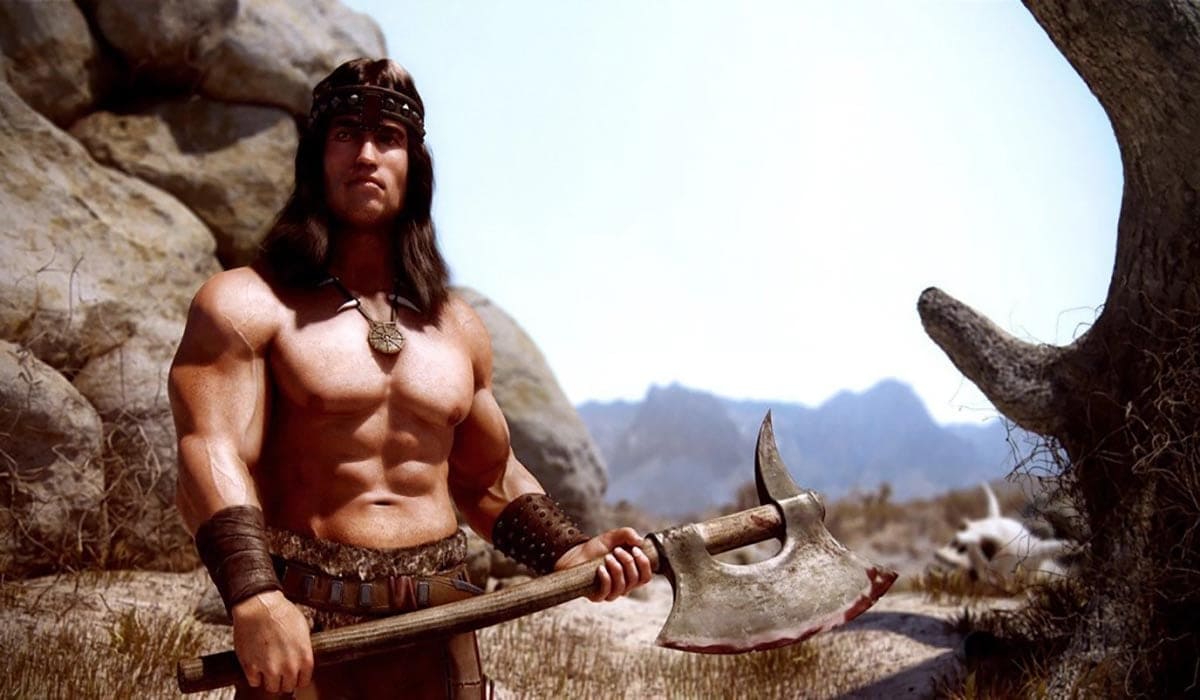
“That which does not kill us makes us stronger,” reads the Nietzschean maxim that serves as epigraph for writer-director John Milius’s 1982 adaptation of Conan the Barbarian, thereby encouraging viewers to plumb the philosophical depths of this rousing sword-and-sorcery epic starring Arnold Schwarzenegger from the get-go. So it’s sort of ironic to consider that, given the film’s commercial success and subsequent cult status, Milius no doubt contributed to the seemingly endless proliferation of this slogan across multiple platforms, emblazoned on everything from motivational posters to coffee mugs.
Milius’s seriousness of intent is signaled from the opening scene when Conan’s father (William Smith) advises his young son (Jorge Sanz) to trust nothing in this world but his sword. Critics at the time believed this solipsistic bit of paternal advice to reflect the ruthless individualism of Reagan’s America. But things are a bit more complicated than that, since this notion ultimately proves to be untenable. Far from a loner, the adult Conan (Schwarzenegger) is aided in his quest of revenge against Thulsa Doom (James Earl Jones) for slaughtering his parents and entire village by his right-hand man, Subotai (Gerry Lopez), and Valeria (Sandahl Bergman), a clever thief and brave warrior who proves every inch Conan’s equal on several occasions.
The warmth of Conan and Valeria’s relationship tends to undercut other toxically macho pronouncements, in particular Conan’s blustery response when a Mongol general asks him: “What is best in life?” Conan replies, “To crush your enemies, see them driven before you, and to hear the lamentations of their women.” Then again, this happens long before he meets Valeria and becomes a kinder, gentler Conan. Give him his due, as he’s a work in progress.
As depicted in Conan the Barbarian, Thulsa Doom clearly represents a messianic Jim Jones type, able to inspire suicidal sacrifice among his acolytes with little more than a seductive word and a chillingly blank stare. Doom’s followers wear white robes presumably to signify their vow of purity, but, as is often the case with these hypocritical cult leaders, his inner sanctum houses a perpetual orgy of polymorphous perversities, including the consumption of a viscous green substance out of a smoldering cauldron that also contains human body parts.
When Conan infiltrates a procession of Doom’s followers, they most resemble a bunch of flower-power hippies on their way to a Renaissance fair. As they approach Doom’s Mountain of Power, though, they exchange their disparate attire for identical white robes, trading in their individualism for the mass cult of groupthink, chanting “Doom!” in unison. It’s an acerbic piss-take on the 1960s counterculture from the more bellicose-minded Milius.

Conan the Barbarian makes it clear that although Conan believes in Crom, his god is either silent or useless to him here on earth. If Crom can’t help, he should just get out of the way. Crom only carries any real weight as ultimate arbiter of the afterlife. Theologically, this position can be considered a fairly brutal form of deism. Similarly, Conan seems to lack any affirmative life philosophy apart from a desire for revenge. After we hear that Doom’s followers counsel Conan to throw down his sword and “return to the earth” (a very hippie-friendly pursuit), the wizard narrator (Mako) quips, “Time enough for the earth in the grave.”
The climax of the film takes place at night high atop Doom’s Mountain of Power fortress. The aftermath, with Conan throwing his sword down the stairs ahead of him as he descends toward throngs of Doom’s candle-wielding acolytes, both thematically and visually echoes the ending of Apocalypse Now, which Milius had a hand in writing. Nor is this the only time Milius seems to shout out to another film. After Conan’s crucifixion on the Tree of Woe, the wizard covers him with sacred symbols to ward off evil spirits in an echo of the “Hoichi the Earless” segment of Kwaidan. There’s also a distinct nod to Seven Samurai in Conan and Subotai’s spiky showdown with Doom’s henchmen set amid a hilltop megalithic structure.
The film’s 1984 sequel, Conan the Destroyer, trades in John Milius for journeyman director Richard Fleischer, working from a boilerplate script by Stanley Mann. The film is lighter, sillier, and sloppier, sporting a family-friendly PG rating. This time out the proceedings get bogged down with protracted (and pedestrianly choreographed) fight scenes, leavened with largely unsuccessful attempts at comic relief from Conan’s wily sidekick, Malak (Tracey Walter). Aside from Schwarzenegger, only Mako returns as Conan’s on-call wizard, now named Akiro. The archetypal fantasy scenario sees lovely but lethal Queen Taramis (Sarah Douglas) dispatch Conan, Malak, and Akiro to accompany Princess Jehnna (Olivia D’Abo) on a quest to retrieve a fabled jeweled horn that can reawaken the “dreaming god” Dagoth.
In contrast to the first film, there are no philosophical underpinnings to unpack. What we get instead are more elaborate sets, fancier optical effects, and several Ray Harryhausen-inflected creatures courtesy of Carlo Rambaldi. Luckily, we also get another crackerjack score from composer Basil Poledouris that’s every bit as rousing and clangorous as his work on the first film. Where Conan the Barbarian made room for Max von Sydow to chew his way through a couple of choice lines, Conan the Destroyer has to content itself with the stunt casting of basketball legend Wilt Chamberlain, who’s actually quite solid in his role.
Arrow Video offers both of the Conan films in new UHD packages. The 4K restorations are sourced from original camera elements, and they both look absolutely superb, replete with vibrant colors and deep blacks. As far as extras go, the films come with multiple commentary tracks, making-of documentaries, hours of cast and crew interviews, deleted scenes, and other bonus materials. Each film also comes with its own two-sided foldout poster, six art cards, and a thick, lavishly illustrated book containing new and archival writing.
Conan the Barbarian and Conan the Destroyer are now available on Arrow Video.
Since 2001, we've brought you uncompromising, candid takes on the world of film, music, television, video games, theater, and more. Independently owned and operated publications like Slant have been hit hard in recent years, but we’re committed to keeping our content free and accessible—meaning no paywalls or fees.
If you like what we do, please consider subscribing to our Patreon or making a donation.