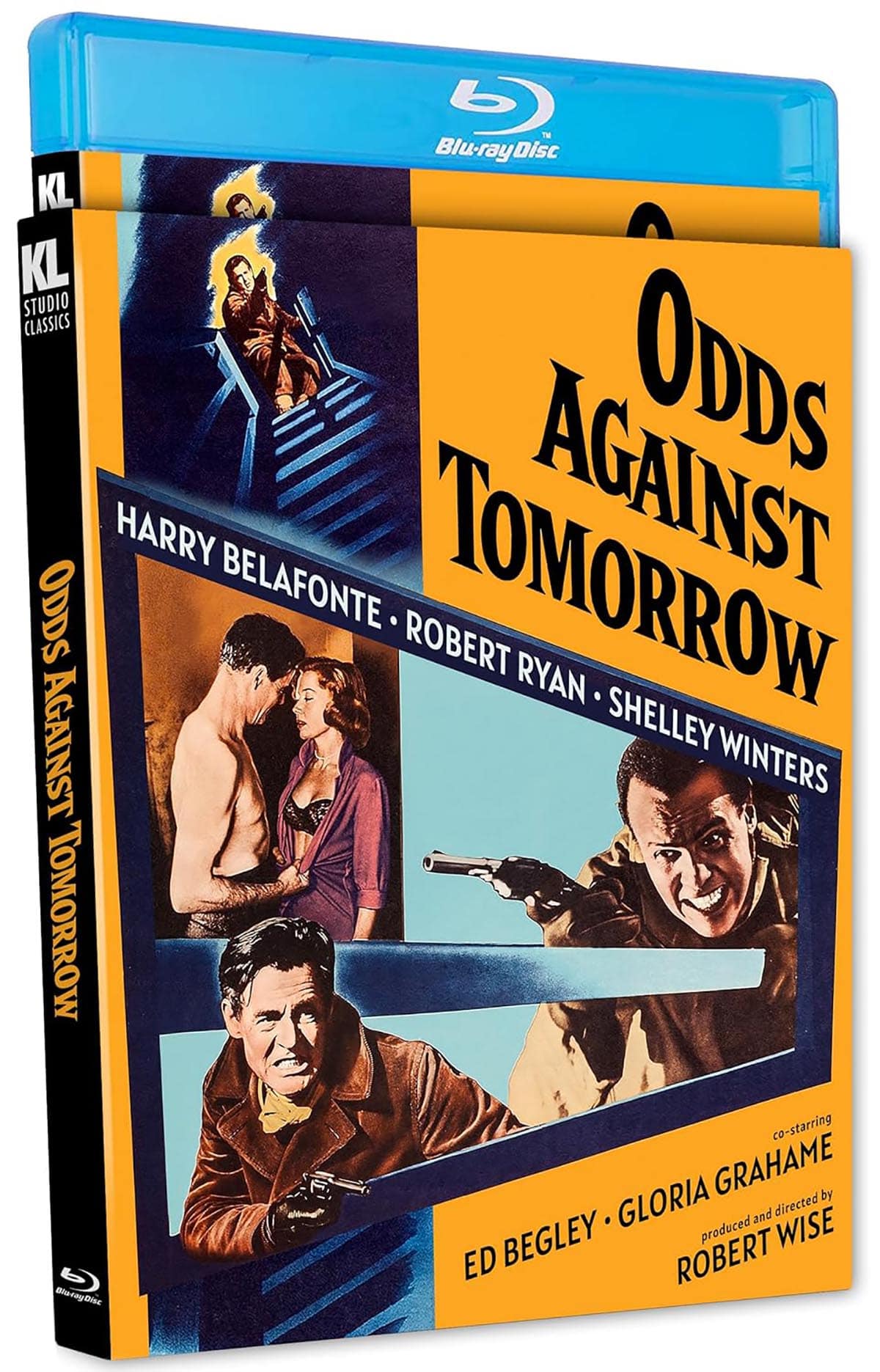
 Robert Wise’s Odds Against Tomorrow came along at the tail end of film noir’s steady decline in popularity in the 1950s and just before the civil rights movement reached its peak in the ’60s. The quintessential male icons of these two distinct eras clash in the film through the extremely confrontational yet mutually beneficial collaboration between a virulently racist ex-con, Earle (Robert Ryan), and a slick, Black jazz musician, Johnny (Harry Belaafonte).
The unlikely pair are brought together by a disgraced retired cop, Burke (Ed Begley), who caught wind of a robbery that’s a sure thing. If something sounds too good to be true in a noir, it always is, but the weaselly Earle’s too macho to let his doting wife, Lorry (Shelley Winters), continue being the breadwinner. Meanwhile, Johnny’s gambling debts have caused him to be estranged from his wife, Ruth (Kim Hamilton), as his bookie (Will Kuluva) has started to really put the squeeze on him. Johnny initially tells Burke, “I’ll go down the drain on my own,” but after later declaring to Ruth that “it’s their world and we’re just living in it,” he decides that he might as well circle down the drain while chasing something worthwhile.
Odds Against Tomorrow is ostensibly a heist film, but the filmmakers spend the first two acts intimately examining Earle and Johnny’s troubled home lives and gradually ratcheting up the tension between the two whenever they meet up with Burke to hatch a final plan. The racial dimensions of Earle and Johnny’s discord are certainly foregrounded at times, and the film leaves no doubt that Earle is an unrepentant racist, but their ability to play nice with one another in the name of collective greed stands as perhaps then-blacklisted screenwriter Abraham Polonsky’s most damning bit of commentary on mid-century America.
While Odds Against Tomorrow takes place in a world where people think in black and white terms, it spends most of its time probing the ambiguities and contradictions of its characters. We learn that Johnny’s gambling lifestyle isn’t just a degenerate’s addiction, but a subconscious rebellion against a wife who tries to ingratiate herself to the same white community that oppresses them. Meanwhile, Earle is a perpetual victim to his own self-loathing and irrepressible rage, which finds him digging himself into deeper holes at every turn.
Few actors have conveyed that explosive combination of wounded masculinity and insatiable anger as credibly and vividly as Robert Ryan. Earle is essentially an exposed nerve. And though he’s capable of compassion and regret, his occasional displays of sensitivity only seem to open the floodgates for his repressed anger to again be channeled outward at the world at large.

This may make it sound like it reeks of both-sidesism, but while the film explores the roots of Earle’s racism and general contempt for mankind, it doesn’t excuse or minimize the vileness of his beliefs or actions. He and Johnny are both distinct, fully realized characters who are also embodiments of social tensions that had been building and morphing since America’s early days. Earle’s resentments, for one, are amplified by Johnny being well-dressed and driving a flashy car, as well as for the way that Johnny pushes back at him at every turn.
Earle’s toxic being breeds a mistrust that can ruin even the best laid plans. And it’s through that mutual mistrust between Earle and Johnny that the filmmakers amp up the final act’s white-knuckle suspense, as the success of the heist is not only reliant on perfect timing and the various forms of luck that must fall in the men’s favor, but also in how well Earle and Johnny work in unison. The finale may be blunt, but its thematic directness dovetails beautifully with the story’s narrative progression, speaking powerfully to the ways that unchecked hate and discrimination can both exacerbate oppression and function as an agent of mutually assured destruction.
Image/Sound
Kino’s 1080p transfer is rich in detail and boasts a strong contrast ratio. This pays off especially well in the film’s nighttime robbery sequence near the end and across the frequent close-ups. Black levels are stellar and he grain is tight and even, and while there are the occasional signs of damage and debris, they don’t appear often enough to distract from the viewing experience. The stereo audio has some minor pops but is otherwise solid, boasting clean, clear dialogue.
Extras
In a newly recorded commentary track, author and film historian Alan K. Rode delves into Harry Belafonte’s involvement in the development process by way of his new company, HarBel Productions, and the numerous differences between the film and source novel. He also takes a deep dive into the backgrounds of many of the film’s cast and crew, providing tons of fascinating quotes from various interviews. Also included is a 45-minute interview with Belafonte from 2009 in which he discusses how he discovered the book and the excitement of working as both producer and actor, as well as a 2007 interview with Kim Hamilton, who talks about how she got her role and the joy of working with Belafonte and Wise. The package is rounded out with a trailer for Odds Against Tomorrow and other films that Kino Lorber has released on Blu-ray.
Overall
Robert Wise’s Odds Against Tomorrow is a pointed critique of race in America, and it’s as tense, thrilling, and relevant today as it was in 1959.
Since 2001, we've brought you uncompromising, candid takes on the world of film, music, television, video games, theater, and more. Independently owned and operated publications like Slant have been hit hard in recent years, but we’re committed to keeping our content free and accessible—meaning no paywalls or fees.
If you like what we do, please consider subscribing to our Patreon or making a donation.